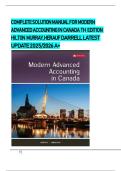
COMPLETE SOLUTION MANUAL FOR MODERN
ADVANCED ACCOUNTING IN CANADA TH EDITION
HILTON MURRAY, HERAUF DARRELL LATEST
UPDATE 2025/2026 A+
1
,CHAPTER 1 CONCEPTUAL & CASE ANALYSIS FRAMEWORKS FOR FINANCIAL REPORTING
A Brief Description Of The Major Points Covered In Each Case And Problem. CASES
CASE 1-1
In This Case, Students Are Introduced To The Difference In Accounting For R&D Costs Between IFRS And
ASPE And Asked To Provide Arguments To Support The Different Standards.
CASE 1-2 (Adapted From A Case Prepared By Peter Secord, Saint Mary’s University)
In This Real Life Case, Students Are Asked To Discuss The Merits Of Historical Costs Vs. Replacement Costs.
Actual Note Disclosure From A Company’s Financial Statements Is Provided As Background Material.
CASE 1-3 (Adapted From A Case Prepared By Peter Secord, Saint Mary’s University)
Copyright 2019 McGraw-Hill Education. All rights reserved.
2 Modern Advanced Accounting in Canada, Ninth Edition
,A Canadian Company Has Just Acquired A Non-Controlling Interest In A U.S. Public Company. It Must Decide
Whether To Use IFRS Or U.S. GAAP For The U.S. Subsidiary. Financial Statement Information Is Provided
Under IFRS And U.S. GAAP. The Reasons For Some Of The Differences In Numbers Must Be Explained And An
Opinion Provided As To Which Method Best Reflects Economic Reality.
CASE 1-4
This Case Is Adapted From A CPA Canada Case. A Private Company Is Planning To Go Public. Analysis And
Recommendations Are Required For Accounting Issues Related To Purchase And Installation Of New
Information System, Revenue Recognition, Convertible Debentures And Doubtful Accounts Receivable.
CASE 1-5
This Case Is Adapted From A CPA Canada Case. A Private Company Is Planning To Transition From ASPE To
IFRS. Analysis And Recommendations Are Required For Accounting Issues Related To Convertible
Debentures, Unusual Item, Revenue Recognition, Contingency And Impairment.
3
, PROBLEMS
Problem 1-1 (40 Min.)
A Single Asset Is Acquired. Students Are Asked To Prepare And Compare Financial Statement Numbers
During The Life Of The Asset Using Both A Historical Cost And A Current Value Model.
Problem 1-2 (40 Min.)
Details Of A European Company That Reports Using IFRS Are Given Along With Specific Details Relating To
Certain Account Balances. Students Are Asked To Show How These Balances Should Be Reported Under 1)
ASPE And 2) IFRS Using The Facts Provided. Students Are Also Asked To Reconcile Net Income And
Shareholders` Equity From IFRS To ASPE.
Problem 1-3 (50 Min.)
A Private Company Plans To Convert To IFRS Go Public Within 5 Years. It Wants To Know The Impact On Net
Income And Shareholders’ Equity If It Converts From ASPE To IFRS For Impaired Loans, Interest Costs,
Actuarial Gains, Compound Financial Instrument And Income Taxes.
Problem 1-4 (50 Min.)
While Taking The Role Of A Financial Analyst, The Student Uses Vertical And Horizontal Analysis And Ratios
To Analyse And Interpret The Profitability, Solvency And Liquidity Of A Private Company.
Problem 1-5 (25 Min.)
A Private Company Plans To Convert To IFRS. It Wants To Know The Impact On Three Key Ratios If It Converts
From ASPE To IFRS For Impaired Loans, Capitalization Of Interest And Actuarial Gains/Losses.
Problem 1-6 (50 Min.)
A Private Company Plans To Convert From ASPE To IFRS And Wants To Know The Impact On Three Key Ratios
If It Converts From ASPE To IFRS For Impairment Losses, Convertible Bonds And Income Taxes.
Copyright 2019 McGraw-Hill Education. All rights reserved.
4 Modern Advanced Accounting in Canada, Ninth Edition
ADVANCED ACCOUNTING IN CANADA TH EDITION
HILTON MURRAY, HERAUF DARRELL LATEST
UPDATE 2025/2026 A+
1
,CHAPTER 1 CONCEPTUAL & CASE ANALYSIS FRAMEWORKS FOR FINANCIAL REPORTING
A Brief Description Of The Major Points Covered In Each Case And Problem. CASES
CASE 1-1
In This Case, Students Are Introduced To The Difference In Accounting For R&D Costs Between IFRS And
ASPE And Asked To Provide Arguments To Support The Different Standards.
CASE 1-2 (Adapted From A Case Prepared By Peter Secord, Saint Mary’s University)
In This Real Life Case, Students Are Asked To Discuss The Merits Of Historical Costs Vs. Replacement Costs.
Actual Note Disclosure From A Company’s Financial Statements Is Provided As Background Material.
CASE 1-3 (Adapted From A Case Prepared By Peter Secord, Saint Mary’s University)
Copyright 2019 McGraw-Hill Education. All rights reserved.
2 Modern Advanced Accounting in Canada, Ninth Edition
,A Canadian Company Has Just Acquired A Non-Controlling Interest In A U.S. Public Company. It Must Decide
Whether To Use IFRS Or U.S. GAAP For The U.S. Subsidiary. Financial Statement Information Is Provided
Under IFRS And U.S. GAAP. The Reasons For Some Of The Differences In Numbers Must Be Explained And An
Opinion Provided As To Which Method Best Reflects Economic Reality.
CASE 1-4
This Case Is Adapted From A CPA Canada Case. A Private Company Is Planning To Go Public. Analysis And
Recommendations Are Required For Accounting Issues Related To Purchase And Installation Of New
Information System, Revenue Recognition, Convertible Debentures And Doubtful Accounts Receivable.
CASE 1-5
This Case Is Adapted From A CPA Canada Case. A Private Company Is Planning To Transition From ASPE To
IFRS. Analysis And Recommendations Are Required For Accounting Issues Related To Convertible
Debentures, Unusual Item, Revenue Recognition, Contingency And Impairment.
3
, PROBLEMS
Problem 1-1 (40 Min.)
A Single Asset Is Acquired. Students Are Asked To Prepare And Compare Financial Statement Numbers
During The Life Of The Asset Using Both A Historical Cost And A Current Value Model.
Problem 1-2 (40 Min.)
Details Of A European Company That Reports Using IFRS Are Given Along With Specific Details Relating To
Certain Account Balances. Students Are Asked To Show How These Balances Should Be Reported Under 1)
ASPE And 2) IFRS Using The Facts Provided. Students Are Also Asked To Reconcile Net Income And
Shareholders` Equity From IFRS To ASPE.
Problem 1-3 (50 Min.)
A Private Company Plans To Convert To IFRS Go Public Within 5 Years. It Wants To Know The Impact On Net
Income And Shareholders’ Equity If It Converts From ASPE To IFRS For Impaired Loans, Interest Costs,
Actuarial Gains, Compound Financial Instrument And Income Taxes.
Problem 1-4 (50 Min.)
While Taking The Role Of A Financial Analyst, The Student Uses Vertical And Horizontal Analysis And Ratios
To Analyse And Interpret The Profitability, Solvency And Liquidity Of A Private Company.
Problem 1-5 (25 Min.)
A Private Company Plans To Convert To IFRS. It Wants To Know The Impact On Three Key Ratios If It Converts
From ASPE To IFRS For Impaired Loans, Capitalization Of Interest And Actuarial Gains/Losses.
Problem 1-6 (50 Min.)
A Private Company Plans To Convert From ASPE To IFRS And Wants To Know The Impact On Three Key Ratios
If It Converts From ASPE To IFRS For Impairment Losses, Convertible Bonds And Income Taxes.
Copyright 2019 McGraw-Hill Education. All rights reserved.
4 Modern Advanced Accounting in Canada, Ninth Edition