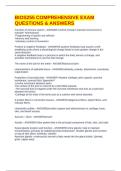
BIOS255 COMPREHENSIVE EXAM
QUESTIONS & ANSWERS
Function of nervous system - ANSWER-Control of body's internal environment to
maintain 'homeostasis'
-Programming of spinal cord reflexes
-Memory and learning
-Voluntary control of movement
Positive & negative feedback - ANSWERA positive feedback loop causes a self-
amplifying cycle where a physiological change leads to even greater change in the
same direction.
A negative feedback loop is a process in which the body senses a change, and
activates mechanisms to reverse that change.
The name of the joint in the ankle - ANSWERtalocrural joint
characteristics of epithelial tissue - ANSWERcellularity, polarity, attachment, vascularity,
regeneration
Properties of synovial joints - ANSWER**Hyaline cartilage, joint capsule, synovial
membrane, synovial fluid, ligaments**
-Involve movement between joints
The surface of the joint is covered by a fluid filled capsule.
-The synovial fluid is trapped under the synovial membrane and acts as a lubricant
between the bones.
-Cartilage at the ends of the bone acts as a cushion and shock absorber.
3 protein fibers in connective tissues - ANSWERcollagenous fibers, elastic fibers, and
reticular fibers.
chondroitin sulfate - ANSWERprovides support and adhesiveness in cartilage, bone,
skin, and blood vessels
Sacrum— illium - ANSWERanswer
Keratin - ANSWERA fiber protein that is the principal component of hair, skin, and nails
Sweat glands location and function - ANSWEREccrine glands: help to maintain
homoeostasis, primarily by stabilizing body temperature. Smaller glands and excretes
on top of skin ((feet, forehead, cheeks)
Apocrine glands: continuously secrete a fatty sweat into the gland tubule. ((armpit,
groin, nipple area)
, Hard palate bone - ANSWER-formed by maxilla and palatine bones
The shaft of the bone is called - ANSWEREnd-> Epiphysis
Middle/shaft -->>diaphysis
Articular process of bone - ANSWERlimits rotation
What happens during osteoclasts - ANSWEROsteoclasts are responsible for aged bone
resorption
osteoBlasts are responsible for new bone formation
5 steps of endochondral ossification - ANSWER1. Chondrocytes enlarge and matrix
begins to calcify
2. Bone formation starts at the shaft surface
3. Blood vessels invade inner region of cartilage
4. Osteoclasts begin to break down spongy bone in center
5. Centers of the epiphyses begin to calcify
Smallest unit (fiber) in skeletal muscle - ANSWERSarcomere
Primary motor cortex - ANSWERthe section of the frontal lobe responsible for voluntary
movement
Anti-diuretic hormone (ADH) - ANSWERA hormone produced by the pituitary gland
when the body is dehydrated. It causes the kidneys to reabsorb more water into the
blood making the urine more concentrated.
Cranial nerves "wanders" - ANSWERThe Vagus Nerve
sympathetic activation - ANSWERoccurs in anger or fear, leads to physiological arousal
- increased vigilance, heart rate, and blood flow to the skeletal muscles, and decreased
blood flow to the gastrointestinal system and skin (which is why arousal leads to cold
hands and feet).
Order of light passing through the eye - ANSWERcornea, pupil, lens, vitreous humor,
retina, optic nerve
Endocrine cell function - ANSWERsecrete hormones into the blood
metabolism.
growth and development.
sexual function and reproduction.
heart rate.
blood pressure.
appetite.
sleeping and waking cycles.
body temperature.
QUESTIONS & ANSWERS
Function of nervous system - ANSWER-Control of body's internal environment to
maintain 'homeostasis'
-Programming of spinal cord reflexes
-Memory and learning
-Voluntary control of movement
Positive & negative feedback - ANSWERA positive feedback loop causes a self-
amplifying cycle where a physiological change leads to even greater change in the
same direction.
A negative feedback loop is a process in which the body senses a change, and
activates mechanisms to reverse that change.
The name of the joint in the ankle - ANSWERtalocrural joint
characteristics of epithelial tissue - ANSWERcellularity, polarity, attachment, vascularity,
regeneration
Properties of synovial joints - ANSWER**Hyaline cartilage, joint capsule, synovial
membrane, synovial fluid, ligaments**
-Involve movement between joints
The surface of the joint is covered by a fluid filled capsule.
-The synovial fluid is trapped under the synovial membrane and acts as a lubricant
between the bones.
-Cartilage at the ends of the bone acts as a cushion and shock absorber.
3 protein fibers in connective tissues - ANSWERcollagenous fibers, elastic fibers, and
reticular fibers.
chondroitin sulfate - ANSWERprovides support and adhesiveness in cartilage, bone,
skin, and blood vessels
Sacrum— illium - ANSWERanswer
Keratin - ANSWERA fiber protein that is the principal component of hair, skin, and nails
Sweat glands location and function - ANSWEREccrine glands: help to maintain
homoeostasis, primarily by stabilizing body temperature. Smaller glands and excretes
on top of skin ((feet, forehead, cheeks)
Apocrine glands: continuously secrete a fatty sweat into the gland tubule. ((armpit,
groin, nipple area)
, Hard palate bone - ANSWER-formed by maxilla and palatine bones
The shaft of the bone is called - ANSWEREnd-> Epiphysis
Middle/shaft -->>diaphysis
Articular process of bone - ANSWERlimits rotation
What happens during osteoclasts - ANSWEROsteoclasts are responsible for aged bone
resorption
osteoBlasts are responsible for new bone formation
5 steps of endochondral ossification - ANSWER1. Chondrocytes enlarge and matrix
begins to calcify
2. Bone formation starts at the shaft surface
3. Blood vessels invade inner region of cartilage
4. Osteoclasts begin to break down spongy bone in center
5. Centers of the epiphyses begin to calcify
Smallest unit (fiber) in skeletal muscle - ANSWERSarcomere
Primary motor cortex - ANSWERthe section of the frontal lobe responsible for voluntary
movement
Anti-diuretic hormone (ADH) - ANSWERA hormone produced by the pituitary gland
when the body is dehydrated. It causes the kidneys to reabsorb more water into the
blood making the urine more concentrated.
Cranial nerves "wanders" - ANSWERThe Vagus Nerve
sympathetic activation - ANSWERoccurs in anger or fear, leads to physiological arousal
- increased vigilance, heart rate, and blood flow to the skeletal muscles, and decreased
blood flow to the gastrointestinal system and skin (which is why arousal leads to cold
hands and feet).
Order of light passing through the eye - ANSWERcornea, pupil, lens, vitreous humor,
retina, optic nerve
Endocrine cell function - ANSWERsecrete hormones into the blood
metabolism.
growth and development.
sexual function and reproduction.
heart rate.
blood pressure.
appetite.
sleeping and waking cycles.
body temperature.