

EKG Packet for NUA 421
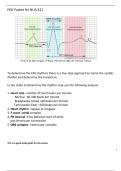
Parts of an EKG complex. P Wave, PR Interval, QRS, QT Interval, T Wave
To determine the EKG rhythms there is a five-step approach to name the cardiac
rhythm and determine the treatment.
In the order to determine the rhythm strip use the following analysis:
1. Heart rate -number of heart beats per minute.
Normal 60-100 beats per minute
Bradycardia (slow) <60 beats per minute
Tachycardia (fast) >100 beats per minute
2. Heart rhythm -regular or irregular
3. P wave -atrial complex
4. PR interval -time between start of atrial
and ventricular contraction
5. QRS complex -Ventricular complex
This is a good study guide for the exams.
1
,EKG Packet for NUA 421
Calculate Heart Rate
To calculate the heart rate, count the number of electrical impulses as represented by PQRST complexes
conducted through the myocardium in 60 seconds (1 minute)
Heart Rate may be counted by the atrial or ventricular beats.
▪Atrial rate: Count the number of P waves
▪Ventricular rate: Count the number of QRS complexes
On the standard EKG Paper, it is marked in small and large grids to increments related to time to determine
measurements.
1 large square = 0.20 seconds
1 small square=0.04 seconds
2
,EKG Packet for NUA 421
Or by the 6 second method
▪Denotes a 6 second interval on EKG strip
▪Strip is marked by 3 or 6 second tick marks on the top or bottom of the graph paper
▪Count the number of QRS complexes occurring within the 6 second interval, and then multiply that
number by 10
Determine Rhythm ▪A sequential beating of the heart because of the generation of
electrical impulses
▪Classified as:
▪Regular pattern: Interval between the R waves is regular
▪Irregular pattern: Interval between the R waves is not regular
Measuring a Regular Rhythm
▪Measure the intervals between R waves (measure from R to R)
▪If the intervals vary by less than 0.06 seconds or 1.5 small boxes, the rhythm is regular
• If the intervals are greater than 0.06 seconds, the rhythm is irregular.
3
, EKG Packet for NUA 421
Regular rhythm
Irregular rhythm
Is there a P wave? This represents the electrical conduction produced when the left and right atria
depolarize.
▪First deviation from the isoelectric line
▪Should be rounded and upright
▪P wave is the SA node pacing or firing at regular intervals
4
Parts of an EKG complex. P Wave, PR Interval, QRS, QT Interval, T Wave
To determine the EKG rhythms there is a five-step approach to name the cardiac
rhythm and determine the treatment.
In the order to determine the rhythm strip use the following analysis:
1. Heart rate -number of heart beats per minute.
Normal 60-100 beats per minute
Bradycardia (slow) <60 beats per minute
Tachycardia (fast) >100 beats per minute
2. Heart rhythm -regular or irregular
3. P wave -atrial complex
4. PR interval -time between start of atrial
and ventricular contraction
5. QRS complex -Ventricular complex
This is a good study guide for the exams.
1
,EKG Packet for NUA 421
Calculate Heart Rate
To calculate the heart rate, count the number of electrical impulses as represented by PQRST complexes
conducted through the myocardium in 60 seconds (1 minute)
Heart Rate may be counted by the atrial or ventricular beats.
▪Atrial rate: Count the number of P waves
▪Ventricular rate: Count the number of QRS complexes
On the standard EKG Paper, it is marked in small and large grids to increments related to time to determine
measurements.
1 large square = 0.20 seconds
1 small square=0.04 seconds
2
,EKG Packet for NUA 421
Or by the 6 second method
▪Denotes a 6 second interval on EKG strip
▪Strip is marked by 3 or 6 second tick marks on the top or bottom of the graph paper
▪Count the number of QRS complexes occurring within the 6 second interval, and then multiply that
number by 10
Determine Rhythm ▪A sequential beating of the heart because of the generation of
electrical impulses
▪Classified as:
▪Regular pattern: Interval between the R waves is regular
▪Irregular pattern: Interval between the R waves is not regular
Measuring a Regular Rhythm
▪Measure the intervals between R waves (measure from R to R)
▪If the intervals vary by less than 0.06 seconds or 1.5 small boxes, the rhythm is regular
• If the intervals are greater than 0.06 seconds, the rhythm is irregular.
3
, EKG Packet for NUA 421
Regular rhythm
Irregular rhythm
Is there a P wave? This represents the electrical conduction produced when the left and right atria
depolarize.
▪First deviation from the isoelectric line
▪Should be rounded and upright
▪P wave is the SA node pacing or firing at regular intervals
4


