© strawberrywaffles 2025
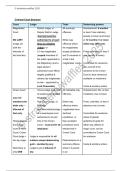
Criminal Court Structure
Court Judge Trials Sentencing powers
Magistrates’ - District Judge; or All summary Imprisonment: 6 months
Court - Deputy District Judge offences. or less if max statutory
(barrister/solicitor penalty is lower (summary)
NO JURY authorised to sit part Either-way or 12 months (1 or more
(mags are time as a District offences where either-way offences).
both the Judge); or the magistrates
tribunals of - 2-3 lay magistrates accept jurisdiction Fines: unlimited (or less if
fact and law). (unpaid members of and D consents to max penalty is lower).
the public appointed to a trial in the
the Magistracy) and a magistrates’ court. Committals for sentence:
legal adviser / Can commit D for
authorised court officer sentence to the Crown
(legally qualified & Court to face sentences
advises lay magistrates available on indictment.
on law – appointed by
Lord Chancellor) Costs & ancillary orders.
Crown Court - Circuit Judge (had right All indictable only Imprisonment: life, or less
of audience for at least offences. if statutory max is lower.
Jury (12 10 years)
members) for - High Court Judge; or Either-way Fines: unlimited, or less if
trials only – - Recorder offences where statutory max is lower.
tribunal of (barrister/solicitor/judge magistrates have
fact only. of a lower/equal court declined Committals for sentence:
authorised to sit part jurisdiction, or where D pleads
Hears appeals time in the Crown they accepted guilty/found guilty for
from mags’ Court – must sit for 30 jurisdiction but D either-way offence in
court & Youth days/year) elected trial in mags’ court, can be
Court: Crown Crown Court. committed to Crown Court
Court judge + Judge is responsible for all for sentence.
two lay mags. matters except determining Plea/sentence to a
guilt – decided by jury. summary offence Costs & ancillary orders.
Note there is Judge is just a tribunal of where it is joined
only ONE law. to an
, © strawberrywaffles 2025
CROWN indictable/either- Appeals from Mags’
COURT that way offence. Court/Youth Court: can
sits in different make any decision that
places. lower court has made,
including a more severe
sentence.
High Court Limited jurisdiction as regards to criminal matters.
- Appeals by way of “case stated” or JR from mags’ court or Youth Court
- Same case where it has been heard on appeal by Crown Court
Admin Court has no jurisdiction to judicially review matters relating to trial on
indictment itself, but court can consider matters not so related e.g. irrational
failure to grant bail.
Court of - Court of Appeal No trials but may Cannot pass sentence but
Appeal judges; or review new can alter sentence.
(Criminal - High Court Judges; or evidence.
Division) - Crown Court Judges See below.
authorised to sit in the
Leave Court of Appeal (note:
needed, unable to sit on an
except for appeal where the trial
cases of was conducted in the
contempt Crown Court by a High
where appeals Court judge)
lie of right.
Supreme Supreme Court Justices
Court
**need leave from CA/SC to
appeal CA decisions to SC.
Modes of address
Position Address
Lay magistrates Sir/Madam
District Judge, Deputy District Judge, Judge
tribunal judges, employment judges
,© strawberrywaffles 2025
Recorder, most Circuit Judges Your Honour
High Court Judges, Judges sitting at the My Lord/My Lady
Central Criminal Court (Old Bailey), Senior
Circuit Judges, Honorary Recorders (e.g.
Recorder of Westminster)
Professional conduct
Conflicts of interest
- Publicly funded cases (legal aid): one litigator for all co-defendants, unless there is a
conflict of interest
- Steps to take:
o Get full instructions from the first client (C1) and tell C1 that you have also
been asked to act for C2 and will do so if there’s no conflict.
o Ask C1 if they know of any conflict
▪ No conflict → can act for both C1 & C2
▪ Tell C1 that, if at any stage, you come across info confidential to C1
but relevant to C2, you have to tell C2, at which stage you need C1’s
consent to disclose to C2
• No obligation for C1 to consent
• If C1 doesn’t consent, you cannot act for C2 anymore (must
not disclose reasons for ceasing to act)
o Take instructions from C2 and tell C2 that you are acting for C1 and follow
above instructions
Duties to the court
- Cannot call witnesses whose evidence you know is untrue
- Cannot generate false evidence / destroy evidence
- Cannot persuade witnesses to change evidence
- If client tells you that they are guilty, they can still enter a not guilty plea
o Put prosecution to proof i.e. make them prove beyond reasonable doubt
o Can’t put forward a defence, advance a positive case or deny offence
- Key principle: public interest in the administration of justice
o DO NOT BREACH CONFIDENTIALITY
o E.g. if you have a court order to disclose some info, but the client refuses to
give consent, then you have to stop acting for the client
, © strawberrywaffles 2025
o E.g. if you have a court order to disclose some info, but you have no
instructions from your client, tell the court that you can’t disclose but don’t
give reasons
Funding
Litigants in person = individuals who conduct legal proceedings on their own
Defendants can only make an oral application directly when:
- To lay magistrates: when legal aid has been refused by the designated official
- To Crown Court judge:
o Where a person is charged with contempt of court / breach of court order and
there is no time to instruct a solicitor, or
o Where defendant is brought to court on a warrant for their arrest
Application for representation order
Must pass means & merits test.
Passported through means test: under 18 or on benefits.
Magistrates’ Court Crown Court
Means Assess weighted gross annual Assess annual household disposable
test income (applicant & partner’s income.
gross annual income divided by no.
of people in household). Thresholds:
- Not applicable if partner is - £3,398 or less = pass
involved in proceedings - £37,500 or more = fail
- In between = pass, with income-based
Thresholds: contribution (90% of disposable
- £12,475 or less = pass income for max 6 months in
- £22,325 or more = fail instalments, subject to maximum based
- In between = fill out Form on type of offence)
CRM15 to undergo a full o Refunded with interest if D is
means test based on acquitted
annual household
disposable income (£3,398 How much contribution is payable?
or less = pass) - Combined capital & equities allowance
of £30k
Criminal Court Structure
Court Judge Trials Sentencing powers
Magistrates’ - District Judge; or All summary Imprisonment: 6 months
Court - Deputy District Judge offences. or less if max statutory
(barrister/solicitor penalty is lower (summary)
NO JURY authorised to sit part Either-way or 12 months (1 or more
(mags are time as a District offences where either-way offences).
both the Judge); or the magistrates
tribunals of - 2-3 lay magistrates accept jurisdiction Fines: unlimited (or less if
fact and law). (unpaid members of and D consents to max penalty is lower).
the public appointed to a trial in the
the Magistracy) and a magistrates’ court. Committals for sentence:
legal adviser / Can commit D for
authorised court officer sentence to the Crown
(legally qualified & Court to face sentences
advises lay magistrates available on indictment.
on law – appointed by
Lord Chancellor) Costs & ancillary orders.
Crown Court - Circuit Judge (had right All indictable only Imprisonment: life, or less
of audience for at least offences. if statutory max is lower.
Jury (12 10 years)
members) for - High Court Judge; or Either-way Fines: unlimited, or less if
trials only – - Recorder offences where statutory max is lower.
tribunal of (barrister/solicitor/judge magistrates have
fact only. of a lower/equal court declined Committals for sentence:
authorised to sit part jurisdiction, or where D pleads
Hears appeals time in the Crown they accepted guilty/found guilty for
from mags’ Court – must sit for 30 jurisdiction but D either-way offence in
court & Youth days/year) elected trial in mags’ court, can be
Court: Crown Crown Court. committed to Crown Court
Court judge + Judge is responsible for all for sentence.
two lay mags. matters except determining Plea/sentence to a
guilt – decided by jury. summary offence Costs & ancillary orders.
Note there is Judge is just a tribunal of where it is joined
only ONE law. to an
, © strawberrywaffles 2025
CROWN indictable/either- Appeals from Mags’
COURT that way offence. Court/Youth Court: can
sits in different make any decision that
places. lower court has made,
including a more severe
sentence.
High Court Limited jurisdiction as regards to criminal matters.
- Appeals by way of “case stated” or JR from mags’ court or Youth Court
- Same case where it has been heard on appeal by Crown Court
Admin Court has no jurisdiction to judicially review matters relating to trial on
indictment itself, but court can consider matters not so related e.g. irrational
failure to grant bail.
Court of - Court of Appeal No trials but may Cannot pass sentence but
Appeal judges; or review new can alter sentence.
(Criminal - High Court Judges; or evidence.
Division) - Crown Court Judges See below.
authorised to sit in the
Leave Court of Appeal (note:
needed, unable to sit on an
except for appeal where the trial
cases of was conducted in the
contempt Crown Court by a High
where appeals Court judge)
lie of right.
Supreme Supreme Court Justices
Court
**need leave from CA/SC to
appeal CA decisions to SC.
Modes of address
Position Address
Lay magistrates Sir/Madam
District Judge, Deputy District Judge, Judge
tribunal judges, employment judges
,© strawberrywaffles 2025
Recorder, most Circuit Judges Your Honour
High Court Judges, Judges sitting at the My Lord/My Lady
Central Criminal Court (Old Bailey), Senior
Circuit Judges, Honorary Recorders (e.g.
Recorder of Westminster)
Professional conduct
Conflicts of interest
- Publicly funded cases (legal aid): one litigator for all co-defendants, unless there is a
conflict of interest
- Steps to take:
o Get full instructions from the first client (C1) and tell C1 that you have also
been asked to act for C2 and will do so if there’s no conflict.
o Ask C1 if they know of any conflict
▪ No conflict → can act for both C1 & C2
▪ Tell C1 that, if at any stage, you come across info confidential to C1
but relevant to C2, you have to tell C2, at which stage you need C1’s
consent to disclose to C2
• No obligation for C1 to consent
• If C1 doesn’t consent, you cannot act for C2 anymore (must
not disclose reasons for ceasing to act)
o Take instructions from C2 and tell C2 that you are acting for C1 and follow
above instructions
Duties to the court
- Cannot call witnesses whose evidence you know is untrue
- Cannot generate false evidence / destroy evidence
- Cannot persuade witnesses to change evidence
- If client tells you that they are guilty, they can still enter a not guilty plea
o Put prosecution to proof i.e. make them prove beyond reasonable doubt
o Can’t put forward a defence, advance a positive case or deny offence
- Key principle: public interest in the administration of justice
o DO NOT BREACH CONFIDENTIALITY
o E.g. if you have a court order to disclose some info, but the client refuses to
give consent, then you have to stop acting for the client
, © strawberrywaffles 2025
o E.g. if you have a court order to disclose some info, but you have no
instructions from your client, tell the court that you can’t disclose but don’t
give reasons
Funding
Litigants in person = individuals who conduct legal proceedings on their own
Defendants can only make an oral application directly when:
- To lay magistrates: when legal aid has been refused by the designated official
- To Crown Court judge:
o Where a person is charged with contempt of court / breach of court order and
there is no time to instruct a solicitor, or
o Where defendant is brought to court on a warrant for their arrest
Application for representation order
Must pass means & merits test.
Passported through means test: under 18 or on benefits.
Magistrates’ Court Crown Court
Means Assess weighted gross annual Assess annual household disposable
test income (applicant & partner’s income.
gross annual income divided by no.
of people in household). Thresholds:
- Not applicable if partner is - £3,398 or less = pass
involved in proceedings - £37,500 or more = fail
- In between = pass, with income-based
Thresholds: contribution (90% of disposable
- £12,475 or less = pass income for max 6 months in
- £22,325 or more = fail instalments, subject to maximum based
- In between = fill out Form on type of offence)
CRM15 to undergo a full o Refunded with interest if D is
means test based on acquitted
annual household
disposable income (£3,398 How much contribution is payable?
or less = pass) - Combined capital & equities allowance
of £30k