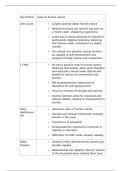
Key thinker View on human nature
John Locke Largely positive about human nature.
Believed humans are rational and born as
a 'blank slate', shaped by experience.
Locke was a strong advocate for tolerance,
particularly religious tolerance, believing
that diverse views contribute to a stable
society.
His outlook was positive, seeing humans
as capable of self-improvement and
progress through reason and cooperation.
J S Mill He had a positive view of human nature,
believing that people, when given freedom
and education, would make rational and
beneficial choices for themselves and
society.
Mill emphasised the importance of
education for self-improvement.
Focus on freedom of thought and opinion.
Diverse opinions allow for reasoned and
rational debate, leading to improvement in
society.
Mary optimistic view on human nature
Wollstonecr
Humans are rational individuals, included
aft
women in this view
Importance of education
Emphasised the importance of women in
regards to education
Optimistic for both sexes, equally capable
Betty Similar to Mary Wollstonecraft, women are
Friedan equally capable
Believed that the tradition roles for women
in the household were holding them back
, from reaching their full potential
John Rawls Believed Humans can pursue their own
goals and cooperate fairly with others,
rational and reasonable
People have a sense of justice and can
understand fairness.
Rawls saw humans as capable of fairness,
not just self-interest.
Key thinker View on society
John Locke Society comes before the states
Co-operative individuals
Natural rights, life, liberty and property,
exceed the state
Importance of tolerance
J S Mill Society should promote the individual,
about individuals co-operating with each
other
Progressive developing individuals will
cause a progressive developing society
Tolerance is key to a flourishing society
Harm principal
Mary Society was limiting women
Wollstonecr Women were equally capable
aft Wanted a society that allowed women to
be individuals
Betty Friedan criticized the post-war American
Friedan ideal of domestic womanhood, arguing it
stunted women's personal and intellectual
development.
she supported a society that ensures equal
opportunities regardless of gender,
aligning with the liberal ideal of formal
equality.
John Rawls Still largely optimistic view on human
nature, believed that people are
sympathetic to others and are capable of
rational thought
At the same time, recognises that people
are self-interested and that is the reason
for the necessity of the veil of ignorance
John Locke Largely positive about human nature.
Believed humans are rational and born as
a 'blank slate', shaped by experience.
Locke was a strong advocate for tolerance,
particularly religious tolerance, believing
that diverse views contribute to a stable
society.
His outlook was positive, seeing humans
as capable of self-improvement and
progress through reason and cooperation.
J S Mill He had a positive view of human nature,
believing that people, when given freedom
and education, would make rational and
beneficial choices for themselves and
society.
Mill emphasised the importance of
education for self-improvement.
Focus on freedom of thought and opinion.
Diverse opinions allow for reasoned and
rational debate, leading to improvement in
society.
Mary optimistic view on human nature
Wollstonecr
Humans are rational individuals, included
aft
women in this view
Importance of education
Emphasised the importance of women in
regards to education
Optimistic for both sexes, equally capable
Betty Similar to Mary Wollstonecraft, women are
Friedan equally capable
Believed that the tradition roles for women
in the household were holding them back
, from reaching their full potential
John Rawls Believed Humans can pursue their own
goals and cooperate fairly with others,
rational and reasonable
People have a sense of justice and can
understand fairness.
Rawls saw humans as capable of fairness,
not just self-interest.
Key thinker View on society
John Locke Society comes before the states
Co-operative individuals
Natural rights, life, liberty and property,
exceed the state
Importance of tolerance
J S Mill Society should promote the individual,
about individuals co-operating with each
other
Progressive developing individuals will
cause a progressive developing society
Tolerance is key to a flourishing society
Harm principal
Mary Society was limiting women
Wollstonecr Women were equally capable
aft Wanted a society that allowed women to
be individuals
Betty Friedan criticized the post-war American
Friedan ideal of domestic womanhood, arguing it
stunted women's personal and intellectual
development.
she supported a society that ensures equal
opportunities regardless of gender,
aligning with the liberal ideal of formal
equality.
John Rawls Still largely optimistic view on human
nature, believed that people are
sympathetic to others and are capable of
rational thought
At the same time, recognises that people
are self-interested and that is the reason
for the necessity of the veil of ignorance