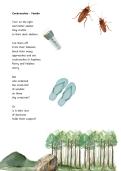
Cockroaches - Yambo
Turn on the light
and helter-skelter
they scuttle
to their dark shelters.
Cut them off
From their hideouts
block their many
approaches and see
cockroaches in hopeless
flurry and helpless
worry.
But
who ordained
the crash-fall
of sandals
on these
shy creatures?
Or
is it their love
of darkness
holds them suspect?
, - The title highlights creatures often seen as pests, drawing
attention to their behavior and human judgment.
Cockroaches
- Its simplicity contrasts with the poem’s deeper reflections,
prompting readers to consider the cockroaches’ natural instincts
and their ethical implications.
- The line functions both literally and symbolically. Literally, it
signals the action of exposing cockroaches to illumination, forcing
them out of their dark hiding places and revealing their frantic
movement.
- Symbolically, the line suggests revelation, confrontation, or
Turn on the light disruption of secrecy—the sudden light exposes what is usually
hidden, creating vulnerability and tension.
- Its position at the very beginning of the poem immediately sets
the scene and establishes a contrast between light and darkness,
safety and fear, control and chaos.
- The imperative tone also conveys human authority and
intervention, highlighting the power dynamic between the observer
and the creatures.
- The phrase conveys a sense of chaotic, frantic movement,
suggesting that the cockroaches are scrambling in all directions
without order or control.
- The use of the hyphenated term emphasizes speed and disarray,
reflecting both the insects’ natural instinct to flee and the sudden
and helter-skelter disturbance caused by the light.
- It also creates a vivid auditory and visual impression, almost
mimicking the rapid, erratic scuttling, which draws the reader into
the scene and highlights the tension between the observer and the
small, vulnerable creatures.
- The word choice captures both energy and panic, reinforcing the
poem’s exploration of vulnerability and the instinctual drive for
survival.
- The word choice here conveys rapid, frantic movement,
emphasizing the insects’ instinctive drive to escape danger.
- The verb has a light, almost slippery sound, which mirrors the
skittish, unpredictable motion of cockroaches as they react to
they scuttle sudden disturbances.
- It captures both the physical swiftness and the nervous energy of
the creatures, highlighting their vulnerability and the chaotic
energy of their survival instincts.
- The brevity of the word also mirrors the quick, fleeting nature of
their actions, creating a vivid visual image in the reader’s mind.
- This line conveys the instinctive retreat of the cockroaches into
safety, emphasizing their vulnerability and need for protection.
Turn on the light
and helter-skelter
they scuttle
to their dark shelters.
Cut them off
From their hideouts
block their many
approaches and see
cockroaches in hopeless
flurry and helpless
worry.
But
who ordained
the crash-fall
of sandals
on these
shy creatures?
Or
is it their love
of darkness
holds them suspect?
, - The title highlights creatures often seen as pests, drawing
attention to their behavior and human judgment.
Cockroaches
- Its simplicity contrasts with the poem’s deeper reflections,
prompting readers to consider the cockroaches’ natural instincts
and their ethical implications.
- The line functions both literally and symbolically. Literally, it
signals the action of exposing cockroaches to illumination, forcing
them out of their dark hiding places and revealing their frantic
movement.
- Symbolically, the line suggests revelation, confrontation, or
Turn on the light disruption of secrecy—the sudden light exposes what is usually
hidden, creating vulnerability and tension.
- Its position at the very beginning of the poem immediately sets
the scene and establishes a contrast between light and darkness,
safety and fear, control and chaos.
- The imperative tone also conveys human authority and
intervention, highlighting the power dynamic between the observer
and the creatures.
- The phrase conveys a sense of chaotic, frantic movement,
suggesting that the cockroaches are scrambling in all directions
without order or control.
- The use of the hyphenated term emphasizes speed and disarray,
reflecting both the insects’ natural instinct to flee and the sudden
and helter-skelter disturbance caused by the light.
- It also creates a vivid auditory and visual impression, almost
mimicking the rapid, erratic scuttling, which draws the reader into
the scene and highlights the tension between the observer and the
small, vulnerable creatures.
- The word choice captures both energy and panic, reinforcing the
poem’s exploration of vulnerability and the instinctual drive for
survival.
- The word choice here conveys rapid, frantic movement,
emphasizing the insects’ instinctive drive to escape danger.
- The verb has a light, almost slippery sound, which mirrors the
skittish, unpredictable motion of cockroaches as they react to
they scuttle sudden disturbances.
- It captures both the physical swiftness and the nervous energy of
the creatures, highlighting their vulnerability and the chaotic
energy of their survival instincts.
- The brevity of the word also mirrors the quick, fleeting nature of
their actions, creating a vivid visual image in the reader’s mind.
- This line conveys the instinctive retreat of the cockroaches into
safety, emphasizing their vulnerability and need for protection.