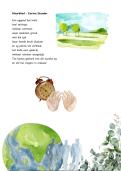
Kleurblind – Carina Stander
Een oggend het hulle
heel terloops
mekaar ontmoet:
waar douklam grond
met die tyd
haar hande bruin skakeer
en sy palms wit verbleik,
het hulle eers geskrik,
mekaar onseker aangekyk.
Toe bewus geword van die aardse eg
en stil hul vingers in mekaar
, Kleurblind - The title suggests seeing beyond external differences. It reflects
Colorblind how the two figures connect through touch and presence,
focusing on shared human intimacy rather than appearances.
Een oggend het hulle - The line immediately sets the scene in a specific, quiet moment
One morning they
of time, suggesting intimacy and immediacy.
- The choice of “one morning” conveys a sense of everyday
normalcy, yet it also hints at something significant about to
unfold.
- The use of the past tense “het hulle” situates the action as
already occurring, giving the reader a feeling of witnessing a
private encounter.
- The line’s simplicity and brevity create an understated, almost
delicate opening, preparing the reader for the subtle
emotional and physical interaction that follows between the
two figures.
heel terloops - In the context of the poem, it emphasizes the spontaneous and
unplanned nature of the meeting between the two individuals.
It suggests that their encounter was not orchestrated or
deliberate, but rather a natural, almost incidental moment in
time.
- This casualness contrasts with the deeper emotional and
physical awareness that follows—the initial encounter may be
accidental, yet it quickly becomes charged with sensitivity and
intimacy.
The choice of heel terloops therefore sets up a tension
-
between the mundanity of the meeting and the significance of
met quite casually: the connection that develops.
mekaar ontmoet: -
The line is deceptively simple but loaded with significance.
-
The use of the colon immediately after ontmoet emphasizes
the moment as a pivotal pause, signaling that what follows is
a direct unfolding of the encounter.
- The verb ontmoet conveys not just physical meeting but also
an emotional and relational recognition between the two
people. It suggests a mutuality—an equal, reciprocal
experience—heightening the intimacy of the moment.
- In the context of the poem, this line marks the threshold
between strangers and connection, framing the subsequent
descriptions of touch, awareness, and sensitivity as the natural
progression of this encounter.
- The brevity and placement of the line also create a visual and
rhythmic pause, inviting the reader to linger on the
significance of the meeting itself.
met quite casually:
Een oggend het hulle
heel terloops
mekaar ontmoet:
waar douklam grond
met die tyd
haar hande bruin skakeer
en sy palms wit verbleik,
het hulle eers geskrik,
mekaar onseker aangekyk.
Toe bewus geword van die aardse eg
en stil hul vingers in mekaar
, Kleurblind - The title suggests seeing beyond external differences. It reflects
Colorblind how the two figures connect through touch and presence,
focusing on shared human intimacy rather than appearances.
Een oggend het hulle - The line immediately sets the scene in a specific, quiet moment
One morning they
of time, suggesting intimacy and immediacy.
- The choice of “one morning” conveys a sense of everyday
normalcy, yet it also hints at something significant about to
unfold.
- The use of the past tense “het hulle” situates the action as
already occurring, giving the reader a feeling of witnessing a
private encounter.
- The line’s simplicity and brevity create an understated, almost
delicate opening, preparing the reader for the subtle
emotional and physical interaction that follows between the
two figures.
heel terloops - In the context of the poem, it emphasizes the spontaneous and
unplanned nature of the meeting between the two individuals.
It suggests that their encounter was not orchestrated or
deliberate, but rather a natural, almost incidental moment in
time.
- This casualness contrasts with the deeper emotional and
physical awareness that follows—the initial encounter may be
accidental, yet it quickly becomes charged with sensitivity and
intimacy.
The choice of heel terloops therefore sets up a tension
-
between the mundanity of the meeting and the significance of
met quite casually: the connection that develops.
mekaar ontmoet: -
The line is deceptively simple but loaded with significance.
-
The use of the colon immediately after ontmoet emphasizes
the moment as a pivotal pause, signaling that what follows is
a direct unfolding of the encounter.
- The verb ontmoet conveys not just physical meeting but also
an emotional and relational recognition between the two
people. It suggests a mutuality—an equal, reciprocal
experience—heightening the intimacy of the moment.
- In the context of the poem, this line marks the threshold
between strangers and connection, framing the subsequent
descriptions of touch, awareness, and sensitivity as the natural
progression of this encounter.
- The brevity and placement of the line also create a visual and
rhythmic pause, inviting the reader to linger on the
significance of the meeting itself.
met quite casually: