Palimpses - Johann de Lange
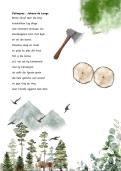
Bome skryf teen die blou
kreukellose lug dinge
wat niemand verstaan nie.
Houtkappers kom met byle
en vel die bome.
Meulens saag en maal
en pulp en plet die hout.
Stil is die bome;
stil, net tot hy kletterend
met sy tikmasjien
uit selfs die fynste grein
die hele gamma van woord
en pyn ring op ring
deur hierdie oggend laat dein.
, Palimpses - The title refers to a surface rewritten over time, like trees
turned into paper.
- It suggests layers of creation and destruction, where traces of
the original remain, highlighting memory, loss, and the
persistence of meaning.
Bome skryf teen die blou - The line is a striking metaphor suggesting that trees, through
their branches, “write” against the vast, crease-free sky as if
the natural world itself is a form of text.
- The sky “die blou” becomes a blank page, while the trees
become pens or scribes, inscribing meanings that are beyond
human comprehension.
- This image positions nature as an author with its own silent
language, one that exists independently of human
interpretation.
-
At the same time, it foreshadows the central theme of the
poem (the transformation of trees into literal writing material)
but here, in their untouched state, they are already creators of
meaning.
-
The line therefore captures both the mystery and autonomy of
the natural world, while hinting at the tension between organic
Trees write against the blue expression and human exploitation that follows
kreukellose lug dinge
- The phrase “kreukellose lug dinge” combines imagery of purity
and mystery. “Kreukellose lug” suggests a flawless, unwrinkled
sky - smooth, perfect, and untouched, almost like a blank page
before writing.
- By linking this with “dinge”, the poem hints at hidden messages
or signs inscribed in the vastness of the sky, beyond human
comprehension.
- The trees are portrayed as writers against this flawless canvas,
suggesting that nature itself holds meaning that humans cannot
easily decode.
- The choice of “kreukellose” emphasizes fragility and perfection
(once disturbed, it cannot return to its untouched state)
foreshadowing the violence that follows when humans cut down
wrinkleless sky things the trees.
The line highlights the mysterious, almost sacred language of
wat niemand verstaan nie. -
the trees as they “skryf teen die blou kreukellose lug.”
- It suggests that nature communicates in a code or script
beyond human comprehension, reminding us of the depth and
complexity of the natural world.
Bome skryf teen die blou
kreukellose lug dinge
wat niemand verstaan nie.
Houtkappers kom met byle
en vel die bome.
Meulens saag en maal
en pulp en plet die hout.
Stil is die bome;
stil, net tot hy kletterend
met sy tikmasjien
uit selfs die fynste grein
die hele gamma van woord
en pyn ring op ring
deur hierdie oggend laat dein.
, Palimpses - The title refers to a surface rewritten over time, like trees
turned into paper.
- It suggests layers of creation and destruction, where traces of
the original remain, highlighting memory, loss, and the
persistence of meaning.
Bome skryf teen die blou - The line is a striking metaphor suggesting that trees, through
their branches, “write” against the vast, crease-free sky as if
the natural world itself is a form of text.
- The sky “die blou” becomes a blank page, while the trees
become pens or scribes, inscribing meanings that are beyond
human comprehension.
- This image positions nature as an author with its own silent
language, one that exists independently of human
interpretation.
-
At the same time, it foreshadows the central theme of the
poem (the transformation of trees into literal writing material)
but here, in their untouched state, they are already creators of
meaning.
-
The line therefore captures both the mystery and autonomy of
the natural world, while hinting at the tension between organic
Trees write against the blue expression and human exploitation that follows
kreukellose lug dinge
- The phrase “kreukellose lug dinge” combines imagery of purity
and mystery. “Kreukellose lug” suggests a flawless, unwrinkled
sky - smooth, perfect, and untouched, almost like a blank page
before writing.
- By linking this with “dinge”, the poem hints at hidden messages
or signs inscribed in the vastness of the sky, beyond human
comprehension.
- The trees are portrayed as writers against this flawless canvas,
suggesting that nature itself holds meaning that humans cannot
easily decode.
- The choice of “kreukellose” emphasizes fragility and perfection
(once disturbed, it cannot return to its untouched state)
foreshadowing the violence that follows when humans cut down
wrinkleless sky things the trees.
The line highlights the mysterious, almost sacred language of
wat niemand verstaan nie. -
the trees as they “skryf teen die blou kreukellose lug.”
- It suggests that nature communicates in a code or script
beyond human comprehension, reminding us of the depth and
complexity of the natural world.