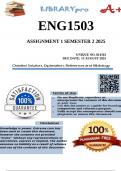
, ENG1503 Assignment 2 Semester 2 2025 (Unique
Number: 737611) - Due 17 September 2025; 100
% TRUSTED workings, Expert Solved, Explanations
and Solutions.
Does the Use of LLMs Constitute Plagiarism?
Large Language Models (LLMs) such as ChatGPT have sparked
significant debate in academic contexts about whether their
outputs should be considered plagiarism. While these systems
generate responses that appear thoughtful and human-like,
they are in fact products of vast computational processes
trained on extensive datasets (Naithani, 2025). In my view,
using outputs from LLMs without proper acknowledgement
does constitute plagiarism. This argument rests on three key
reasons: the unoriginality of the content, the lack of
intellectual authorship by students, and the ethical violation
of academic integrity.
Firstly, the output of LLMs cannot be regarded as original
intellectual work in the same way as human-authored writing.
LLMs do not “create” new knowledge; they reassemble
patterns from pre-existing texts and datasets. When a student
submits this type of material as their own, it amounts to
presenting recycled ideas without giving credit to the model or
to the underlying sources on which the model has been
trained. According to Naithani (2025), this raises concerns
Number: 737611) - Due 17 September 2025; 100
% TRUSTED workings, Expert Solved, Explanations
and Solutions.
Does the Use of LLMs Constitute Plagiarism?
Large Language Models (LLMs) such as ChatGPT have sparked
significant debate in academic contexts about whether their
outputs should be considered plagiarism. While these systems
generate responses that appear thoughtful and human-like,
they are in fact products of vast computational processes
trained on extensive datasets (Naithani, 2025). In my view,
using outputs from LLMs without proper acknowledgement
does constitute plagiarism. This argument rests on three key
reasons: the unoriginality of the content, the lack of
intellectual authorship by students, and the ethical violation
of academic integrity.
Firstly, the output of LLMs cannot be regarded as original
intellectual work in the same way as human-authored writing.
LLMs do not “create” new knowledge; they reassemble
patterns from pre-existing texts and datasets. When a student
submits this type of material as their own, it amounts to
presenting recycled ideas without giving credit to the model or
to the underlying sources on which the model has been
trained. According to Naithani (2025), this raises concerns