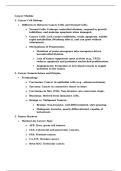
Cancer Module
1. Cancer Cell Biology
Differences Between Cancer Cells and Normal Cells:
o Normal Cells: Undergo controlled division, respond to growth
inhibition, and undergo apoptosis when damaged.
o Cancer Cells: Lack contact inhibition, evade apoptosis, exhibit
rapid metabolism (Warburg effect), and can grow without
attachment.
o Mechanisms of Progression:
Mutation of proto-oncogenes into oncogenes drives
uncontrolled division.
Loss of tumor suppressor gene activity (e.g., TP53)
reduces apoptosis and promotes unchecked proliferation.
Angiogenesis: Formation of new blood vessels to supply
nutrients to the tumor.
2. Cancer Nomenclature and Origins
Terminology:
o Carcinoma: Cancer in epithelial cells (e.g., adenocarcinoma).
o Sarcoma: Cancer in connective tissue or bone.
o Carcinoma in Situ (CIS): Non-invasive, pre-cancerous stage.
o Blastoma: Derived from immature cells.
o Benign vs. Malignant Tumors:
Benign: Non-invasive, well-differentiated, slow-growing.
Malignant: Invasive, poorly differentiated, capable of
metastasis.
3. Tumor Markers
Markers by Cancer Type:
o AFP: Liver, germ cell tumors.
o CEA: Colorectal and pancreatic cancers.
o PSA: Prostate cancer.
o CA-125: Ovarian cancer.
o Beta-hCG: Testicular cancer.
, 4. Mechanisms of Cancer Metastasis
Cancer cells invade local tissues, enter the bloodstream/lymphatic
system, and form secondary tumors in distant organs. Common
metastasis patterns:
o Lung Cancer: Brain, bones, adrenal glands.
o Breast Cancer: Bones, liver, lungs, brain.
o Ovarian Cancer: Peritoneum, liver, lungs.
o Prostate Cancer: Bones (spine, pelvis).
5. TNM Staging System
T: Tumor size and invasion extent.
N: Lymph node involvement.
M: Presence of distant metastasis.
6. BRCA Genes
Mutations in BRCA1/BRCA2:
o Significantly increase the risk for breast, ovarian, and prostate
cancers.
o Inherited mutations impair DNA repair, leading to
accumulation of mutations.
7. Clinical Manifestations of Cancer
Cachexia: Severe weight loss, muscle wasting, systemic inflammation.
Paraneoplastic Syndromes:
o Endocrine: Hypercalcemia, Cushing’s syndrome.
o Neurological: Myasthenia gravis.
Musculoskeletal Module
1. Osteoarthritis (OA) vs. Rheumatoid Arthritis (RA)
OA:
o Pathophysiology: Mechanical wear leads to cartilage breakdown
and joint remodeling.
o Symptoms: Joint pain, stiffness, and swelling (non-
inflammatory).
1. Cancer Cell Biology
Differences Between Cancer Cells and Normal Cells:
o Normal Cells: Undergo controlled division, respond to growth
inhibition, and undergo apoptosis when damaged.
o Cancer Cells: Lack contact inhibition, evade apoptosis, exhibit
rapid metabolism (Warburg effect), and can grow without
attachment.
o Mechanisms of Progression:
Mutation of proto-oncogenes into oncogenes drives
uncontrolled division.
Loss of tumor suppressor gene activity (e.g., TP53)
reduces apoptosis and promotes unchecked proliferation.
Angiogenesis: Formation of new blood vessels to supply
nutrients to the tumor.
2. Cancer Nomenclature and Origins
Terminology:
o Carcinoma: Cancer in epithelial cells (e.g., adenocarcinoma).
o Sarcoma: Cancer in connective tissue or bone.
o Carcinoma in Situ (CIS): Non-invasive, pre-cancerous stage.
o Blastoma: Derived from immature cells.
o Benign vs. Malignant Tumors:
Benign: Non-invasive, well-differentiated, slow-growing.
Malignant: Invasive, poorly differentiated, capable of
metastasis.
3. Tumor Markers
Markers by Cancer Type:
o AFP: Liver, germ cell tumors.
o CEA: Colorectal and pancreatic cancers.
o PSA: Prostate cancer.
o CA-125: Ovarian cancer.
o Beta-hCG: Testicular cancer.
, 4. Mechanisms of Cancer Metastasis
Cancer cells invade local tissues, enter the bloodstream/lymphatic
system, and form secondary tumors in distant organs. Common
metastasis patterns:
o Lung Cancer: Brain, bones, adrenal glands.
o Breast Cancer: Bones, liver, lungs, brain.
o Ovarian Cancer: Peritoneum, liver, lungs.
o Prostate Cancer: Bones (spine, pelvis).
5. TNM Staging System
T: Tumor size and invasion extent.
N: Lymph node involvement.
M: Presence of distant metastasis.
6. BRCA Genes
Mutations in BRCA1/BRCA2:
o Significantly increase the risk for breast, ovarian, and prostate
cancers.
o Inherited mutations impair DNA repair, leading to
accumulation of mutations.
7. Clinical Manifestations of Cancer
Cachexia: Severe weight loss, muscle wasting, systemic inflammation.
Paraneoplastic Syndromes:
o Endocrine: Hypercalcemia, Cushing’s syndrome.
o Neurological: Myasthenia gravis.
Musculoskeletal Module
1. Osteoarthritis (OA) vs. Rheumatoid Arthritis (RA)
OA:
o Pathophysiology: Mechanical wear leads to cartilage breakdown
and joint remodeling.
o Symptoms: Joint pain, stiffness, and swelling (non-
inflammatory).