

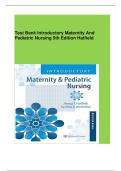
Test Bank Introductory Maternity And
Pediatric Nursing 5th Edition Hatfield
,test bank introductory maternity and pediatric nursing 5th edition
hatfield
chapter 1: the nurse's role in a changing maternal–child health care
environment
multiple choice
1. which principle of teaching should the nurse use to ensure
learning in a family situation?
a. motivate the family with praise and positive feedback.
b. learning is best accomplished with the lecture format.
c. present complex subject material first while the family is alert
and ready to learn.
d. families should be taught using medical jargon so they will be
able to understand the technical language used by physicians.
CORRECT ANSWER>> a
praise and positive feedback are particularly important when a family
is trying to master a frustrating task such as breastfeeding. a lively
,discussion stimulates more learning than a straight lecture, which
tends to inhibit questions. learning is enhanced when the teaching is
structured to present the simple tasks before the complex material.
even though a family may understand english fairly well, they may not
understand the medical terminology or slang terms that are used.
pts: 1 dif: cognitive level: application ref: 18, 19
obj: nursing process step: planning msc: client needs: health
promotion and maintenance
2. which nursing intervention is an independent function of the
nurse?
a. administering oral analgesics
b. requesting diagnostic studies
c. teaching the client perineal care
d. providing wound care to a surgical incision
CORRECT ANSWER>> c
nurses are now responsible for various independent functions,
including teaching, counseling, and intervening in nonmedical
problems. interventions initiated by the physician and carried out by
the nurse are called dependent functions. administrating oral
analgesics is a dependent function; it is initiated by a physician and
,carried out by a nurse. requesting diagnostic studies is a dependent
function. providing wound care is a dependent function; it is usually
initiated by the physician through direct orders or protocol.
pts: 1 dif: cognitive level: understanding ref: 24 obj: nursing process
step: assessment
msc: client needs: safe and effective care environment
3. which most therapeutic response to the clients statement, im
afraid to have a cesarean birth should be made by the nurse?
a. everything will be ok.
b. dont worry about it. it will be over soon.
c. what concerns you most about a cesarean birth?
d. the physician will be in later and you can talk to him.
CORRECT ANSWER>> c
the response, what concerns you most about a cesarean birth focuses
on what the client is saying and asks for clarification, which is the
most therapeutic response. the response, everything will be ok is
belittling the clients feelings. the response, dont worry about it. it will
be over soon will indicate that the clients feelings are not important.
the response, the physician will be in later and you can talk to him
does not allow the client to verbalize her feelings when she wishes to
do that.
,pts: 1 dif: cognitive level: application ref: 18 obj: nursing process step:
implementation
msc: client needs: psychosocial integrity
4. which action should the nurse take to evaluate the clients
learning about performing infant care?
a. demonstrate infant care procedures.
b. allow the client to verbalize the procedure.
c. routinely assess the infant for cleanliness.
d. observe the client as she performs the procedure.
CORRECT ANSWER>> d
the clients correct performance of the procedure under the nurses
supervision is the best proof of her ability. demonstration is an
excellent teaching method, but not an evaluation method. during
verbalization of the procedure, the nurse may not pick up on
techniques that are incorrect. it is not the best tool for evaluation.
routinely assessing the infant for cleanliness will not ensure that the
proper procedure is carried out. the nurse may miss seeing that
unsafe techniques being used.
pts: 1 dif: cognitive level: application ref: 21
,obj: nursing process step: evaluation msc: client needs: health
promotion and maintenance
5. a nurse is reviewing teaching and learning principles. which
situation is most conducive to learning?
a. an auditorium is being used as a classroom for 300 students.
b. a teacher who speaks very little spanish is teaching a class of
hispanic students.
c. a class is composed of students of various ages and educational
backgrounds.
d. an asian nurse provides nutritional information to a group of
pregnant asian women.
CORRECT ANSWER>> d
a clients culture influences the learning process; thus, a situation that
is most conducive to learning is one in which the teacher has
knowledge and understanding of the clients cultural beliefs. a large
class is not conducive to learning. it does not allow questions, and the
teacher cannot see nonverbal cues from the students to ensure
understanding. the ability to understand the language in which
teaching is done determines how much the client learns. clients for
whom english is not their primary language may not understand
idioms, nuances, slang terms, informed usage of words, or medical
terms. the teacher should be fluent in the language of the student.
, developmental levels and educational levels influence how a person
learns best. for the teacher to present the information in the best
way, the class should be at the same level.
pts: 1 dif: cognitive level: application ref: 20
obj: nursing process step: planning msc: client needs: psychosocial
integrity
6. which is the step of the nursing process in which the nurse
determines the appropriate interventions for the identified nursing
diagnosis?
a. planning
b. evaluation
c. assessment
d. intervention
CORRECT ANSWER>> a
the third step in the nursing process involves planning care for
problems that were identified during assessment. the evaluation
phase is determining whether the goals have been met. during the
assessment phase, data are collected. the intervention phase is when
the plan of care is carried out.
pts: 1 dif: cognitive level: understanding ref: 24 obj: nursing process
step: planning
Pediatric Nursing 5th Edition Hatfield
,test bank introductory maternity and pediatric nursing 5th edition
hatfield
chapter 1: the nurse's role in a changing maternal–child health care
environment
multiple choice
1. which principle of teaching should the nurse use to ensure
learning in a family situation?
a. motivate the family with praise and positive feedback.
b. learning is best accomplished with the lecture format.
c. present complex subject material first while the family is alert
and ready to learn.
d. families should be taught using medical jargon so they will be
able to understand the technical language used by physicians.
CORRECT ANSWER>> a
praise and positive feedback are particularly important when a family
is trying to master a frustrating task such as breastfeeding. a lively
,discussion stimulates more learning than a straight lecture, which
tends to inhibit questions. learning is enhanced when the teaching is
structured to present the simple tasks before the complex material.
even though a family may understand english fairly well, they may not
understand the medical terminology or slang terms that are used.
pts: 1 dif: cognitive level: application ref: 18, 19
obj: nursing process step: planning msc: client needs: health
promotion and maintenance
2. which nursing intervention is an independent function of the
nurse?
a. administering oral analgesics
b. requesting diagnostic studies
c. teaching the client perineal care
d. providing wound care to a surgical incision
CORRECT ANSWER>> c
nurses are now responsible for various independent functions,
including teaching, counseling, and intervening in nonmedical
problems. interventions initiated by the physician and carried out by
the nurse are called dependent functions. administrating oral
analgesics is a dependent function; it is initiated by a physician and
,carried out by a nurse. requesting diagnostic studies is a dependent
function. providing wound care is a dependent function; it is usually
initiated by the physician through direct orders or protocol.
pts: 1 dif: cognitive level: understanding ref: 24 obj: nursing process
step: assessment
msc: client needs: safe and effective care environment
3. which most therapeutic response to the clients statement, im
afraid to have a cesarean birth should be made by the nurse?
a. everything will be ok.
b. dont worry about it. it will be over soon.
c. what concerns you most about a cesarean birth?
d. the physician will be in later and you can talk to him.
CORRECT ANSWER>> c
the response, what concerns you most about a cesarean birth focuses
on what the client is saying and asks for clarification, which is the
most therapeutic response. the response, everything will be ok is
belittling the clients feelings. the response, dont worry about it. it will
be over soon will indicate that the clients feelings are not important.
the response, the physician will be in later and you can talk to him
does not allow the client to verbalize her feelings when she wishes to
do that.
,pts: 1 dif: cognitive level: application ref: 18 obj: nursing process step:
implementation
msc: client needs: psychosocial integrity
4. which action should the nurse take to evaluate the clients
learning about performing infant care?
a. demonstrate infant care procedures.
b. allow the client to verbalize the procedure.
c. routinely assess the infant for cleanliness.
d. observe the client as she performs the procedure.
CORRECT ANSWER>> d
the clients correct performance of the procedure under the nurses
supervision is the best proof of her ability. demonstration is an
excellent teaching method, but not an evaluation method. during
verbalization of the procedure, the nurse may not pick up on
techniques that are incorrect. it is not the best tool for evaluation.
routinely assessing the infant for cleanliness will not ensure that the
proper procedure is carried out. the nurse may miss seeing that
unsafe techniques being used.
pts: 1 dif: cognitive level: application ref: 21
,obj: nursing process step: evaluation msc: client needs: health
promotion and maintenance
5. a nurse is reviewing teaching and learning principles. which
situation is most conducive to learning?
a. an auditorium is being used as a classroom for 300 students.
b. a teacher who speaks very little spanish is teaching a class of
hispanic students.
c. a class is composed of students of various ages and educational
backgrounds.
d. an asian nurse provides nutritional information to a group of
pregnant asian women.
CORRECT ANSWER>> d
a clients culture influences the learning process; thus, a situation that
is most conducive to learning is one in which the teacher has
knowledge and understanding of the clients cultural beliefs. a large
class is not conducive to learning. it does not allow questions, and the
teacher cannot see nonverbal cues from the students to ensure
understanding. the ability to understand the language in which
teaching is done determines how much the client learns. clients for
whom english is not their primary language may not understand
idioms, nuances, slang terms, informed usage of words, or medical
terms. the teacher should be fluent in the language of the student.
, developmental levels and educational levels influence how a person
learns best. for the teacher to present the information in the best
way, the class should be at the same level.
pts: 1 dif: cognitive level: application ref: 20
obj: nursing process step: planning msc: client needs: psychosocial
integrity
6. which is the step of the nursing process in which the nurse
determines the appropriate interventions for the identified nursing
diagnosis?
a. planning
b. evaluation
c. assessment
d. intervention
CORRECT ANSWER>> a
the third step in the nursing process involves planning care for
problems that were identified during assessment. the evaluation
phase is determining whether the goals have been met. during the
assessment phase, data are collected. the intervention phase is when
the plan of care is carried out.
pts: 1 dif: cognitive level: understanding ref: 24 obj: nursing process
step: planning


