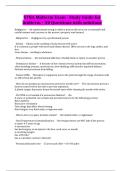
STNA Midterm Exam - Study Guide for
midterm – 30 Questions with solutions
Negligence - -An unintentional wrong in which a person did not act in a reasonable and
careful manner and a person or the person's property was harmed.
-Malpractice - -Negligence by a professional person
-Edema - -Edema is the swelling of body tissues with water.
It is common in people with heart and kidney disease. Often occurs in the legs, ankles, and
feet.
Liver disease - swelling in abdomen.
-Physical Abuse - -the intentional infliction of bodily harm or injury on another person
-Parkinson's disease - -A disorder of the central nervous system that affects movement,
often including tremors, memory loss, slow thinking, stiff muscles, impaired balance.
Patients need protection from falling.
-Passive ROM - -Therapist or equipment moves the joint through the range of motion with
no effort from the patient.
-How do you position an unconscious person for mouth care? - -The unconscious person's
head is turned well to the side to prevent aspiration.
A plastic tongue depressor keeps the mouth open while cleaning the mouth with swabs.
-Do STNA's cut toenails if a person has diabetes? - -No.
A nurse or podiatrist cut toenails and provide footcare for the following persons:
Have diabetes
Have poor circulation
Take drugs that affect blood clotting
Have fungus, very thick nails, or ingrown nails
-Where don't you place bedside urinals? - -On bedside table, or nightstand
-Oral Temperature Contraindications - -Oral temperatures are NOT take if the person:
is under 4-5 years of age
is unconscious
has had surgery or an injury to the face, neck, nose, or mouth
is receiving oxygen
has a NG tube
has a convulsive (seizure) disorder
-Normal adult pulse rate - -12 years and older = 60-100 pulse
midterm – 30 Questions with solutions
Negligence - -An unintentional wrong in which a person did not act in a reasonable and
careful manner and a person or the person's property was harmed.
-Malpractice - -Negligence by a professional person
-Edema - -Edema is the swelling of body tissues with water.
It is common in people with heart and kidney disease. Often occurs in the legs, ankles, and
feet.
Liver disease - swelling in abdomen.
-Physical Abuse - -the intentional infliction of bodily harm or injury on another person
-Parkinson's disease - -A disorder of the central nervous system that affects movement,
often including tremors, memory loss, slow thinking, stiff muscles, impaired balance.
Patients need protection from falling.
-Passive ROM - -Therapist or equipment moves the joint through the range of motion with
no effort from the patient.
-How do you position an unconscious person for mouth care? - -The unconscious person's
head is turned well to the side to prevent aspiration.
A plastic tongue depressor keeps the mouth open while cleaning the mouth with swabs.
-Do STNA's cut toenails if a person has diabetes? - -No.
A nurse or podiatrist cut toenails and provide footcare for the following persons:
Have diabetes
Have poor circulation
Take drugs that affect blood clotting
Have fungus, very thick nails, or ingrown nails
-Where don't you place bedside urinals? - -On bedside table, or nightstand
-Oral Temperature Contraindications - -Oral temperatures are NOT take if the person:
is under 4-5 years of age
is unconscious
has had surgery or an injury to the face, neck, nose, or mouth
is receiving oxygen
has a NG tube
has a convulsive (seizure) disorder
-Normal adult pulse rate - -12 years and older = 60-100 pulse