Evidence Phenols
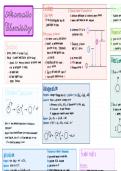
Aromatic 1) Bond lengths
* X-ray crystallography shows all
2) Enthalpy change of hydrogenation
*
*
unsaturare hydrocarbons lytosalurared ,
amount or heat liberated per mole -
energy released
measured
A hydroxyl
* aromatic alc
grou
Chemistry bond lengths are same
3) Resistance to Reaction
* cyclohexane / lead to
lylcohexane -11012J
- Properties
.
* Re density arrack by electrophile * solid at RT
-
-
-
4> however , as mechanism involves * Theoretical A
Structure
,
if benzene soluble in w
disruption to ring .
: electrophiles had 34=36012, 4> benzene p
* arenes simplest is benzene / Coto )
,
have to be more powerful than
* Hekate =3 double bonds shifted position /wrong )
'
w/ alkenes * accreieases 108kt
↳ instead ,
bit e- making up bonds are detrained around * fulludl localised ring : stable .
: ↳ 152kt more stable
Reaction
ring by overlapping p orbitals resist attack * Resonance energy *
Sabas add 1) Rxnwl Na
-
4> no double bonds * would Upset rinqote
4> all bond lengths equal * subnoaftectdelocalitah.MX of,
↳ planar structure
Halogenation
Electrophilic Substitution Reagents halogen
:
t.halogencarrierl-calalust-stlttfedri-FEBr.tt/Br
Mechanism : Conditions: reflux in presence of halogen carrier
+
µ
4> Chlorination : Fe Felts Alclz ,
↳ Bromination : Fe ,FeBr, ,AlBr, 2) Rxnwl Sodiu
E
,
1- Ht A Ct .
non-polar .
: not good electrophile * reactive me
E * halogen carrier required to polaris halogen + sodium p
Equation :(c. Hot Bri → Colts Br -
+ HBR
OH
Electrophile :( It / Brt FeBr, Brt
-
* pair 01 e- leaves delocaiisedsusienntoformco.pro/bondto → Br , + → FeBn ,
+
electrophile 2
* disrupts stable delicalisedsysremtforms unstable intermediate d "
Brt
-
→ s Brttlt
* restore stability pair 1- H bond back
-
Ole in moves into ring
,
Br
* Htion formed by hetero / uric fission #
Preparation of methyl
Friedel-Crafts
-
3- nitrobenzene
Nitration * place mernui benzoate in conical flask
Reagents :(one HNO > + conc .
Hisou * add conc .
112504 to dissolve
Conditions : reflux at 55°C * cool mixture in ice Alkylation :
Aromatic 1) Bond lengths
* X-ray crystallography shows all
2) Enthalpy change of hydrogenation
*
*
unsaturare hydrocarbons lytosalurared ,
amount or heat liberated per mole -
energy released
measured
A hydroxyl
* aromatic alc
grou
Chemistry bond lengths are same
3) Resistance to Reaction
* cyclohexane / lead to
lylcohexane -11012J
- Properties
.
* Re density arrack by electrophile * solid at RT
-
-
-
4> however , as mechanism involves * Theoretical A
Structure
,
if benzene soluble in w
disruption to ring .
: electrophiles had 34=36012, 4> benzene p
* arenes simplest is benzene / Coto )
,
have to be more powerful than
* Hekate =3 double bonds shifted position /wrong )
'
w/ alkenes * accreieases 108kt
↳ instead ,
bit e- making up bonds are detrained around * fulludl localised ring : stable .
: ↳ 152kt more stable
Reaction
ring by overlapping p orbitals resist attack * Resonance energy *
Sabas add 1) Rxnwl Na
-
4> no double bonds * would Upset rinqote
4> all bond lengths equal * subnoaftectdelocalitah.MX of,
↳ planar structure
Halogenation
Electrophilic Substitution Reagents halogen
:
t.halogencarrierl-calalust-stlttfedri-FEBr.tt/Br
Mechanism : Conditions: reflux in presence of halogen carrier
+
µ
4> Chlorination : Fe Felts Alclz ,
↳ Bromination : Fe ,FeBr, ,AlBr, 2) Rxnwl Sodiu
E
,
1- Ht A Ct .
non-polar .
: not good electrophile * reactive me
E * halogen carrier required to polaris halogen + sodium p
Equation :(c. Hot Bri → Colts Br -
+ HBR
OH
Electrophile :( It / Brt FeBr, Brt
-
* pair 01 e- leaves delocaiisedsusienntoformco.pro/bondto → Br , + → FeBn ,
+
electrophile 2
* disrupts stable delicalisedsysremtforms unstable intermediate d "
Brt
-
→ s Brttlt
* restore stability pair 1- H bond back
-
Ole in moves into ring
,
Br
* Htion formed by hetero / uric fission #
Preparation of methyl
Friedel-Crafts
-
3- nitrobenzene
Nitration * place mernui benzoate in conical flask
Reagents :(one HNO > + conc .
Hisou * add conc .
112504 to dissolve
Conditions : reflux at 55°C * cool mixture in ice Alkylation :