Unit 12
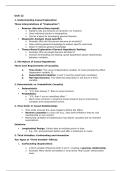
1. Understanding Causal Explanation
Three Interpretations of “Explanation”:
Reasons (Narrative/Story-based):
o Explains why you became an alcoholic, for instance.
o Uses individual stories or biographies.
o Can be a basis for developing general theories.
Diagnostic Analysis (Case-specific):
o Example: Why did this person become an alcoholic?
o Uses existing general knowledge to explain specific outcomes.
o Doesn’t improve general knowledge.
Theory-Based Explanation (General Hypothesis Testing):
o Example: Why do people become alcoholics?
o Involves formulating and testing causal hypotheses about relationships
between variables.
2. The Nature of Causal Hypotheses
Three Core Requirements of Causality:
1. Time Order: The cause (independent variable, X) must precede the effect
(dependent variable, Y).
2. Association/Correlation: X and Y must be empirically correlated.
3. Non-Spuriousness: The observed association is not due to a third
variable.
3. Deterministic vs. Probabilistic Causality
Deterministic:
o “If X, then always Y.” Rare in social sciences.
Probabilistic:
o “If X, then Y occurs more/less often.”
o Much more common in empirical social research due to intervening
variables and measurement errors.
4. Time Order in Causal Relationships
Time order ensures the cause happens before the effect.
Reverse causation is a key risk (e.g., does self-confidence lead to club
membership or vice versa?).
Measuring variables simultaneously may distort causality due to reversed
assumptions.
Solutions:
Longitudinal Design: Collect data at multiple points in time.
o E.g., Pre- and post-tests before and after a treatment or event.
5. Third Variables: Confounding and Interaction
Two Types of “Third Variable” Effects:
1. Confounding (Explanation):
o A third variable influences both X and Y, creating a spurious relationship.
o Example: More storks and babies in rural areas. Real cause? Urbanization
level.
, 2. Interaction (Specification/Modification):
o A third variable modifies the strength or direction of the X-Y relationship.
o Example: Holiday spending is influenced by income and willingness to go
on holiday.
6. Types of Bivariate Relationships
Relationships can be linear, non-linear, or even spurious.
Causal relationships must satisfy the three conditions: time order, correlation, and
non-spuriousness.
Measurement Levels:
Interval or ratio variables can be represented in graphs.
Nominal/ordinal variables are better represented in tables (e.g., cross-
tabulations).
Examples:
Two dichotomous variables → probabilistic causality in a table.
Two ordinal variables → expectations ordered in rows/columns.
7. Hypothesis Testing and Variation
A causal hypothesis is only testable if:
o It's precise.
o It assumes variation in X and Y.
o It is probabilistic, not deterministic (especially in social sciences).
Example Hypothesis:
“Making more assignments leads to higher grades.”
Must specify:
o X: Number of assignments made (independent variable)
o Y: Final grade (dependent variable)
Additional Influences (Third Variables):
Lecture attendance
IQ
Study environment
Exam quality
Assignment quality
8. Testing Causal Relationships
Social sciences rarely allow single observation falsification due to
probabilistic nature.
Variation is essential — across individuals (cross-case) or within individuals
(within-case).
9. Practical Application in Research Design
Research Process:
1. THINK: Theory building — Why should X affect Y? What else might affect Y?
2. PLAN: Design the test — identify variables, units, and design.
3. OBSERVE: Collect and analyze data with an awareness of spuriousness,
timing, and variable levels.
, Types of Analysis:
Within-case: One subject across situations (e.g., a student’s grades across
courses).
Across-case: Multiple subjects in one situation (e.g., many students in one
course).
Combined: Multilevel — students across multiple courses.
Key terms
1. Why do causal statements play a big role when trying to answer an empirical
explanatory research question?
Causal statements are essential in empirical explanatory research because they aim to
explain why certain phenomena occur, not just describe them. An explanatory research
question seeks to uncover the mechanism behind an observed effect — in other words,
what causes what.
For example, instead of merely observing that students who do more assignments tend to
have higher grades (a descriptive statement), an explanatory question would be:
“Does making more assignments cause higher grades?”
To answer such questions, researchers must formulate and test causal hypotheses —
statements that suggest a directional and theoretical relationship between an
independent (cause) and a dependent (effect) variable. These hypotheses guide data
1. Understanding Causal Explanation
Three Interpretations of “Explanation”:
Reasons (Narrative/Story-based):
o Explains why you became an alcoholic, for instance.
o Uses individual stories or biographies.
o Can be a basis for developing general theories.
Diagnostic Analysis (Case-specific):
o Example: Why did this person become an alcoholic?
o Uses existing general knowledge to explain specific outcomes.
o Doesn’t improve general knowledge.
Theory-Based Explanation (General Hypothesis Testing):
o Example: Why do people become alcoholics?
o Involves formulating and testing causal hypotheses about relationships
between variables.
2. The Nature of Causal Hypotheses
Three Core Requirements of Causality:
1. Time Order: The cause (independent variable, X) must precede the effect
(dependent variable, Y).
2. Association/Correlation: X and Y must be empirically correlated.
3. Non-Spuriousness: The observed association is not due to a third
variable.
3. Deterministic vs. Probabilistic Causality
Deterministic:
o “If X, then always Y.” Rare in social sciences.
Probabilistic:
o “If X, then Y occurs more/less often.”
o Much more common in empirical social research due to intervening
variables and measurement errors.
4. Time Order in Causal Relationships
Time order ensures the cause happens before the effect.
Reverse causation is a key risk (e.g., does self-confidence lead to club
membership or vice versa?).
Measuring variables simultaneously may distort causality due to reversed
assumptions.
Solutions:
Longitudinal Design: Collect data at multiple points in time.
o E.g., Pre- and post-tests before and after a treatment or event.
5. Third Variables: Confounding and Interaction
Two Types of “Third Variable” Effects:
1. Confounding (Explanation):
o A third variable influences both X and Y, creating a spurious relationship.
o Example: More storks and babies in rural areas. Real cause? Urbanization
level.
, 2. Interaction (Specification/Modification):
o A third variable modifies the strength or direction of the X-Y relationship.
o Example: Holiday spending is influenced by income and willingness to go
on holiday.
6. Types of Bivariate Relationships
Relationships can be linear, non-linear, or even spurious.
Causal relationships must satisfy the three conditions: time order, correlation, and
non-spuriousness.
Measurement Levels:
Interval or ratio variables can be represented in graphs.
Nominal/ordinal variables are better represented in tables (e.g., cross-
tabulations).
Examples:
Two dichotomous variables → probabilistic causality in a table.
Two ordinal variables → expectations ordered in rows/columns.
7. Hypothesis Testing and Variation
A causal hypothesis is only testable if:
o It's precise.
o It assumes variation in X and Y.
o It is probabilistic, not deterministic (especially in social sciences).
Example Hypothesis:
“Making more assignments leads to higher grades.”
Must specify:
o X: Number of assignments made (independent variable)
o Y: Final grade (dependent variable)
Additional Influences (Third Variables):
Lecture attendance
IQ
Study environment
Exam quality
Assignment quality
8. Testing Causal Relationships
Social sciences rarely allow single observation falsification due to
probabilistic nature.
Variation is essential — across individuals (cross-case) or within individuals
(within-case).
9. Practical Application in Research Design
Research Process:
1. THINK: Theory building — Why should X affect Y? What else might affect Y?
2. PLAN: Design the test — identify variables, units, and design.
3. OBSERVE: Collect and analyze data with an awareness of spuriousness,
timing, and variable levels.
, Types of Analysis:
Within-case: One subject across situations (e.g., a student’s grades across
courses).
Across-case: Multiple subjects in one situation (e.g., many students in one
course).
Combined: Multilevel — students across multiple courses.
Key terms
1. Why do causal statements play a big role when trying to answer an empirical
explanatory research question?
Causal statements are essential in empirical explanatory research because they aim to
explain why certain phenomena occur, not just describe them. An explanatory research
question seeks to uncover the mechanism behind an observed effect — in other words,
what causes what.
For example, instead of merely observing that students who do more assignments tend to
have higher grades (a descriptive statement), an explanatory question would be:
“Does making more assignments cause higher grades?”
To answer such questions, researchers must formulate and test causal hypotheses —
statements that suggest a directional and theoretical relationship between an
independent (cause) and a dependent (effect) variable. These hypotheses guide data