1|Page
CS6250 Computer Networks Exam 1 |Actual
Questions With Answers
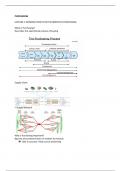
What are the ramifications of the hourglass shape of the internet? -correct-
answer-A. Many technologies that were not originally designed for the internet
have been modified so that they have versions that can communicate over the
internet (such as Radio over IP).
B. It has been a difficult and slow process to transition to IPv6, despite the
shortage of public IPv4 addresses.
Repeaters, hubs, bridges, routers operate on which layers? -correct-answer-
Repeaters and Hubs work over L1 (Physical Layer)
Bridges and Layer 2-Switches work over L2 (Data link layer)
Routers and Layer 3-Switches work over L3 (Network layer)
Repeaters and Hubs -correct-answer-Work over L1 (Physical Layer
,2|Page
Bridges -correct-answer-Work over L2 (Data Link Layer) along with Layer 2
Switches
Routers -correct-answer-Work over L3 (Network Layer) along with Layer 3
Switches
What is a bridge, and how does it "learn"? -correct-answer-A bridge is a device
with multiple inputs/outputs.
A bridge transfers frames from an input to one (or multiple) outputs.
Though it doesn't need to forward all the frames it receives.
A learning bridge learns, populates and maintains a forwarding table.
The bridge consults that table so that it only forwards frames on specific ports,
rather than over all ports.
So how does the bridge learn?
When the bridge receives any frame this is a "learning opportunity" to know
which hosts are reachable through which ports.
,3|Page
This is because the bridge can view the port over which a frame arrives and the
source host.
What is a distributed algorithm? -correct-answer-A distributed algorithm is an
algorithm designed to run on computer hardware constructed from
interconnected processors.
Distributed algorithms are used in many varied application areas of distributed
computing, such as telecommunications, scientific computing, distributed
information processing, and real-time process control.
https://en.wikipedia.org/wiki/Distributed_algorithm
Explain the Spanning Tree Algorithm. -correct-answer-The algorithm runs in
"rounds" and at every round each node sends to each neighbor node a
configuration message with three fields:
a) the sending node's ID,
b) the ID of the roots as perceived by the sending node, and
c) the number of hops between that (perceived) root and the sending node.
At every round, each node keeps track of the best configuration message that it
has received so far, and it compares that against the configuration messages it
receives from neighboring nodes at that round.
, 4|Page
At the very first round of the algorithm, every node thinks that it is the root.
What is the purpose of the Spanning Tree Algorithm? -correct-answer-The
purpose of the Spanning Tree Algorithm is to prevent broadcast storm through the
network and cause stalls or heavy congestion.
The spanning tree also prevents loops (cycles) from occurring in a network.
What does the transport layer provide? -correct-answer-The transport layer is the
logical connection.
Transport layer consists of TCP and UDP protocols.
The transport layer provides an end-to-end connection between two applications
that are running on different hosts.
Of course the transport layer provides this logical connection regardless if the
hosts are in the same network.
User datagram protocol (UDP) and the Transmission Control Protocol (TCP).
CS6250 Computer Networks Exam 1 |Actual
Questions With Answers
What are the ramifications of the hourglass shape of the internet? -correct-
answer-A. Many technologies that were not originally designed for the internet
have been modified so that they have versions that can communicate over the
internet (such as Radio over IP).
B. It has been a difficult and slow process to transition to IPv6, despite the
shortage of public IPv4 addresses.
Repeaters, hubs, bridges, routers operate on which layers? -correct-answer-
Repeaters and Hubs work over L1 (Physical Layer)
Bridges and Layer 2-Switches work over L2 (Data link layer)
Routers and Layer 3-Switches work over L3 (Network layer)
Repeaters and Hubs -correct-answer-Work over L1 (Physical Layer
,2|Page
Bridges -correct-answer-Work over L2 (Data Link Layer) along with Layer 2
Switches
Routers -correct-answer-Work over L3 (Network Layer) along with Layer 3
Switches
What is a bridge, and how does it "learn"? -correct-answer-A bridge is a device
with multiple inputs/outputs.
A bridge transfers frames from an input to one (or multiple) outputs.
Though it doesn't need to forward all the frames it receives.
A learning bridge learns, populates and maintains a forwarding table.
The bridge consults that table so that it only forwards frames on specific ports,
rather than over all ports.
So how does the bridge learn?
When the bridge receives any frame this is a "learning opportunity" to know
which hosts are reachable through which ports.
,3|Page
This is because the bridge can view the port over which a frame arrives and the
source host.
What is a distributed algorithm? -correct-answer-A distributed algorithm is an
algorithm designed to run on computer hardware constructed from
interconnected processors.
Distributed algorithms are used in many varied application areas of distributed
computing, such as telecommunications, scientific computing, distributed
information processing, and real-time process control.
https://en.wikipedia.org/wiki/Distributed_algorithm
Explain the Spanning Tree Algorithm. -correct-answer-The algorithm runs in
"rounds" and at every round each node sends to each neighbor node a
configuration message with three fields:
a) the sending node's ID,
b) the ID of the roots as perceived by the sending node, and
c) the number of hops between that (perceived) root and the sending node.
At every round, each node keeps track of the best configuration message that it
has received so far, and it compares that against the configuration messages it
receives from neighboring nodes at that round.
, 4|Page
At the very first round of the algorithm, every node thinks that it is the root.
What is the purpose of the Spanning Tree Algorithm? -correct-answer-The
purpose of the Spanning Tree Algorithm is to prevent broadcast storm through the
network and cause stalls or heavy congestion.
The spanning tree also prevents loops (cycles) from occurring in a network.
What does the transport layer provide? -correct-answer-The transport layer is the
logical connection.
Transport layer consists of TCP and UDP protocols.
The transport layer provides an end-to-end connection between two applications
that are running on different hosts.
Of course the transport layer provides this logical connection regardless if the
hosts are in the same network.
User datagram protocol (UDP) and the Transmission Control Protocol (TCP).