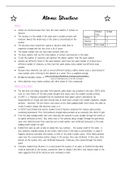
Atomic Structure
Atoms:
• Atoms are neutral because they have the same number of protons as
Relative Charge
electron.
Mass
• The nucleus is in the middle of the atom and it contains protons and Proton 1 +1
neutrons. Almost the whole mass of the atom is concentrated in the
Neutron 1 0
nucleus.
• The electrons move around the nucleus in electron shells, they’re Electron Very small -1
negatively charged and tiny but cover a lot of space.
• The atomic number tells you have many protons there are.
• The mass number tells you the total number of protons and neutrons in the atom.
• To get the number of neutrons, just subtract the atomic number from the mass number.
• Isotopes are different forms of the same element, which have the same number of protons but a
different number of neutrons, so they have the same atomic mass number but different mass
number.
• Because many elements can exist as several different isotopes, relative atomic mass is used instead of
mass number when referring to the element as a whole. This is a weighted average.
!"# %& ((!%)%*+ ,-"./,.0+ ×(!%)%*+ #,!! ."#-+2)
• !"#$%&'" $%)*&+ *$,, = !"# %& ,-"./,.0+! %& ,44 )5+ (!%)%*+!
• When elements react, atoms combine with other atoms to form compounds.
History of the Atom:
• The idea that everything was made from particles called atoms was accepted in the early 1800s after
work by John Dalton. At the time people thought that atoms were the smallest possible particles.
• In 1897 J. J. Thomson concluded from his experiments that atoms weren’t solid spheres. His
measurements of charge and mass showed that an atom must contain even smaller, negatively charged
particles – electrons. The new theory was known as the ‘plum pudding model’ which shows the atom as
a ball of positive charge with electrons stuck in it.
• In 1909 Ernest Rutherford and his student Ernest Marsden conducted the famous alpha particle
scattering experiments. They fired positively charged alpha particles at an extremely thin sheet of gold.
• From the plum pudding model, they were expecting the particles to pass straight through the sheets or
be slightly deflected at most. But, whilst most of the particles did go straight through the gold sheets
some were deflected more than expected, and a small number were deflected backwards so the plum
pudding model couldn’t be right.
• Rutherford came up with an idea to explain this new evidence – the nuclear model of the atom. A
tiny, positively charged nucleus at the centre, where most of the mass is concentrated. A cloud of
negative electrons surrounds this nucleus, so most of the atom is empty space. When Alpha particles
came near the concentrated, positive charge of the nucleus, they were deflected. If they were fired
directly at the nucleus, they were deflected backwards. Otherwise, they passed through the empty
space.
• Scientists realized that electron’s in a cloud around the nucleus of an atom, as Rutherford described,
would be attracted to the nucleus, causing the atom to collapse. Niels Bohr’s and nuclear model of the
atom suggested that all the electrons were contained in shells.
Atoms:
• Atoms are neutral because they have the same number of protons as
Relative Charge
electron.
Mass
• The nucleus is in the middle of the atom and it contains protons and Proton 1 +1
neutrons. Almost the whole mass of the atom is concentrated in the
Neutron 1 0
nucleus.
• The electrons move around the nucleus in electron shells, they’re Electron Very small -1
negatively charged and tiny but cover a lot of space.
• The atomic number tells you have many protons there are.
• The mass number tells you the total number of protons and neutrons in the atom.
• To get the number of neutrons, just subtract the atomic number from the mass number.
• Isotopes are different forms of the same element, which have the same number of protons but a
different number of neutrons, so they have the same atomic mass number but different mass
number.
• Because many elements can exist as several different isotopes, relative atomic mass is used instead of
mass number when referring to the element as a whole. This is a weighted average.
!"# %& ((!%)%*+ ,-"./,.0+ ×(!%)%*+ #,!! ."#-+2)
• !"#$%&'" $%)*&+ *$,, = !"# %& ,-"./,.0+! %& ,44 )5+ (!%)%*+!
• When elements react, atoms combine with other atoms to form compounds.
History of the Atom:
• The idea that everything was made from particles called atoms was accepted in the early 1800s after
work by John Dalton. At the time people thought that atoms were the smallest possible particles.
• In 1897 J. J. Thomson concluded from his experiments that atoms weren’t solid spheres. His
measurements of charge and mass showed that an atom must contain even smaller, negatively charged
particles – electrons. The new theory was known as the ‘plum pudding model’ which shows the atom as
a ball of positive charge with electrons stuck in it.
• In 1909 Ernest Rutherford and his student Ernest Marsden conducted the famous alpha particle
scattering experiments. They fired positively charged alpha particles at an extremely thin sheet of gold.
• From the plum pudding model, they were expecting the particles to pass straight through the sheets or
be slightly deflected at most. But, whilst most of the particles did go straight through the gold sheets
some were deflected more than expected, and a small number were deflected backwards so the plum
pudding model couldn’t be right.
• Rutherford came up with an idea to explain this new evidence – the nuclear model of the atom. A
tiny, positively charged nucleus at the centre, where most of the mass is concentrated. A cloud of
negative electrons surrounds this nucleus, so most of the atom is empty space. When Alpha particles
came near the concentrated, positive charge of the nucleus, they were deflected. If they were fired
directly at the nucleus, they were deflected backwards. Otherwise, they passed through the empty
space.
• Scientists realized that electron’s in a cloud around the nucleus of an atom, as Rutherford described,
would be attracted to the nucleus, causing the atom to collapse. Niels Bohr’s and nuclear model of the
atom suggested that all the electrons were contained in shells.