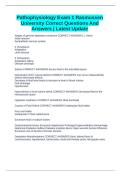
Pathophysiology Exam 1 Rasmussen
University Correct Questions And
Answers | Latest Update
Stages of general adaptation syndrome CORRECT ANSWERS 1. Alarm
Initial reaction
Sympathetic nervous system
2. Resistance
Adaptation
Limit stressor
3. Exhaustion
Adaptation failing
Disease develops
Edema CORRECT ANSWERS Excess fluid in the interstitial space
Dehydration (ECF volume deficit) CORRECT ANSWERS Can occur independently
without electrolyte defects
Decrease in fluid level leads to increase in level of blood solutes
Cell shrinkage
Hypotension
Hypovolemia or fluid volume deficit CORRECT ANSWERS Decreased fluid in the
intravascular space
Hypotonic Hydration CORRECT ANSWERS (fluid overload)
Causes of Fluid Deficit CORRECT ANSWERS Inadequate fluid intake
Poor oral intake
Inadequate IV fluid replacement
Excessive fluid or sodium losses:
Gastrointestinal losses Excessive diaphoresis Prolonged hyperventilation Hemorrhage
Nephrosis Diabetes mellitus Diabetes insipidus Burns Open wounds Ascites Effusions
Excessive use of diuretics Osmotic diuresis
Deydration Manisfestations CORRECT ANSWERS thirst, altered level of
consciousness, hypotension, tachycardia, weak and thready pulse, flat jugular veins,
,dry mucous membranes, decreased skin turgor, oliguria, weight loss, and sunken
fontanelles
Cancer Benign CORRECT ANSWERS Slow, progressive, localized, well defined,
resembles host (more differentiated), grows by expansion, does not usually cause death
Cancer Malignant CORRECT ANSWERS Rapid growing, spreads (metastasis) quickly,
fatal, highly undifferentiated
Sodium CORRECT ANSWERS Normal range: 135-145 mEq/L.
• Most significant cation and prevalent electrolyte of extracellular fluid.
• Controls serum osmolality and water balance. Plays a role in acid-base balance.
• Facilitates muscles and nerve impulses.
• Main source is dietary intake.
• Excreted through the kidneys and gastrointestinal tract.
Hypernatremia CORRECT ANSWERS Sodium > 145 mEq/L
Serum osmolarity increases
• Results in fluid shifts
Causes of Hypernatremia CORRECT ANSWERS Excessive sodium ingestion
Hypertonic IV saline (3% saline) administration
Cushing's syndrome
Corticosteroid use
Diarrhea
Excessive sweating
Prolonged episode of hyperventilation
Diuretic use Diabetes insipidus
Decreased water ingestion
Loss of thirst sensation
Inability to drink water
Third spacing
Vomiting
Hypernatremia Manifestations: CORRECT ANSWERS increased temperature, warm
and flushed skin, dry and sticky mucous membranes, dysphagia, increased thirst,
irritability, agitation, weakness, headache, seizures, lethargy, coma, blood pressure
changes, tachycardia, weak and thready pulse, edema, and decreased urine output
Hyponatremia CORRECT ANSWERS Sodium < 135 mEq/L
Serum osmolarity decreases
Causes of Hyponatremia CORRECT ANSWERS Deficient sodium
Diuretic use
Gastrointestinal losses
Excessive sweating
, Insufficient aldosterone levels
Adrenal insufficiency
Dietary sodium restrictions
Excessive water
Hypotonic intravenous saline (0.45% saline) Hyperglycemia
Excessive water ingestion
Renal failure
Syndrome of inappropriate antidiuretic hormone Heart failure
Hyponatremia Manifestations: CORRECT ANSWERS anorexia, gastrointestinal upset,
poor skin turgor, dry mucous membranes, blood pressure changes, pulse changes,
edema, headache, lethargy, confusion, diminished deep tendon reflexes, muscle
weakness seizures, and coma
Hyponatremia Treatment: CORRECT ANSWERS limit fluids and increase dietary
sodium
Chloride CORRECT ANSWERS Normal range: 98-108 mEq/L
Mineral electrolyte
Major extracellular anion
Found in gastric secretions, pancreatic juices, bile, and cerebrospinal fluid
Plays a role in acid-base balance
Main source is dietary intake
Excreted through the kidneys
Hyperchloremia CORRECT ANSWERS Chloride > 108 mEq/L
Hyperchloremia Causes CORRECT ANSWERS Increased chloride intake or exchange:
hypernatremia, hypertonic intravenous solution, metabolic acidosis, and hyperkalemia
Decreased chloride excretion:
hyperparathyroidism, hyperaldosteronism, and renal failure
Hypochloremia CORRECT ANSWERS Chloride < 98 mEq/L
Hypochloremia Causes CORRECT ANSWERS Decreased chloride intake or exchange:
hyponatremia, administration of 5% dextrose in water intravenous solution, water
intoxication, and hypokalemia Increased chloride excretion: diuretics, vomiting,
metabolic alkalosis, and other gastrointestinal losses
Hypochloremia Treatment: CORRECT ANSWERS identify and manage underlying
cause, sodium replacement (oral or intravenous), ammonium chloride, and saline
irrigation of gastric tubes
Potassium CORRECT ANSWERS Normal range: 3.5-5 mEq/L.
The primary intracellular cation.
Plays a role in electrical conduction, acid-base balance, and metabolism.
University Correct Questions And
Answers | Latest Update
Stages of general adaptation syndrome CORRECT ANSWERS 1. Alarm
Initial reaction
Sympathetic nervous system
2. Resistance
Adaptation
Limit stressor
3. Exhaustion
Adaptation failing
Disease develops
Edema CORRECT ANSWERS Excess fluid in the interstitial space
Dehydration (ECF volume deficit) CORRECT ANSWERS Can occur independently
without electrolyte defects
Decrease in fluid level leads to increase in level of blood solutes
Cell shrinkage
Hypotension
Hypovolemia or fluid volume deficit CORRECT ANSWERS Decreased fluid in the
intravascular space
Hypotonic Hydration CORRECT ANSWERS (fluid overload)
Causes of Fluid Deficit CORRECT ANSWERS Inadequate fluid intake
Poor oral intake
Inadequate IV fluid replacement
Excessive fluid or sodium losses:
Gastrointestinal losses Excessive diaphoresis Prolonged hyperventilation Hemorrhage
Nephrosis Diabetes mellitus Diabetes insipidus Burns Open wounds Ascites Effusions
Excessive use of diuretics Osmotic diuresis
Deydration Manisfestations CORRECT ANSWERS thirst, altered level of
consciousness, hypotension, tachycardia, weak and thready pulse, flat jugular veins,
,dry mucous membranes, decreased skin turgor, oliguria, weight loss, and sunken
fontanelles
Cancer Benign CORRECT ANSWERS Slow, progressive, localized, well defined,
resembles host (more differentiated), grows by expansion, does not usually cause death
Cancer Malignant CORRECT ANSWERS Rapid growing, spreads (metastasis) quickly,
fatal, highly undifferentiated
Sodium CORRECT ANSWERS Normal range: 135-145 mEq/L.
• Most significant cation and prevalent electrolyte of extracellular fluid.
• Controls serum osmolality and water balance. Plays a role in acid-base balance.
• Facilitates muscles and nerve impulses.
• Main source is dietary intake.
• Excreted through the kidneys and gastrointestinal tract.
Hypernatremia CORRECT ANSWERS Sodium > 145 mEq/L
Serum osmolarity increases
• Results in fluid shifts
Causes of Hypernatremia CORRECT ANSWERS Excessive sodium ingestion
Hypertonic IV saline (3% saline) administration
Cushing's syndrome
Corticosteroid use
Diarrhea
Excessive sweating
Prolonged episode of hyperventilation
Diuretic use Diabetes insipidus
Decreased water ingestion
Loss of thirst sensation
Inability to drink water
Third spacing
Vomiting
Hypernatremia Manifestations: CORRECT ANSWERS increased temperature, warm
and flushed skin, dry and sticky mucous membranes, dysphagia, increased thirst,
irritability, agitation, weakness, headache, seizures, lethargy, coma, blood pressure
changes, tachycardia, weak and thready pulse, edema, and decreased urine output
Hyponatremia CORRECT ANSWERS Sodium < 135 mEq/L
Serum osmolarity decreases
Causes of Hyponatremia CORRECT ANSWERS Deficient sodium
Diuretic use
Gastrointestinal losses
Excessive sweating
, Insufficient aldosterone levels
Adrenal insufficiency
Dietary sodium restrictions
Excessive water
Hypotonic intravenous saline (0.45% saline) Hyperglycemia
Excessive water ingestion
Renal failure
Syndrome of inappropriate antidiuretic hormone Heart failure
Hyponatremia Manifestations: CORRECT ANSWERS anorexia, gastrointestinal upset,
poor skin turgor, dry mucous membranes, blood pressure changes, pulse changes,
edema, headache, lethargy, confusion, diminished deep tendon reflexes, muscle
weakness seizures, and coma
Hyponatremia Treatment: CORRECT ANSWERS limit fluids and increase dietary
sodium
Chloride CORRECT ANSWERS Normal range: 98-108 mEq/L
Mineral electrolyte
Major extracellular anion
Found in gastric secretions, pancreatic juices, bile, and cerebrospinal fluid
Plays a role in acid-base balance
Main source is dietary intake
Excreted through the kidneys
Hyperchloremia CORRECT ANSWERS Chloride > 108 mEq/L
Hyperchloremia Causes CORRECT ANSWERS Increased chloride intake or exchange:
hypernatremia, hypertonic intravenous solution, metabolic acidosis, and hyperkalemia
Decreased chloride excretion:
hyperparathyroidism, hyperaldosteronism, and renal failure
Hypochloremia CORRECT ANSWERS Chloride < 98 mEq/L
Hypochloremia Causes CORRECT ANSWERS Decreased chloride intake or exchange:
hyponatremia, administration of 5% dextrose in water intravenous solution, water
intoxication, and hypokalemia Increased chloride excretion: diuretics, vomiting,
metabolic alkalosis, and other gastrointestinal losses
Hypochloremia Treatment: CORRECT ANSWERS identify and manage underlying
cause, sodium replacement (oral or intravenous), ammonium chloride, and saline
irrigation of gastric tubes
Potassium CORRECT ANSWERS Normal range: 3.5-5 mEq/L.
The primary intracellular cation.
Plays a role in electrical conduction, acid-base balance, and metabolism.