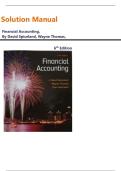
Solution Manual
Financial Accounting,
By David Spiceland, Wayne Thomas,
6th Edition
,Table Of Contents
Chapter 1: A Framework For Financial Accounting
Chapter 2: The Accounting Cycle: During The Period
Chapter 3: The Accounting Cycle: End Of The Period
Chapter 4: Cash And Internal Controls
Chapter 5: Receivables And Sales
Chapter 6: Inventory And Cost Of Goods Sold
Chapter 7: Long-Term Assets
Chapter 8: Current Liabilities
Chapter 9: Long-Term Liabilities
Chapter 10: Stockholders’ Equity
Chapter 11: Statement Of Cash Flows
Chapter 12: Financial Statement Analysis
Chapter 1
A Framework For Financial Accounting
REVIEW QUESTIONS
Question 1-1 (LO 1-1)
Accounting Is The Language Of Business. Whereas A Basic Math Class Might Involve Adding,
Subtracting, And Solving For Unknown Variables, Accounting Involves Learning To Measure
Business Transactions And Communicating Those Measurements In A Format That Is Generally
Understood By Decision Makers.
Question 1-2 (LO 1-1)
Those Interested In Making Decisions About A Company Include Investors, Creditors,
Customers, Suppliers, Managers, Employees, Competitors, Regulators, Tax Authorities, And Local
Communities.
Question 1-3 (LO 1-1)
Financial Accounting Seeks To Measure Business Activities Of A Company And To
Communicate Those Measurements To External Parties For Decision-Making Purposes. The Two
Primary External, Or Outside The Firm, Users Of Financial Accounting Information Are Investors
And Creditors. Managerial Accounting Deals With The Methods Accountants Use To Provide
Information To An Organization’s Internal Users, That Is, Its Own Managers.
Question 1-4 (LO 1-1)
The Two Primary Functions Of Financial Accounting Are To Measure Business Activities Of A
Company And To Communicate Information About Those Activities To Investors And Creditors For
Decision-Making Purposes.
Question 1-5 (LO 1-2)
The Three Basic Business Activities Are Financing, Investing, And Operating Activities.
Financing Activities Are Transactions That Raise Cash Needed To Operate The Business, Such As
Issuing Stock And Borrowing Money From A Bank. Investing Activities Typically Include The
Purchase Or Disposal Of Long- Term Resources That Are Expected To Benefit The Company For
, Several Years, Such As Land, Buildings, Equipment, And Machinery. Operating Activities Include
The Primary Operations Of The Company, Providing Products And Services To Customers And The
Associated Costs Of Doing So, Like Utilities, Taxes, Advertising, Wages, Rent, And Maintenance.
Question 1-6 (LO 1-2)
Typical Financing Activities For UPS Would Include Selling Stock And Paying Dividends To
Investors, As Well As Borrowing And Repaying Debt To Creditors.
Question 1-7 (LO 1-2)
Typical Investing Activities For Caesars Entertainment Would Include The Purchase Or Disposal
Of Land, Casino Buildings, Hotels, Gaming Tables, Chairs, Cleaning Equipment, And Food
Preparation Machines.
©2022 Mcgraw Hill Education. All Rights Reserved. Authorized Only For Instructor Use In The Classroom. No Reproduction Or Further
Distribution Permitted Without The Prior Written Consent Of Mcgraw Hill Education.
Solutions Manual, Chapter 1 1-1
, Answers to Review Questions (continued)
Question 1-8 (LO 1-2)
Typical Operating Activities For Oracle Would Include The Sale Of Software And Consulting
Services, As Well As Costs Related To Salaries, Research, Utilities, Advertising, Rent, And Taxes.
Question 1-9 (LO 1-2)
The Three Major Legal Forms Of Business Organizations Include Sole Proprietorship,
Partnership, And Corporation? A Corporation Is Chosen By Most Of The Largest Companies In The
United States.
Question 1-10 (LO 1-2)
Assets: Resources Owned.
Liabilities: Amounts Owed.
Stockholders’ Equity: Owners’ Claims To Resources.
Dividends: Distributions To Stockholders.
Revenues: Sales Of Products Or Services To Customers.
Expenses: Costs Of Selling Products Or Services.
Question 1-11 (LO 1-2)
The Major Advantage Of A Corporation Is Limited Liability. Stockholders Of A Corporation
Are Not Held Personally Responsible For The Financial Obligations Of The Corporation. Owners Of
Sole Proprietorships Or Partnerships Remain Personally Liable For Activities Of The Business.
Corporations Have The Disadvantages Of Double Taxation Compared To Sole Proprietorships And
Partnerships. Sole Proprietorship And Partnership Forms Of Business Have The Advantage That
Income Is Taxed Only Once. However, There Could Be Other Tax Advantages For Certain Types Of
Corporations, Such As A Lower Overall Tax Rate Compared To Partnerships And Sole
Proprietorships. Sole Proprietorships And Partnerships Are Often Limited In The Amount Of Funds
They Can Raise To Start A Business.
Question 1-12 (LO 1-3)
1. Income Statement: Reports The Company’s Revenues And Expenses During An Interval Of
Time. If Revenues Exceed Expenses, Then The Company Reports Net Income. If Expenses
Exceed Revenues, Then The Company Reports A Net Loss.
2. Statement Of Stockholders’ Equity: Summarizes The Changes In Stockholders’ Equity
From Net Income, Dividends, And Stock Issuances During An Interval Of Time.
3. Balance Sheet: Presents The Financial Position Of The Company On A Particular Date. It
Shows That Assets Equal Liabilities Plus Stockholders’ Equity.
4. Statement Of Cash Flows: Reports Cash Inflows And Outflows Related To Operating,
Investing, And Financing Activities During An Interval Of Time.
Question 1-13 (LO 1-3)
Balances Of Accounts Reported In The Income Statement, Statement Of Stockholders’ Equity,
And Statement Of Cash Flows Reflect Activity From The Beginning Of The Period Through The End
Of The Period. Balances Of Accounts Reported In The Balance Sheet Reflect The Financial Position
Of The Company As Of A Single Date, The End Of The Period. The Income Statement,
Statement Of Stockholders’ Equity And
1-2 Financial Accounting, 6e
Financial Accounting,
By David Spiceland, Wayne Thomas,
6th Edition
,Table Of Contents
Chapter 1: A Framework For Financial Accounting
Chapter 2: The Accounting Cycle: During The Period
Chapter 3: The Accounting Cycle: End Of The Period
Chapter 4: Cash And Internal Controls
Chapter 5: Receivables And Sales
Chapter 6: Inventory And Cost Of Goods Sold
Chapter 7: Long-Term Assets
Chapter 8: Current Liabilities
Chapter 9: Long-Term Liabilities
Chapter 10: Stockholders’ Equity
Chapter 11: Statement Of Cash Flows
Chapter 12: Financial Statement Analysis
Chapter 1
A Framework For Financial Accounting
REVIEW QUESTIONS
Question 1-1 (LO 1-1)
Accounting Is The Language Of Business. Whereas A Basic Math Class Might Involve Adding,
Subtracting, And Solving For Unknown Variables, Accounting Involves Learning To Measure
Business Transactions And Communicating Those Measurements In A Format That Is Generally
Understood By Decision Makers.
Question 1-2 (LO 1-1)
Those Interested In Making Decisions About A Company Include Investors, Creditors,
Customers, Suppliers, Managers, Employees, Competitors, Regulators, Tax Authorities, And Local
Communities.
Question 1-3 (LO 1-1)
Financial Accounting Seeks To Measure Business Activities Of A Company And To
Communicate Those Measurements To External Parties For Decision-Making Purposes. The Two
Primary External, Or Outside The Firm, Users Of Financial Accounting Information Are Investors
And Creditors. Managerial Accounting Deals With The Methods Accountants Use To Provide
Information To An Organization’s Internal Users, That Is, Its Own Managers.
Question 1-4 (LO 1-1)
The Two Primary Functions Of Financial Accounting Are To Measure Business Activities Of A
Company And To Communicate Information About Those Activities To Investors And Creditors For
Decision-Making Purposes.
Question 1-5 (LO 1-2)
The Three Basic Business Activities Are Financing, Investing, And Operating Activities.
Financing Activities Are Transactions That Raise Cash Needed To Operate The Business, Such As
Issuing Stock And Borrowing Money From A Bank. Investing Activities Typically Include The
Purchase Or Disposal Of Long- Term Resources That Are Expected To Benefit The Company For
, Several Years, Such As Land, Buildings, Equipment, And Machinery. Operating Activities Include
The Primary Operations Of The Company, Providing Products And Services To Customers And The
Associated Costs Of Doing So, Like Utilities, Taxes, Advertising, Wages, Rent, And Maintenance.
Question 1-6 (LO 1-2)
Typical Financing Activities For UPS Would Include Selling Stock And Paying Dividends To
Investors, As Well As Borrowing And Repaying Debt To Creditors.
Question 1-7 (LO 1-2)
Typical Investing Activities For Caesars Entertainment Would Include The Purchase Or Disposal
Of Land, Casino Buildings, Hotels, Gaming Tables, Chairs, Cleaning Equipment, And Food
Preparation Machines.
©2022 Mcgraw Hill Education. All Rights Reserved. Authorized Only For Instructor Use In The Classroom. No Reproduction Or Further
Distribution Permitted Without The Prior Written Consent Of Mcgraw Hill Education.
Solutions Manual, Chapter 1 1-1
, Answers to Review Questions (continued)
Question 1-8 (LO 1-2)
Typical Operating Activities For Oracle Would Include The Sale Of Software And Consulting
Services, As Well As Costs Related To Salaries, Research, Utilities, Advertising, Rent, And Taxes.
Question 1-9 (LO 1-2)
The Three Major Legal Forms Of Business Organizations Include Sole Proprietorship,
Partnership, And Corporation? A Corporation Is Chosen By Most Of The Largest Companies In The
United States.
Question 1-10 (LO 1-2)
Assets: Resources Owned.
Liabilities: Amounts Owed.
Stockholders’ Equity: Owners’ Claims To Resources.
Dividends: Distributions To Stockholders.
Revenues: Sales Of Products Or Services To Customers.
Expenses: Costs Of Selling Products Or Services.
Question 1-11 (LO 1-2)
The Major Advantage Of A Corporation Is Limited Liability. Stockholders Of A Corporation
Are Not Held Personally Responsible For The Financial Obligations Of The Corporation. Owners Of
Sole Proprietorships Or Partnerships Remain Personally Liable For Activities Of The Business.
Corporations Have The Disadvantages Of Double Taxation Compared To Sole Proprietorships And
Partnerships. Sole Proprietorship And Partnership Forms Of Business Have The Advantage That
Income Is Taxed Only Once. However, There Could Be Other Tax Advantages For Certain Types Of
Corporations, Such As A Lower Overall Tax Rate Compared To Partnerships And Sole
Proprietorships. Sole Proprietorships And Partnerships Are Often Limited In The Amount Of Funds
They Can Raise To Start A Business.
Question 1-12 (LO 1-3)
1. Income Statement: Reports The Company’s Revenues And Expenses During An Interval Of
Time. If Revenues Exceed Expenses, Then The Company Reports Net Income. If Expenses
Exceed Revenues, Then The Company Reports A Net Loss.
2. Statement Of Stockholders’ Equity: Summarizes The Changes In Stockholders’ Equity
From Net Income, Dividends, And Stock Issuances During An Interval Of Time.
3. Balance Sheet: Presents The Financial Position Of The Company On A Particular Date. It
Shows That Assets Equal Liabilities Plus Stockholders’ Equity.
4. Statement Of Cash Flows: Reports Cash Inflows And Outflows Related To Operating,
Investing, And Financing Activities During An Interval Of Time.
Question 1-13 (LO 1-3)
Balances Of Accounts Reported In The Income Statement, Statement Of Stockholders’ Equity,
And Statement Of Cash Flows Reflect Activity From The Beginning Of The Period Through The End
Of The Period. Balances Of Accounts Reported In The Balance Sheet Reflect The Financial Position
Of The Company As Of A Single Date, The End Of The Period. The Income Statement,
Statement Of Stockholders’ Equity And
1-2 Financial Accounting, 6e