

Page 1 of 20
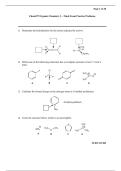
Chem227 Organic Chemistry I – Final Exam Practice Problems
1. Determine the hybridization for the atoms indicated by arrows.
H H CH3
C C C H
Cl Si
H H CH2 CH 3
2. Which one of the following molecules has a net dipole moment of zero? Circle a
letter.
F Cl O
H3 C
C
F F S O
F O H3 C
A B C D
3. Calculate the formal charge on the nitrogen atom in N-methyl pyridinium.
N-methyl pyridinium
N
CH3
4. Circle the structure below which is an electrophile.
S CH3
H3 C CH3 C
AlCl4
O H 3C CH 3
A B C D
TURN OVER
, Page 2 of 20
5. Circle the structure below which is a Lewis base.
H
N N Br
N N
H
A B C D
6. (a) Name each of the circled functional groups in the molecule of Prostaglandin E1
shown below. Put a letter in each box.
O
H
COOH
HO
H HO H
H
A - Carboxylic acid
B - Aldehyde
C - Alkene
D - Alcohol
E - Ketone
F - Halide
G - Ether
(b) How many chirality centers are present in Prostaglandin E1? _____
(c) How many stereoisomers are possible for Prostaglandin E1? ____
7. Which one of the following structures is a meso compound?
H H
CH3 HO CH 3 Br
C Br CH3
C H Ph
CH3 Br CH 3 H
H H
H CH 3
A B C D
TURN OVER
, Page 3 of 20
8. Which one of the statements below is INCORRECT?
(a) Stereoisomers are compounds whose atoms have the same connectivity but
differ in their spatial orientation.
(b) Enantiomers are stereoisomers which are non-superimposable mirror images of
one another.
(c) Diastereomers may be separated on the basis of their different physical
properties.
(d) A racemic mixture consists of unequal amounts of enantiomers so that
the net optical rotation is greater or less than zero.
9. Designate the prochirality of the hydrogen (pro-R/pro-S) and face (re/si) indicated by
each arrow.
10. Designate the chirality centers as R or S in the following structure.
H 3C
CH 3
H3 CH2C
Br
11. Designate the stereochemical configurations of the alkenes below as E or Z.
F Cl
TURN OVER
Chem227 Organic Chemistry I – Final Exam Practice Problems
1. Determine the hybridization for the atoms indicated by arrows.
H H CH3
C C C H
Cl Si
H H CH2 CH 3
2. Which one of the following molecules has a net dipole moment of zero? Circle a
letter.
F Cl O
H3 C
C
F F S O
F O H3 C
A B C D
3. Calculate the formal charge on the nitrogen atom in N-methyl pyridinium.
N-methyl pyridinium
N
CH3
4. Circle the structure below which is an electrophile.
S CH3
H3 C CH3 C
AlCl4
O H 3C CH 3
A B C D
TURN OVER
, Page 2 of 20
5. Circle the structure below which is a Lewis base.
H
N N Br
N N
H
A B C D
6. (a) Name each of the circled functional groups in the molecule of Prostaglandin E1
shown below. Put a letter in each box.
O
H
COOH
HO
H HO H
H
A - Carboxylic acid
B - Aldehyde
C - Alkene
D - Alcohol
E - Ketone
F - Halide
G - Ether
(b) How many chirality centers are present in Prostaglandin E1? _____
(c) How many stereoisomers are possible for Prostaglandin E1? ____
7. Which one of the following structures is a meso compound?
H H
CH3 HO CH 3 Br
C Br CH3
C H Ph
CH3 Br CH 3 H
H H
H CH 3
A B C D
TURN OVER
, Page 3 of 20
8. Which one of the statements below is INCORRECT?
(a) Stereoisomers are compounds whose atoms have the same connectivity but
differ in their spatial orientation.
(b) Enantiomers are stereoisomers which are non-superimposable mirror images of
one another.
(c) Diastereomers may be separated on the basis of their different physical
properties.
(d) A racemic mixture consists of unequal amounts of enantiomers so that
the net optical rotation is greater or less than zero.
9. Designate the prochirality of the hydrogen (pro-R/pro-S) and face (re/si) indicated by
each arrow.
10. Designate the chirality centers as R or S in the following structure.
H 3C
CH 3
H3 CH2C
Br
11. Designate the stereochemical configurations of the alkenes below as E or Z.
F Cl
TURN OVER


