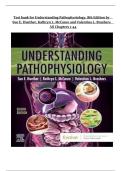
Test bank for Understanding Pathophysiology, 8th Edition by
Sue E. Huether, Kathryn L. McCance and Valentina L. Brashers
All Chapters 1-44
,Table of Contents
1 Cellular Biology
2 Genes and Genetic Diseases
3 Epigenetics and Disease
4 Altered Cellular and Tissue Biology
5 Fluids and Electrolytes, Acids and Bases
6 Innate Immunity: Inflammation and Wound Healing
7 Adaptive Immunity
8 Alterations of Immunity
9 Infection
10 Stress and Disease
11 Cancer Biology
12 Cancer Epidemiology
13 Cancer in Children and Adolescents
14 Structure and Function of the Neurologic System
15 Pain. Temperature, Sleep, and Sensory Function
16 Alterations of Cognitive Systems, Cerebral Hemodynamics, and Motor Function
17 Alterations of the Brain, Spinal Cord, and Peripheral Nerves
19 Mechanisms of Hormonal Regulation
20 Alterations of Hormonal Regulation
21 Obesity, Starvation, and Anorexia of Aging
22 Structure and Function of the Hematologic System
23 Alterations of Hematologic Function
24 Alterations of Hematologic Function in Children
25 Structure and Function of the Cardiovascular and Lymphatic Systems
26 Alterations of Cardiovascular Function
28 Structure and Function of the Pulmonary System
29 Alterations of Pulmonary Function
,30 Alterations of Pulmonary Function in Children
31 Structure and Function of the Renal and Urologic Systems
32 Alterations of Renal and Urinary Tract Function
33 Alterations of Renal and Urinary Tract Function in Children
34 Structure and Function of the Reproductive Systems
35 Alterations of the Female Reproductive System
36 Alterations of the Male Reproductive System
37 Structure and Function of the Digestive System
38 Alterations of Digestive Function
39 Alterations of Digestive Function in Children
40 Structure and Function of the Musculoskeletal System
41 Alterations of Musculoskeletal Function
42 Alterations of Musculoskeletal Function in Children
43 Structure, Function, and Disorders of the Integument
44 Alterations of the Integument in Children
MULTIPLE CHOICE
1. A student is observing a cell under the microscope. It is observed to have supercoiled DNA
with histones. Which of the following would also be observed by the student?
a. A single circular chromosome
b. A nucleus
c. Free-floating nuclear material
d. No organelles
ANS: B
The cell described is a eukaryotic cell, so it has histones and a supercoiled DNA within its
nucleus; thus, the nucleus should be observed.
, A single circular chromosome is characteristic of prokaryotic cells, which do not have histones.
Free-floating nuclear material describes a prokaryotic cell, which would not have a distinct
nucleus.
Eukaryotic cells have membrane bounded cellular components called organelles. No organelles
describes a prokaryotic cell.
2. A nurse is instructing the staff about cellular functions. Which cellular function is the nurse
describing when an isolated cell absorbs oxygen and uses it to transform nutrients to energy?
a. Metabolic absorption
b. Communication
c. Secretion
d. Respiration
ANS: D
The ability of the cell to absorb oxygen refers to the cells function of respiration.
The ability of the cell to function within a society of cells refers to its function of communication.
The ability of the cell to take in nutrients refers to the cells function of metabolic absorption.
The ability of the cell to synthesize new substances and secrete these elsewhere refers to the cells
function of secretion.
3. A eukaryotic cell is undergoing DNA replication. In which region of the cell would most of the
genetic information be contained?
a. Mitochondria
b. Ribosome
c. Nucleolus
d. Nucleus
ANS: C
Sue E. Huether, Kathryn L. McCance and Valentina L. Brashers
All Chapters 1-44
,Table of Contents
1 Cellular Biology
2 Genes and Genetic Diseases
3 Epigenetics and Disease
4 Altered Cellular and Tissue Biology
5 Fluids and Electrolytes, Acids and Bases
6 Innate Immunity: Inflammation and Wound Healing
7 Adaptive Immunity
8 Alterations of Immunity
9 Infection
10 Stress and Disease
11 Cancer Biology
12 Cancer Epidemiology
13 Cancer in Children and Adolescents
14 Structure and Function of the Neurologic System
15 Pain. Temperature, Sleep, and Sensory Function
16 Alterations of Cognitive Systems, Cerebral Hemodynamics, and Motor Function
17 Alterations of the Brain, Spinal Cord, and Peripheral Nerves
19 Mechanisms of Hormonal Regulation
20 Alterations of Hormonal Regulation
21 Obesity, Starvation, and Anorexia of Aging
22 Structure and Function of the Hematologic System
23 Alterations of Hematologic Function
24 Alterations of Hematologic Function in Children
25 Structure and Function of the Cardiovascular and Lymphatic Systems
26 Alterations of Cardiovascular Function
28 Structure and Function of the Pulmonary System
29 Alterations of Pulmonary Function
,30 Alterations of Pulmonary Function in Children
31 Structure and Function of the Renal and Urologic Systems
32 Alterations of Renal and Urinary Tract Function
33 Alterations of Renal and Urinary Tract Function in Children
34 Structure and Function of the Reproductive Systems
35 Alterations of the Female Reproductive System
36 Alterations of the Male Reproductive System
37 Structure and Function of the Digestive System
38 Alterations of Digestive Function
39 Alterations of Digestive Function in Children
40 Structure and Function of the Musculoskeletal System
41 Alterations of Musculoskeletal Function
42 Alterations of Musculoskeletal Function in Children
43 Structure, Function, and Disorders of the Integument
44 Alterations of the Integument in Children
MULTIPLE CHOICE
1. A student is observing a cell under the microscope. It is observed to have supercoiled DNA
with histones. Which of the following would also be observed by the student?
a. A single circular chromosome
b. A nucleus
c. Free-floating nuclear material
d. No organelles
ANS: B
The cell described is a eukaryotic cell, so it has histones and a supercoiled DNA within its
nucleus; thus, the nucleus should be observed.
, A single circular chromosome is characteristic of prokaryotic cells, which do not have histones.
Free-floating nuclear material describes a prokaryotic cell, which would not have a distinct
nucleus.
Eukaryotic cells have membrane bounded cellular components called organelles. No organelles
describes a prokaryotic cell.
2. A nurse is instructing the staff about cellular functions. Which cellular function is the nurse
describing when an isolated cell absorbs oxygen and uses it to transform nutrients to energy?
a. Metabolic absorption
b. Communication
c. Secretion
d. Respiration
ANS: D
The ability of the cell to absorb oxygen refers to the cells function of respiration.
The ability of the cell to function within a society of cells refers to its function of communication.
The ability of the cell to take in nutrients refers to the cells function of metabolic absorption.
The ability of the cell to synthesize new substances and secrete these elsewhere refers to the cells
function of secretion.
3. A eukaryotic cell is undergoing DNA replication. In which region of the cell would most of the
genetic information be contained?
a. Mitochondria
b. Ribosome
c. Nucleolus
d. Nucleus
ANS: C