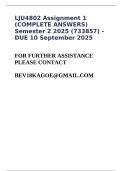
LJU4802 Assignment 1
(COMPLETE ANSWERS)
Semester 2 2025 (733857) -
DUE 10 September 2025
For assistance contact
Email:
, Question 1: Who brought the application that the respondent be struck off the roll?
The application to strike an attorney from the roll is typically brought by the Legal Practice
Council (LPC).
Question 2: Cite the legislation that currently regulates the attorney's profession in South
Africa.
The legislation that currently regulates the legal profession in South Africa is the Legal Practice
Act 28 of 2014.
Question 3: Explain why an attorney must have a Fidelity Fund certificate and practise
with a trust banking account.
An attorney must have a Fidelity Fund certificate and a trust banking account to protect the
public's money.
Trust Banking Account: Attorneys hold money on behalf of clients (e.g., for property
transfers, litigation costs). A separate trust account ensures this money is kept completely
separate from the attorney's personal or business funds. This prevents the commingling of
funds and makes it easier to trace and audit client money.
Fidelity Fund Certificate: This certificate confirms that the attorney is a registered
member of the Legal Practitioners' Fidelity Fund (LPFF). The LPFF acts as a financial
safeguard. If an attorney steals or misuses a client's money from the trust account, the
client can claim their loss from the fund, providing financial protection against attorney
theft or dishonesty.
Question 4: Describe the three-stage enquiry that a court applies to determine whether a
person is fit and proper to practise as an attorney.
A court uses a three-stage enquiry, as established in cases like Malan and Another v The Law
Society, Northern Provinces, to determine if a person is "fit and proper" to practice as an
attorney:
1. Stage 1: Factual Finding: The court must determine whether the alleged misconduct or
unprofessional conduct has been established on a balance of probabilities. The court
reviews the evidence to establish the facts of the case.
2. Stage 2: Factual and Value Judgment: The court must then decide whether the person
is, in light of the established facts, "fit and proper" to continue practicing. This is a mixed
(COMPLETE ANSWERS)
Semester 2 2025 (733857) -
DUE 10 September 2025
For assistance contact
Email:
, Question 1: Who brought the application that the respondent be struck off the roll?
The application to strike an attorney from the roll is typically brought by the Legal Practice
Council (LPC).
Question 2: Cite the legislation that currently regulates the attorney's profession in South
Africa.
The legislation that currently regulates the legal profession in South Africa is the Legal Practice
Act 28 of 2014.
Question 3: Explain why an attorney must have a Fidelity Fund certificate and practise
with a trust banking account.
An attorney must have a Fidelity Fund certificate and a trust banking account to protect the
public's money.
Trust Banking Account: Attorneys hold money on behalf of clients (e.g., for property
transfers, litigation costs). A separate trust account ensures this money is kept completely
separate from the attorney's personal or business funds. This prevents the commingling of
funds and makes it easier to trace and audit client money.
Fidelity Fund Certificate: This certificate confirms that the attorney is a registered
member of the Legal Practitioners' Fidelity Fund (LPFF). The LPFF acts as a financial
safeguard. If an attorney steals or misuses a client's money from the trust account, the
client can claim their loss from the fund, providing financial protection against attorney
theft or dishonesty.
Question 4: Describe the three-stage enquiry that a court applies to determine whether a
person is fit and proper to practise as an attorney.
A court uses a three-stage enquiry, as established in cases like Malan and Another v The Law
Society, Northern Provinces, to determine if a person is "fit and proper" to practice as an
attorney:
1. Stage 1: Factual Finding: The court must determine whether the alleged misconduct or
unprofessional conduct has been established on a balance of probabilities. The court
reviews the evidence to establish the facts of the case.
2. Stage 2: Factual and Value Judgment: The court must then decide whether the person
is, in light of the established facts, "fit and proper" to continue practicing. This is a mixed