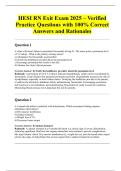
HESI RN Exit Exam 2025 – Verified
Practice Questions with 100% Correct
Answers and Rationales
Question 1
A client with heart failure is prescribed furosemide 40 mg IV. The nurse notes a potassium level
of 3.2 mEq/L. What is the priority nursing action?
a) Administer the furosemide as prescribed
b) Notify the healthcare provider about the potassium level
c) Encourage potassium-rich foods in the diet
d) Monitor the client’s blood pressure
Correct Answer: b) Notify the healthcare provider about the potassium level
Rationale: A potassium level of 3.2 mEq/L indicates hypokalemia, which can be exacerbated by
furosemide, a loop diuretic that promotes potassium excretion. Hypokalemia increases the risk of
dysrhythmias, especially in heart failure clients. Notifying the healthcare provider is the priority
to address the electrolyte imbalance before administering furosemide. Encouraging potassium-
rich foods (c) is not immediate, and administering furosemide (a) could worsen the condition.
Monitoring blood pressure (d) is important but not the priority.
Question 2
A 6-month-old infant is admitted with dehydration. Which assessment finding requires
immediate intervention?
a) Dry mucous membranes
b) Sunken fontanel
c) Weight loss of 5%
d) Decreased urine output
Correct Answer: b) Sunken fontanel
Rationale: A sunken fontanel in a 6-month-old infant is a critical sign of severe dehydration,
indicating significant fluid loss that requires immediate intervention to prevent complications
like hypovolemic shock. Dry mucous membranes (a), weight loss (c), and decreased urine output
(d) are also signs of dehydration but are less urgent than a sunken fontanel in an infant.
,Question 3
A client with type 1 diabetes mellitus reports nausea and abdominal pain. The blood glucose
level is 650 mg/dL. What is the nurse’s first action?
a) Administer insulin as prescribed
b) Check for ketone levels
c) Encourage oral fluid intake
d) Assess for signs of dehydration
Correct Answer: b) Check for ketone levels
Rationale: A blood glucose level of 650 mg/dL with nausea and abdominal pain suggests
possible diabetic ketoacidosis (DKA). Checking ketone levels (via urine or blood) is the priority
to confirm DKA, which requires urgent treatment. Administering insulin (a) may follow, but
confirming the diagnosis is critical. Encouraging fluids (c) or assessing dehydration (d) are
secondary actions.
Question 4
The nurse is teaching a client with chronic obstructive pulmonary disease (COPD) about pursed -
lip breathing. What is the primary purpose of this technique?
a) Increase oxygen saturation
b) Reduce carbon dioxide retention
c) Strengthen respiratory muscles
d) Prevent airway collapse
Correct Answer: b) Reduce carbon dioxide retention
Rationale: Pursed-lip breathing prolongs exhalation, helping to expel trapped carbon dioxide in
clients with COPD, improving gas exchange. While it may indirectly increase oxygen saturation
(a) or prevent airway collapse (d), its primary purpose is to reduce CO2 retention. It does not
directly strengthen respiratory muscles (c).
Question 5
A client is receiving heparin 18 units/kg/hour IV for a pulmonary embolism. The client weighs
80 kg, and the heparin solution is 25,000 units in 250 mL. What is the infusion rate in mL/hour?
a) 12 mL/hour
b) 14.4 mL/hour
c) 16 mL/hour
d) 18 mL/hour
, Correct Answer: b) 14.4 mL/hour
Rationale: Calculate the total dose: 18 units/kg/hour × 80 kg = 1,440 units/hour. The solution is
25,000 units in 250 mL, so the concentration is 100 units/mL (25,000 ÷ 250). Infusion rate =
1,440 units/hour ÷ 100 units/mL = 14.4 mL/hour.
Question 6
A nurse is caring for a client with a new colostomy. Which statement by the client indicates a
need for further teaching?
a) “I should avoid foods that cause gas, like beans.”
b) “I need to change the pouch every 3 to 7 days.”
c) “I can irrigate the colostomy to regulate bowel movements.”
d) “I should drink less water to reduce output.”
Correct Answer: d) “I should drink less water to reduce output.”
Rationale: Adequate hydration is essential for clients with a colostomy to prevent dehydration
and maintain healthy bowel function. Reducing water intake (d) is incorrect and requires further
teaching. The other statements reflect correct understanding of colostomy care.
Question 7
A client with schizophrenia is prescribed risperidone. Which side effect should the nurse monitor
for?
a) Hyperglycemia
b) Bradycardia
c) Hypothyroidism
d) Constipation
Correct Answer: a) Hyperglycemia
Rationale: Risperidone, an atypical antipsychotic, is associated with metabolic side effects,
including hyperglycemia, which can increase the risk of diabetes. Bradycardia (b),
hypothyroidism (c), and constipation (d) are less commonly associated with risperidone.
Question 8
A newborn is receiving phototherapy for hyperbilirubinemia. What is the nurse’s priority action?
a) Apply lotion to prevent skin dryness
b) Monitor the infant’s temperature
Practice Questions with 100% Correct
Answers and Rationales
Question 1
A client with heart failure is prescribed furosemide 40 mg IV. The nurse notes a potassium level
of 3.2 mEq/L. What is the priority nursing action?
a) Administer the furosemide as prescribed
b) Notify the healthcare provider about the potassium level
c) Encourage potassium-rich foods in the diet
d) Monitor the client’s blood pressure
Correct Answer: b) Notify the healthcare provider about the potassium level
Rationale: A potassium level of 3.2 mEq/L indicates hypokalemia, which can be exacerbated by
furosemide, a loop diuretic that promotes potassium excretion. Hypokalemia increases the risk of
dysrhythmias, especially in heart failure clients. Notifying the healthcare provider is the priority
to address the electrolyte imbalance before administering furosemide. Encouraging potassium-
rich foods (c) is not immediate, and administering furosemide (a) could worsen the condition.
Monitoring blood pressure (d) is important but not the priority.
Question 2
A 6-month-old infant is admitted with dehydration. Which assessment finding requires
immediate intervention?
a) Dry mucous membranes
b) Sunken fontanel
c) Weight loss of 5%
d) Decreased urine output
Correct Answer: b) Sunken fontanel
Rationale: A sunken fontanel in a 6-month-old infant is a critical sign of severe dehydration,
indicating significant fluid loss that requires immediate intervention to prevent complications
like hypovolemic shock. Dry mucous membranes (a), weight loss (c), and decreased urine output
(d) are also signs of dehydration but are less urgent than a sunken fontanel in an infant.
,Question 3
A client with type 1 diabetes mellitus reports nausea and abdominal pain. The blood glucose
level is 650 mg/dL. What is the nurse’s first action?
a) Administer insulin as prescribed
b) Check for ketone levels
c) Encourage oral fluid intake
d) Assess for signs of dehydration
Correct Answer: b) Check for ketone levels
Rationale: A blood glucose level of 650 mg/dL with nausea and abdominal pain suggests
possible diabetic ketoacidosis (DKA). Checking ketone levels (via urine or blood) is the priority
to confirm DKA, which requires urgent treatment. Administering insulin (a) may follow, but
confirming the diagnosis is critical. Encouraging fluids (c) or assessing dehydration (d) are
secondary actions.
Question 4
The nurse is teaching a client with chronic obstructive pulmonary disease (COPD) about pursed -
lip breathing. What is the primary purpose of this technique?
a) Increase oxygen saturation
b) Reduce carbon dioxide retention
c) Strengthen respiratory muscles
d) Prevent airway collapse
Correct Answer: b) Reduce carbon dioxide retention
Rationale: Pursed-lip breathing prolongs exhalation, helping to expel trapped carbon dioxide in
clients with COPD, improving gas exchange. While it may indirectly increase oxygen saturation
(a) or prevent airway collapse (d), its primary purpose is to reduce CO2 retention. It does not
directly strengthen respiratory muscles (c).
Question 5
A client is receiving heparin 18 units/kg/hour IV for a pulmonary embolism. The client weighs
80 kg, and the heparin solution is 25,000 units in 250 mL. What is the infusion rate in mL/hour?
a) 12 mL/hour
b) 14.4 mL/hour
c) 16 mL/hour
d) 18 mL/hour
, Correct Answer: b) 14.4 mL/hour
Rationale: Calculate the total dose: 18 units/kg/hour × 80 kg = 1,440 units/hour. The solution is
25,000 units in 250 mL, so the concentration is 100 units/mL (25,000 ÷ 250). Infusion rate =
1,440 units/hour ÷ 100 units/mL = 14.4 mL/hour.
Question 6
A nurse is caring for a client with a new colostomy. Which statement by the client indicates a
need for further teaching?
a) “I should avoid foods that cause gas, like beans.”
b) “I need to change the pouch every 3 to 7 days.”
c) “I can irrigate the colostomy to regulate bowel movements.”
d) “I should drink less water to reduce output.”
Correct Answer: d) “I should drink less water to reduce output.”
Rationale: Adequate hydration is essential for clients with a colostomy to prevent dehydration
and maintain healthy bowel function. Reducing water intake (d) is incorrect and requires further
teaching. The other statements reflect correct understanding of colostomy care.
Question 7
A client with schizophrenia is prescribed risperidone. Which side effect should the nurse monitor
for?
a) Hyperglycemia
b) Bradycardia
c) Hypothyroidism
d) Constipation
Correct Answer: a) Hyperglycemia
Rationale: Risperidone, an atypical antipsychotic, is associated with metabolic side effects,
including hyperglycemia, which can increase the risk of diabetes. Bradycardia (b),
hypothyroidism (c), and constipation (d) are less commonly associated with risperidone.
Question 8
A newborn is receiving phototherapy for hyperbilirubinemia. What is the nurse’s priority action?
a) Apply lotion to prevent skin dryness
b) Monitor the infant’s temperature