Chapter 5: Legal capacity of the parties
Protection Legal capacity
The ability of a natural person to enter into a valid legal transaction
Some people lack the necessary understanding, judgement or
experience to enter into juridical acts, including the ability to bind
themselves by contract
People with
Certain minors
mental disorders
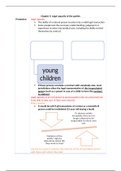
young
children
If these persons conclude a contract with somebody else, most
jurisdictions allow the legal representative of the incapacitated
person (such as a parent in case of a child) to have this contract
invalidated
Legal capacity as an instrument to protect parties who are presumed not
to be able to take care of their own interests
Policy reasons
It would be odd if all transactions of a minor or a mentally ill
person could be invalidated (15-year old buying a book)
To declare adults
incapable: they are no
longer allowed to be
responsible for their own
acts
Violation of the
adults' right to
determ ine which life
they want to lead
Law has to reason to balance the interests of the incapacitated person
with those with whom they deal
, In case of mentally ill persons, it is not always apparent to the
outside world that a party is not capable of making a rational
decision
Example
If Mac, on his weekly trip to the town close to the mental institution in
which he lives, buys a new car, it may not be clear to the local Mercedes
dealer that he is dealing with a patient suffering from a psychiatric
disorder.
Is the dealer’s reliance that Mac was perfectly able to form his own will
should prevail over the need to protect Mac against himself?
Objective reliance of a party: should this reliance be made
subordinate (less important) to the protection of the mentally
weak?
The extent to which minors and adults in need of protection are unable to
enter into valid transactions differs from one country to another
Generally
accepted that two
Every natural categories of
person has the persons
legal capacity to mentioned before
perform legal may lack legal
transactions (Art. capacity for their
1145 CC ex.) incapability of
rational decision-
making
Minors
English law All European jurisdictions set the age of legal capacity at 18 (it does
not mean that a transaction entered into by someone below that
age is necessarily invalid)
The contract of a minor is not binding upon him (the adult cannot
claim enforcement) Section 2 Minors’ contract Act
Each jurisdiction allows exceptions to this rule
English law
“Contract for necessaries”
Allows minors to validly enter into such contracts
Necessaries ‘goods suitable to the condition in life of the minor or
other person concerned and to his actual requirements at the time
of the sale and delivery’ Section 3 (3) of the Sale of Goods Act 1979
(not beyond a reasonable price)
Food, clothing, accommodation and anything else that minor
requires at the relevant certain point in time and that is reasonable
to acquire in view of his “condition in life”
Protection Legal capacity
The ability of a natural person to enter into a valid legal transaction
Some people lack the necessary understanding, judgement or
experience to enter into juridical acts, including the ability to bind
themselves by contract
People with
Certain minors
mental disorders
young
children
If these persons conclude a contract with somebody else, most
jurisdictions allow the legal representative of the incapacitated
person (such as a parent in case of a child) to have this contract
invalidated
Legal capacity as an instrument to protect parties who are presumed not
to be able to take care of their own interests
Policy reasons
It would be odd if all transactions of a minor or a mentally ill
person could be invalidated (15-year old buying a book)
To declare adults
incapable: they are no
longer allowed to be
responsible for their own
acts
Violation of the
adults' right to
determ ine which life
they want to lead
Law has to reason to balance the interests of the incapacitated person
with those with whom they deal
, In case of mentally ill persons, it is not always apparent to the
outside world that a party is not capable of making a rational
decision
Example
If Mac, on his weekly trip to the town close to the mental institution in
which he lives, buys a new car, it may not be clear to the local Mercedes
dealer that he is dealing with a patient suffering from a psychiatric
disorder.
Is the dealer’s reliance that Mac was perfectly able to form his own will
should prevail over the need to protect Mac against himself?
Objective reliance of a party: should this reliance be made
subordinate (less important) to the protection of the mentally
weak?
The extent to which minors and adults in need of protection are unable to
enter into valid transactions differs from one country to another
Generally
accepted that two
Every natural categories of
person has the persons
legal capacity to mentioned before
perform legal may lack legal
transactions (Art. capacity for their
1145 CC ex.) incapability of
rational decision-
making
Minors
English law All European jurisdictions set the age of legal capacity at 18 (it does
not mean that a transaction entered into by someone below that
age is necessarily invalid)
The contract of a minor is not binding upon him (the adult cannot
claim enforcement) Section 2 Minors’ contract Act
Each jurisdiction allows exceptions to this rule
English law
“Contract for necessaries”
Allows minors to validly enter into such contracts
Necessaries ‘goods suitable to the condition in life of the minor or
other person concerned and to his actual requirements at the time
of the sale and delivery’ Section 3 (3) of the Sale of Goods Act 1979
(not beyond a reasonable price)
Food, clothing, accommodation and anything else that minor
requires at the relevant certain point in time and that is reasonable
to acquire in view of his “condition in life”