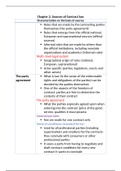
Chapter 2: Sources of Contract law
Characterization on the basis of sources
Rules that are made by the contrasting parties
themselves (the party agreement)
Rules that emerge from the official national,
European and supranational sources (official
sources)
Informal rules that are made by others than
the official institutions, including nonstate
organizations and academics (informal rules)
Multi- level legal system
Geographical origin of rules (national,
European, supranational)
Actor-specific (parties, legislators, courts and
other actors)
The party What is law (in the sense of the enforceable
agreement rights and obligations of the parties) can be
decided by the parties themselves
One of the aspects of the freedom of
contract: parties are free to determine the
contents of their contract
The party agreement
What the parties expressly agreed upon when
entering into the contract (price of the good,
service, qualities it must possess
Contractual rules
Not are made for one contract only
General conditions (standard forms)
Used by all professional parties (including
supermarkets and retailers) for the contracts
they conclude with consumers or other
professional parties
It saves a party from having to negotiate and
draft contract conditions for every new
contract it wants to conclude
, Legislators and courts have developed
mechanisms to avoid that the consumer is
confronted with general conditions that are
too one-sided (B2C)
Official Default rules
sources Rules that are automatically applicable if the
parties have not made any other
arrangements
They are applicable subject to agreement
otherwise and fill the gaps left open by the
parties
Mandatory rules
If parties would like to contract in a way that
is considered contrary to law, public policy or
good morals (ordering to kill someone)
Law may have to intervene with so-called
mandatory rules that such a contract void or
at least avoidable by one of the parties
Both facilitative and mandatory laws can flow from
the “official” national, European and supranational
sources
National law Official contract law at the national level is
primarily produced by the legislature and the courts
France (Civil Code)
Post-revolutionary focus on property (a right
“sacred” and “inviolable”) as the most
important right of the citizen
French Code lacked a general part on the law
of obligations
The French lawmaker sought to repair this
deficiency by revamping and renaming Titles
III and IV of Book III
The German and Dutch Code
Layered structure: the more general
provisions precede the more specific ones,
Characterization on the basis of sources
Rules that are made by the contrasting parties
themselves (the party agreement)
Rules that emerge from the official national,
European and supranational sources (official
sources)
Informal rules that are made by others than
the official institutions, including nonstate
organizations and academics (informal rules)
Multi- level legal system
Geographical origin of rules (national,
European, supranational)
Actor-specific (parties, legislators, courts and
other actors)
The party What is law (in the sense of the enforceable
agreement rights and obligations of the parties) can be
decided by the parties themselves
One of the aspects of the freedom of
contract: parties are free to determine the
contents of their contract
The party agreement
What the parties expressly agreed upon when
entering into the contract (price of the good,
service, qualities it must possess
Contractual rules
Not are made for one contract only
General conditions (standard forms)
Used by all professional parties (including
supermarkets and retailers) for the contracts
they conclude with consumers or other
professional parties
It saves a party from having to negotiate and
draft contract conditions for every new
contract it wants to conclude
, Legislators and courts have developed
mechanisms to avoid that the consumer is
confronted with general conditions that are
too one-sided (B2C)
Official Default rules
sources Rules that are automatically applicable if the
parties have not made any other
arrangements
They are applicable subject to agreement
otherwise and fill the gaps left open by the
parties
Mandatory rules
If parties would like to contract in a way that
is considered contrary to law, public policy or
good morals (ordering to kill someone)
Law may have to intervene with so-called
mandatory rules that such a contract void or
at least avoidable by one of the parties
Both facilitative and mandatory laws can flow from
the “official” national, European and supranational
sources
National law Official contract law at the national level is
primarily produced by the legislature and the courts
France (Civil Code)
Post-revolutionary focus on property (a right
“sacred” and “inviolable”) as the most
important right of the citizen
French Code lacked a general part on the law
of obligations
The French lawmaker sought to repair this
deficiency by revamping and renaming Titles
III and IV of Book III
The German and Dutch Code
Layered structure: the more general
provisions precede the more specific ones,