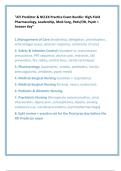
"ATI Predictor & NCLEX Practice Exam Bundle: High-Yield
Pharmacology, Leadership, Med-Surg, Peds/OB, Psych +
Answer Key"
1.Management of Care (leadership, delegation, prioritization,
ethical/legal issues, disaster response, continuity of care)
2. Safety & Infection Control (standard vs. transmission
precautions, PPE sequence, device care, restraints, fall
prevention, fire safety, central lines, sterile technique)
3. Pharmacology (autonomic, cardiac, antibiotics, insulin,
anticoagulants, antidotes, psych meds)
4. Medical-Surgical Nursing I (cardiac + respiratory).
5. Medical-Surgical Nursing II (renal, neuro, endocrine).
6. Pediatric & Obstetric Nursing.
7. Psychiatric Nursing (therapeutic communication, crisis
intervention, depression, schizophrenia, bipolar, anxiety,
substance use, suicide precautions, psychopharmacology)
8. light review + practice set for the final prep day before the
ATI Predictor exam
, 1. Leadership / Delegation – Multiple Choice
The charge nurse on a busy telemetry unit is making
assignments for the upcoming shift. Which client is MOST
appropriate for the unlicensed assistive personnel (UAP)?
A. 78-year-old admitted 2 h ago with new-onset atrial
fibrillation, receiving diltiazem 10 mg/h
B. 62-year-old 1 day post-percutaneous coronary
intervention, ambulating 100 ft with assistance
C. 54-year-old stable at 6 h post-cardiac catheterization,
lying flat, groin site dry
D. 49-year-old scheduled for discharge after coronary
artery bypass graft (CABG) 5 days ago
Metadata
Topic/Subtopic: Delegation — Stable vs. Unstable Patient
NCLEX Category: Management of Care → Assignment,
Delegation and Supervision
Cognitive Level: Application
Difficulty: 3
Learning Objective: Determine which client condition is stable
enough for UAP care.
Answer & Rationale
Correct Answer: C
Rationale: A client 6 h post-cath with a dry site and stable vitals
is predictable; basic positioning and toileting are within UAP
scope.
Distractor Analysis
,A – Continuous anti-arrhythmic infusion requires licensed
assessment.
B – Early ambulation after PCI still needs nurse evaluation for
chest pain or bleeding.
D – Discharge teaching and wound-checking require RN
judgment.
Test-Taking Tip: Ask “Is the condition stable, predictable, and
free from potential complications?”—if yes, consider UAP.
2. Leadership / Delegation – Select-All-That-Apply
The nurse is delegating morning care to a UAP on a
medical floor. Which tasks are appropriate to assign?
(Select all that apply.)
A. Record intake and output for a 72-year-old with heart
failure.
B. Perform a 12-lead ECG on a client scheduled for a stress
test.
C. Assist a 65-year-old to use a bedside commode 8 h post-
hip ORIF.
D. Check capillary refill on a 58-year-old with newly casted
forearm.
E. Obtain a clean-catch urine specimen from a 40-year-old
with diabetes.
Metadata
Topic/Subtopic: Delegation — Scope of UAP Practice
NCLEX Category: Management of Care → Assignment,
, Delegation and Supervision
Cognitive Level: Application
Difficulty: 3
Learning Objective: Identify tasks within UAP scope that do not
require nursing judgment.
Answer & Rationale
Correct Answer: A, C, E
Rationale: Measuring I&O, assisting with toileting, and
collecting routine specimens are stable, non-invasive tasks.
Distractor Analysis
B – ECG placement requires technical interpretation; licensed
personnel perform.
D – Neurovascular assessment requires licensed clinical
judgment.
Test-Taking Tip: If the task involves assessment, interpretation,
or potential complication, keep it with licensed staff.
3. Leadership / Delegation – Multiple Choice
During morning report, the night nurse tells the day charge
nurse, “I didn’t have time to give the 07:30 sliding-scale
insulin to four clients.” The day charge nurse has two RNs,
one LPN, and one UAP arriving. Which action should the
charge nurse take FIRST?
A. Ask the LPN to prepare and administer the insulins.
B. Obtain fresh blood glucose readings for each client
before insulin.
Pharmacology, Leadership, Med-Surg, Peds/OB, Psych +
Answer Key"
1.Management of Care (leadership, delegation, prioritization,
ethical/legal issues, disaster response, continuity of care)
2. Safety & Infection Control (standard vs. transmission
precautions, PPE sequence, device care, restraints, fall
prevention, fire safety, central lines, sterile technique)
3. Pharmacology (autonomic, cardiac, antibiotics, insulin,
anticoagulants, antidotes, psych meds)
4. Medical-Surgical Nursing I (cardiac + respiratory).
5. Medical-Surgical Nursing II (renal, neuro, endocrine).
6. Pediatric & Obstetric Nursing.
7. Psychiatric Nursing (therapeutic communication, crisis
intervention, depression, schizophrenia, bipolar, anxiety,
substance use, suicide precautions, psychopharmacology)
8. light review + practice set for the final prep day before the
ATI Predictor exam
, 1. Leadership / Delegation – Multiple Choice
The charge nurse on a busy telemetry unit is making
assignments for the upcoming shift. Which client is MOST
appropriate for the unlicensed assistive personnel (UAP)?
A. 78-year-old admitted 2 h ago with new-onset atrial
fibrillation, receiving diltiazem 10 mg/h
B. 62-year-old 1 day post-percutaneous coronary
intervention, ambulating 100 ft with assistance
C. 54-year-old stable at 6 h post-cardiac catheterization,
lying flat, groin site dry
D. 49-year-old scheduled for discharge after coronary
artery bypass graft (CABG) 5 days ago
Metadata
Topic/Subtopic: Delegation — Stable vs. Unstable Patient
NCLEX Category: Management of Care → Assignment,
Delegation and Supervision
Cognitive Level: Application
Difficulty: 3
Learning Objective: Determine which client condition is stable
enough for UAP care.
Answer & Rationale
Correct Answer: C
Rationale: A client 6 h post-cath with a dry site and stable vitals
is predictable; basic positioning and toileting are within UAP
scope.
Distractor Analysis
,A – Continuous anti-arrhythmic infusion requires licensed
assessment.
B – Early ambulation after PCI still needs nurse evaluation for
chest pain or bleeding.
D – Discharge teaching and wound-checking require RN
judgment.
Test-Taking Tip: Ask “Is the condition stable, predictable, and
free from potential complications?”—if yes, consider UAP.
2. Leadership / Delegation – Select-All-That-Apply
The nurse is delegating morning care to a UAP on a
medical floor. Which tasks are appropriate to assign?
(Select all that apply.)
A. Record intake and output for a 72-year-old with heart
failure.
B. Perform a 12-lead ECG on a client scheduled for a stress
test.
C. Assist a 65-year-old to use a bedside commode 8 h post-
hip ORIF.
D. Check capillary refill on a 58-year-old with newly casted
forearm.
E. Obtain a clean-catch urine specimen from a 40-year-old
with diabetes.
Metadata
Topic/Subtopic: Delegation — Scope of UAP Practice
NCLEX Category: Management of Care → Assignment,
, Delegation and Supervision
Cognitive Level: Application
Difficulty: 3
Learning Objective: Identify tasks within UAP scope that do not
require nursing judgment.
Answer & Rationale
Correct Answer: A, C, E
Rationale: Measuring I&O, assisting with toileting, and
collecting routine specimens are stable, non-invasive tasks.
Distractor Analysis
B – ECG placement requires technical interpretation; licensed
personnel perform.
D – Neurovascular assessment requires licensed clinical
judgment.
Test-Taking Tip: If the task involves assessment, interpretation,
or potential complication, keep it with licensed staff.
3. Leadership / Delegation – Multiple Choice
During morning report, the night nurse tells the day charge
nurse, “I didn’t have time to give the 07:30 sliding-scale
insulin to four clients.” The day charge nurse has two RNs,
one LPN, and one UAP arriving. Which action should the
charge nurse take FIRST?
A. Ask the LPN to prepare and administer the insulins.
B. Obtain fresh blood glucose readings for each client
before insulin.