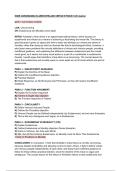
HOW CONVINCING IS ARISTOTELIAN VIRTUE ETHICS? (25 marks)
(pink = out of spec content)
LOA: Unconvincing
CR: Eudaimonia and Morality come Apart
INTRO: Aristotle’s virtue ethics is an agent-based ethical theory, which focuses on
eudaimonia and virtues as a means of achieving a flourishing and moral life. This theory is
good because it gives us space and time to learn and develop our virtues and sense of
morality, rather than being as strict as theories like Kant’s deontological ethics. However, it
also faces many problems like circular definitions of virtues and virtuous people, providing
insufficient guidance, and explaining the difference between eudaimonia and the overall
moral good, as it seems not every moral action is a part of or contributes to eudaimonia.
Overall, I would argue that Aristotle’s virtue ethics is unconvincing. The crucial reason for
this is that eudaimonia and morality seem to come apart as not all moral actions are part of
eudaimonia.
PARA 1 - INSUFFICIENT GUIDANCE:
P) Explain the Doctrine of the Mean
A) Outline the Insufficient Guidance objection
C) Practical Wisdom
E) Weak Response, as Not Everyone has Phronesis, so they still receive Insufficient
Guidance.
PARA 2 - FUNCTION ARGUMENT
P) Explain the Function Argument
A) Hume’s Is Ought Gap objection
E) The Function Argument is Flawed
PARA 3 - CIRCULARITY:
P) Define Virtuous Acts and People
A) Outline the Circularity objection
C) Virtuous People can be Defined Independently (by Eudaimonia), and we have Examples
E) This is still very Ambiguous and Vague, so is Eudaimonia
PARA 4 - EUDAIMONIA VS MORALITY (CR):
P) Explain Eudaimonia
A) Outline Eudaimonia vs Morality objection (Nurse Example)
C) Nurse is Virtuous, her Acts were Moral
E) Still, she did Not Achieve Eudaimonia, so Morality must be More Than Eudaimonia
+ Kant on Prudence vs Morality
CONCLUSION: In conclusion, I think that Aristotle’s virtue theory is not fully convincing,
because despite its flexibility and allowing us time to learn virtues, it fails to define virtues
and virtuous people independently of each other, and doesn't give sufficient guidance to
follow for those without practical wisdom, since the doctrine of the mean is vague and
ambiguous. The crucial reason for the failure of Aristotle’s theory is that eudaimonia and
(pink = out of spec content)
LOA: Unconvincing
CR: Eudaimonia and Morality come Apart
INTRO: Aristotle’s virtue ethics is an agent-based ethical theory, which focuses on
eudaimonia and virtues as a means of achieving a flourishing and moral life. This theory is
good because it gives us space and time to learn and develop our virtues and sense of
morality, rather than being as strict as theories like Kant’s deontological ethics. However, it
also faces many problems like circular definitions of virtues and virtuous people, providing
insufficient guidance, and explaining the difference between eudaimonia and the overall
moral good, as it seems not every moral action is a part of or contributes to eudaimonia.
Overall, I would argue that Aristotle’s virtue ethics is unconvincing. The crucial reason for
this is that eudaimonia and morality seem to come apart as not all moral actions are part of
eudaimonia.
PARA 1 - INSUFFICIENT GUIDANCE:
P) Explain the Doctrine of the Mean
A) Outline the Insufficient Guidance objection
C) Practical Wisdom
E) Weak Response, as Not Everyone has Phronesis, so they still receive Insufficient
Guidance.
PARA 2 - FUNCTION ARGUMENT
P) Explain the Function Argument
A) Hume’s Is Ought Gap objection
E) The Function Argument is Flawed
PARA 3 - CIRCULARITY:
P) Define Virtuous Acts and People
A) Outline the Circularity objection
C) Virtuous People can be Defined Independently (by Eudaimonia), and we have Examples
E) This is still very Ambiguous and Vague, so is Eudaimonia
PARA 4 - EUDAIMONIA VS MORALITY (CR):
P) Explain Eudaimonia
A) Outline Eudaimonia vs Morality objection (Nurse Example)
C) Nurse is Virtuous, her Acts were Moral
E) Still, she did Not Achieve Eudaimonia, so Morality must be More Than Eudaimonia
+ Kant on Prudence vs Morality
CONCLUSION: In conclusion, I think that Aristotle’s virtue theory is not fully convincing,
because despite its flexibility and allowing us time to learn virtues, it fails to define virtues
and virtuous people independently of each other, and doesn't give sufficient guidance to
follow for those without practical wisdom, since the doctrine of the mean is vague and
ambiguous. The crucial reason for the failure of Aristotle’s theory is that eudaimonia and