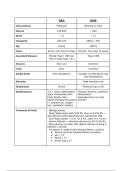
DKA HHS
Urine Ketones Profound Minimal or none
Glucose 250-600 > 600
HCO3 < 15 > 15
Osmolarity 300-325 Often > 350
Age young elderly
Onset Acute; over hours to days Chronic: over days to weeks
Associated Diseases Mostly Type 1 DM, but Type 2 DM
seen in both Type 1 & 2
Seizures Very rare Common
Coma Rare Common
Insulin levels Very low/Absent Enough so body doesn’t go
into ketoacidosis
Mortality High mortality rate
Dehydration Severe Profound (up to 9L)
Manifestations 3 p’s, classic dehydration Osmotic diuresis, profound
signs, flushed/dry skin, dehydration,
fruity breath odor, hyperglycemia, no urine
hyperventilation/Kussmau ketones
l’s, altered LOC, weight
loss, metabolic acidosis
Treatment for Both: - Manage airway
- Fluid replacement with 0.9% NS, then to 0.45% NS →
add dextrose when blood glucose approaches 200
- Give fluids slowly → ½ in 1st 8 hrs, other ½ in 16 hrs
- Insulin Infusion → decrease glucose by 50-75/dL/hr,
- Once glucose is under 200, adjust infusion to keep it
between 150-200.
- Transition to SubQ Insulin therapy (Meet 2 criteria):
● Ketosis must be resolved before transition
● pH > 7.3
● HCO3 > 15
● Anion Gap < 12
, Treatment for Acidosis (DKA):
● Assess respiratory compensation & LOC
● Usually corrected by fluids & insulin (draw labs beforehand)
● Bicarbonate infusion only if pH is less than 7.0
○ Stop bicarb infusion once level reaches 7.1
Patient Teaching:
● Insulin/medication management
● Blood glucose monitoring (Not wiping the first drop of blood away can give a
falsely low blood sugar, resulting in not proper insulin tx)
● Sick day management
● Hypoglycemia prevention, recognition, & tx
● Basic meal planning
● Referral to diabetes self-management education program for follow-up
Urine Ketones Profound Minimal or none
Glucose 250-600 > 600
HCO3 < 15 > 15
Osmolarity 300-325 Often > 350
Age young elderly
Onset Acute; over hours to days Chronic: over days to weeks
Associated Diseases Mostly Type 1 DM, but Type 2 DM
seen in both Type 1 & 2
Seizures Very rare Common
Coma Rare Common
Insulin levels Very low/Absent Enough so body doesn’t go
into ketoacidosis
Mortality High mortality rate
Dehydration Severe Profound (up to 9L)
Manifestations 3 p’s, classic dehydration Osmotic diuresis, profound
signs, flushed/dry skin, dehydration,
fruity breath odor, hyperglycemia, no urine
hyperventilation/Kussmau ketones
l’s, altered LOC, weight
loss, metabolic acidosis
Treatment for Both: - Manage airway
- Fluid replacement with 0.9% NS, then to 0.45% NS →
add dextrose when blood glucose approaches 200
- Give fluids slowly → ½ in 1st 8 hrs, other ½ in 16 hrs
- Insulin Infusion → decrease glucose by 50-75/dL/hr,
- Once glucose is under 200, adjust infusion to keep it
between 150-200.
- Transition to SubQ Insulin therapy (Meet 2 criteria):
● Ketosis must be resolved before transition
● pH > 7.3
● HCO3 > 15
● Anion Gap < 12
, Treatment for Acidosis (DKA):
● Assess respiratory compensation & LOC
● Usually corrected by fluids & insulin (draw labs beforehand)
● Bicarbonate infusion only if pH is less than 7.0
○ Stop bicarb infusion once level reaches 7.1
Patient Teaching:
● Insulin/medication management
● Blood glucose monitoring (Not wiping the first drop of blood away can give a
falsely low blood sugar, resulting in not proper insulin tx)
● Sick day management
● Hypoglycemia prevention, recognition, & tx
● Basic meal planning
● Referral to diabetes self-management education program for follow-up