
AQA Psychology Revision – Topic Summary Jacobs 1887 + Miller 1956: STM capacity
Paper 1 – Memory - Participants given a series of words or digits
and instructed to recall, series progressively
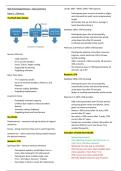
The Multi-Store Model:
longer
- Remember lists up to 9 items, average 7,
lower boundary being 5
Baddeley 1966: STM encoding
- Participants given lists of acoustically,
semantically similar and dissimilar words,
write down lists after 20 seconds
- Confused acoustically similar words
Peterson and Peterson 1959: STM duration
- Participants asked to remember nonsense
Sensory Memory trigrams, count back from 100 in threes,
- Large capacity tested recalling
- 0.5-2 second duration - After 3 seconds = 80% correctly, 18 seconds =
- Iconic, Echoic, Haptic coding 10% correctly
- Supported by Sperling - No rehearsal stays in STM approximately 18
- Forgetting unknown seconds, up to 30
Short Term Store Research: LTM
- 7+/-2 capacity, Jacobs Baddeley 1966: LTM encoding
- Up to 30 seconds duration, Peterson, and - Participants given lists of acoustically,
Peterson semantically similar and dissimilar words,
- Acoustic coding, Baddeley write down lists after 20 minutes
- Forgetting displacement - Better at recalling semantically similar words
Long Term Store Bahrick et al 1975: LTM duration
- Potentially unlimited capacity - High school graduates over 50-year period,
- Limitless but subject to decay duration, one group given names and photos, other
Bahrick given no names and photos
- Semantic coding, Baddeley - Names = 90% correct after 14 years, 60%
- Forgetting decay and interference correct after 47 years
Key Words: - No names = 60% correct after 7 years, 20%
correct after 47 years
Displacement – memories taking the place of original - People can remember certain information for
memories almost a lifetime, but it can decay if not
Decay – losing memories that aren’t used frequently recalled frequently
Interference – other memories being recalled instead Evaluation of Multi-Store Model:
the desired memory - Supporting research
Research: STM - Clive Wearing amnesia, had long term, no
short term, therefore separate
Sperling 1960 – Sensory memory existence - Rehearsal not only way to remember
- STM not just one store, dual modality tasks
- Participants asked to recall letters from a
show capacity is more than 7+/-2
chart, after looking for 50 milliseconds
- LTM not just one store, patient HM
- Participants then recalled single rows
- Not fully explain processes just structure
- First = 4/5 letters, Second = 3 letters
- Item fades in time to recall, 50 milliseconds
Paper 1 – Memory - Participants given a series of words or digits
and instructed to recall, series progressively
The Multi-Store Model:
longer
- Remember lists up to 9 items, average 7,
lower boundary being 5
Baddeley 1966: STM encoding
- Participants given lists of acoustically,
semantically similar and dissimilar words,
write down lists after 20 seconds
- Confused acoustically similar words
Peterson and Peterson 1959: STM duration
- Participants asked to remember nonsense
Sensory Memory trigrams, count back from 100 in threes,
- Large capacity tested recalling
- 0.5-2 second duration - After 3 seconds = 80% correctly, 18 seconds =
- Iconic, Echoic, Haptic coding 10% correctly
- Supported by Sperling - No rehearsal stays in STM approximately 18
- Forgetting unknown seconds, up to 30
Short Term Store Research: LTM
- 7+/-2 capacity, Jacobs Baddeley 1966: LTM encoding
- Up to 30 seconds duration, Peterson, and - Participants given lists of acoustically,
Peterson semantically similar and dissimilar words,
- Acoustic coding, Baddeley write down lists after 20 minutes
- Forgetting displacement - Better at recalling semantically similar words
Long Term Store Bahrick et al 1975: LTM duration
- Potentially unlimited capacity - High school graduates over 50-year period,
- Limitless but subject to decay duration, one group given names and photos, other
Bahrick given no names and photos
- Semantic coding, Baddeley - Names = 90% correct after 14 years, 60%
- Forgetting decay and interference correct after 47 years
Key Words: - No names = 60% correct after 7 years, 20%
correct after 47 years
Displacement – memories taking the place of original - People can remember certain information for
memories almost a lifetime, but it can decay if not
Decay – losing memories that aren’t used frequently recalled frequently
Interference – other memories being recalled instead Evaluation of Multi-Store Model:
the desired memory - Supporting research
Research: STM - Clive Wearing amnesia, had long term, no
short term, therefore separate
Sperling 1960 – Sensory memory existence - Rehearsal not only way to remember
- STM not just one store, dual modality tasks
- Participants asked to recall letters from a
show capacity is more than 7+/-2
chart, after looking for 50 milliseconds
- LTM not just one store, patient HM
- Participants then recalled single rows
- Not fully explain processes just structure
- First = 4/5 letters, Second = 3 letters
- Item fades in time to recall, 50 milliseconds


