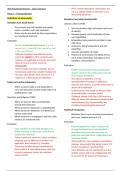
AQA Psychology Revision – Topic Summary - FFA is context dependant, abnormal to not
eat, E.g. hunger strikes in prisoners is not
Paper 1 – Psychopathology necessarily abnormal
Definitions of abnormality: Deviation from Ideal Mental Health
Deviation from Social Norms Jahoda’s criteria (1958)
- Every society has both implicit and explicit 1. Self-actualisation: high self-esteem and sense
norms, unwritten rules and standards of identity
- Those who do not abide by these expectations 2. Personal growth: self-actualisation of their
are considered abnormal own capabilities
Evaluation 3. Integration: being resistant and able to cope
with stress
- Allows for developmental norms, E.g. it is 4. Autonomy: being independent and self-
normal for a 1-year-old to be carried but not regulating
a fifty-year-old man 5. Accurate perception of reality
- Different countries have different norms, 6. Mastery of environment: the ability to love,
cannot be applied to other countries and work, hold relationships and adjust to new
cultures, not applicable to transfer our social situations, solve problems
ideas of normal to other countries,
ethnocentric Evaluation
- Norms change over time, outdated, E.g. be - Holistic, looks at both mental and physical
homosexual used to be considered abnormal aspects, observes the whole person not just
- Not clear who decides what norms are, is it their singular behaviours
majority or a select group of individuals - The criteria is subjective, it is not
Failure to Function Adequately operationalised meaning it is difficult to
measure and observe, a person could easily lie
- Refers to abnormality as not being able to about self-actualisation
carry out behaviours society would expect E.g. - Culture bound, only based on Western ideas
holding down a job of mental health, culturally relative
Rosenhan and Seligman (1989) - Outdated, Jahoda 1958 (the 1950s had very
different views and outlooks on mental health
- When an observer feels uncomfortable and treatments E.g. homosexuality was
around their behaviour considered psychologically abnormal)
- When someone’s behaviour is unpredictable
- When someone’s behaviour is irrational and Statistical Infrequency
hard to understand - Behaviour that is rare/uncommon/anomalous,
- When someone is maladaptive, and their daily bell curve, bottom and top 2.5.%
routines are interfered with
Evaluation
Evaluation
- Practical application, used to measure IQ
- Clear checklist of observable behaviour to through looking at how many standard
define someone as abnormal, could also be deviations away from the mean they are
used by the individual - Objective, operationalised, standardised and
- Cultural relativism, what one culture considers therefore reliable
adequate may be different to another, not - Abnormality has more negative connotations,
applicable, discriminates E.g. travellers whereas ‘abnormality’ like being in top 2.5.%
- There may be other factors contributing to for IQ is considered a positive thing
abnormality E.g. not holding down a job may - Some disorders are not statistically rare, E.g.
be due to economic factors an individual anxiety, using a bell curve undiagnosed, fails
cannot control to account for all ‘abnormal’ behaviours
, Phobias: Behavioural Approach account for this, being born with phobias,
inheriting them
- Irrational and persistent fear, disproportional
- Ignores cognitive aspects to phobias, E.g. the
to the actual danger posed by the stimuli
irrational thoughts surrounding them, these
Characteristics may play an important role and may be an
important part of the process in cause or
- Emotional: fear, anxiety, panic treatment
- Cognitive: irrational thoughts, recognising the
irrationality, recognising their fear is excessive, Treatments
selective attention (when near phobia that is
Systematic desensitisation
all they think about)
- Behavioural: Avoidance, freezing, failure to - Slow, gradual, multiple sessions
function - Counterconditioning: associating the stimuli
with relaxation instead of fear
Explanations
1. Construct an anxiety hierarchy with therapist
- Mower (1947), two-way model process, 2. Patient is taught relaxation techniques such as
combination of classical and operant meditation or breathing exercises
conditioning 3. Works through anxiety hierarchy, once relaxed
move onto next step
Classical conditioning 4. Once all steps are complete, phobia is cured
- Phobia is learned through association of two Flooding
unrelated stimuli
- Before – UCS = UCR, NS = NR - Fast, exposed to worst fear immediately
- During – UCS + NS = UCS - Belief that anxiety is finite, it will eventually
- After – CS (NS) = CS run out and they will no longer feel fear
- Belief that anxiety and relaxation cannot be
Operant conditioning flet at the same time as one another they will
- Phobia is maintained through negative relax around stimuli
reinforcement - Breaks their classical conditioning and will
- Avoiding the phobia, removes fear (negative) learn their association with fear is unrealistic
and encourages to repeat this behaviour Evaluation
(reinforces)
- Systematic desensitisation is very effective.
Research: Watson and Rayner (1920) McGarth et al (1990) found it worked for 95%
- Little Albert, 9-month-old, no reactions to of patients, suitable for most people and
stimuli (including white rat, rabbit, monkey) treating most phobias
- Did react to hammer hitting steel bar, cried - These treatments focus on the root cause of
- At 11 months hammer hit at same time shown the phobia as opposed to biological
white rat, repeated 7 times over 7 weeks approaches such as drugs, they only lower
- Eventually only shown white rat and cried anxiety levels, and not ideal to keep taking
everyday
Evaluation - Teaches patient skills they may use in later
- Behaviourist approach links to some very situations, such as relaxation techniques, they
successful treatments, counterconditioning could work through other phobias
using systematic desensitisation, if the themselves, do not require a specialist unlike
treatment works the explanation behind it suing biological approach and drugs
must be accurate - Systematic desensitisation takes time,
- Support from Little Albert expensive, not everyone can afford multiple
- Ignores biological and evolution-based sessions or may become impatient if they
phobias, innate phobias derived from our cannot climb hierarchy, drop out, high
environments, this explanation does not attrition rate
eat, E.g. hunger strikes in prisoners is not
Paper 1 – Psychopathology necessarily abnormal
Definitions of abnormality: Deviation from Ideal Mental Health
Deviation from Social Norms Jahoda’s criteria (1958)
- Every society has both implicit and explicit 1. Self-actualisation: high self-esteem and sense
norms, unwritten rules and standards of identity
- Those who do not abide by these expectations 2. Personal growth: self-actualisation of their
are considered abnormal own capabilities
Evaluation 3. Integration: being resistant and able to cope
with stress
- Allows for developmental norms, E.g. it is 4. Autonomy: being independent and self-
normal for a 1-year-old to be carried but not regulating
a fifty-year-old man 5. Accurate perception of reality
- Different countries have different norms, 6. Mastery of environment: the ability to love,
cannot be applied to other countries and work, hold relationships and adjust to new
cultures, not applicable to transfer our social situations, solve problems
ideas of normal to other countries,
ethnocentric Evaluation
- Norms change over time, outdated, E.g. be - Holistic, looks at both mental and physical
homosexual used to be considered abnormal aspects, observes the whole person not just
- Not clear who decides what norms are, is it their singular behaviours
majority or a select group of individuals - The criteria is subjective, it is not
Failure to Function Adequately operationalised meaning it is difficult to
measure and observe, a person could easily lie
- Refers to abnormality as not being able to about self-actualisation
carry out behaviours society would expect E.g. - Culture bound, only based on Western ideas
holding down a job of mental health, culturally relative
Rosenhan and Seligman (1989) - Outdated, Jahoda 1958 (the 1950s had very
different views and outlooks on mental health
- When an observer feels uncomfortable and treatments E.g. homosexuality was
around their behaviour considered psychologically abnormal)
- When someone’s behaviour is unpredictable
- When someone’s behaviour is irrational and Statistical Infrequency
hard to understand - Behaviour that is rare/uncommon/anomalous,
- When someone is maladaptive, and their daily bell curve, bottom and top 2.5.%
routines are interfered with
Evaluation
Evaluation
- Practical application, used to measure IQ
- Clear checklist of observable behaviour to through looking at how many standard
define someone as abnormal, could also be deviations away from the mean they are
used by the individual - Objective, operationalised, standardised and
- Cultural relativism, what one culture considers therefore reliable
adequate may be different to another, not - Abnormality has more negative connotations,
applicable, discriminates E.g. travellers whereas ‘abnormality’ like being in top 2.5.%
- There may be other factors contributing to for IQ is considered a positive thing
abnormality E.g. not holding down a job may - Some disorders are not statistically rare, E.g.
be due to economic factors an individual anxiety, using a bell curve undiagnosed, fails
cannot control to account for all ‘abnormal’ behaviours
, Phobias: Behavioural Approach account for this, being born with phobias,
inheriting them
- Irrational and persistent fear, disproportional
- Ignores cognitive aspects to phobias, E.g. the
to the actual danger posed by the stimuli
irrational thoughts surrounding them, these
Characteristics may play an important role and may be an
important part of the process in cause or
- Emotional: fear, anxiety, panic treatment
- Cognitive: irrational thoughts, recognising the
irrationality, recognising their fear is excessive, Treatments
selective attention (when near phobia that is
Systematic desensitisation
all they think about)
- Behavioural: Avoidance, freezing, failure to - Slow, gradual, multiple sessions
function - Counterconditioning: associating the stimuli
with relaxation instead of fear
Explanations
1. Construct an anxiety hierarchy with therapist
- Mower (1947), two-way model process, 2. Patient is taught relaxation techniques such as
combination of classical and operant meditation or breathing exercises
conditioning 3. Works through anxiety hierarchy, once relaxed
move onto next step
Classical conditioning 4. Once all steps are complete, phobia is cured
- Phobia is learned through association of two Flooding
unrelated stimuli
- Before – UCS = UCR, NS = NR - Fast, exposed to worst fear immediately
- During – UCS + NS = UCS - Belief that anxiety is finite, it will eventually
- After – CS (NS) = CS run out and they will no longer feel fear
- Belief that anxiety and relaxation cannot be
Operant conditioning flet at the same time as one another they will
- Phobia is maintained through negative relax around stimuli
reinforcement - Breaks their classical conditioning and will
- Avoiding the phobia, removes fear (negative) learn their association with fear is unrealistic
and encourages to repeat this behaviour Evaluation
(reinforces)
- Systematic desensitisation is very effective.
Research: Watson and Rayner (1920) McGarth et al (1990) found it worked for 95%
- Little Albert, 9-month-old, no reactions to of patients, suitable for most people and
stimuli (including white rat, rabbit, monkey) treating most phobias
- Did react to hammer hitting steel bar, cried - These treatments focus on the root cause of
- At 11 months hammer hit at same time shown the phobia as opposed to biological
white rat, repeated 7 times over 7 weeks approaches such as drugs, they only lower
- Eventually only shown white rat and cried anxiety levels, and not ideal to keep taking
everyday
Evaluation - Teaches patient skills they may use in later
- Behaviourist approach links to some very situations, such as relaxation techniques, they
successful treatments, counterconditioning could work through other phobias
using systematic desensitisation, if the themselves, do not require a specialist unlike
treatment works the explanation behind it suing biological approach and drugs
must be accurate - Systematic desensitisation takes time,
- Support from Little Albert expensive, not everyone can afford multiple
- Ignores biological and evolution-based sessions or may become impatient if they
phobias, innate phobias derived from our cannot climb hierarchy, drop out, high
environments, this explanation does not attrition rate