4PAHPDEV Psychology and Development Week 7
BSc Psychology Year 1 Cognitive Development: Language
COGNITIVE DEVELOPMENT: LANGUAGE
UNDERSTAND AND APPLY KEY THEORIES OF LANGUAGE
ACQUISITION
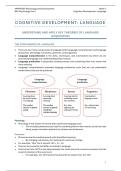
THE COMPONENTS OF LANGUAGE
• There are four main components of language within language comprehension and language
production: phonology, semantics, grammar, and pragmatics
• Language comprehension is the skills, techniques, and mechanisms by which we are
processing language and understanding what it means
• Language production is physically creating sounds and combining them into words that
have meaning
• Language comprehension precedes language production such that we can understand
words before they can be produced
Phonology
• Phonology is the system of sounds that a particular language uses
o This includes phonemes and rules for combining them to form words, as well as rules
about proper intonation patterns for phrases and sentences
Phonemes
• Phonemes are the smallest sound units that affect meaning
o By changing a phoneme, the meaning of a word can change
• For example, ‘ship’ has 3 sounds: /sh/ + /i/ + /p/
• They are not universal and differ according to language
• Voice onset time (VOT) is the delay between the initial sound of a voiced consonant and the
onset of vibration of the vocal cord
o For example, ‘pa’ VOT tends to be about 50 ms slower than ‘ba’ VOT
1
,4PAHPDEV Psychology and Development Week 7
BSc Psychology Year 1 Cognitive Development: Language
Semantics
• The study of word meaning and word combinations, including knowledge of specific words
and their definitions, and how these can be combined into phrases and sentences
• As children mature intellectually, their semantic knowledge continues to grow
Grammar
• The structure of a language that includes morphology and syntax
Morphology
• Focuses on the smallest units of language that has meaning, such as prefixes, suffixes and
root words—morphemes
o For example, ‘ship’ would be one morpheme since the phonemes /sh/, /i/ and /p/ do
not have meaning on their own
• A languages morphological system includes rules for altering roots words to produce things
such as plurals, past tenses, or inflections
Syntax
• Specifies how words are combined into sentences
o Each language has syntactic rules for expressing grammatical relations (e.g.
negation, interrogation, possession and the arrangement of a subject and object)
Pragmatics
• Consists of rules for the use of language in particular contexts (Bates, 1999), important in
effective and appropriate communication
o For example, saying ‘Please may I have a crayon’ rather than ‘Give me a crayon’ in a
school environment
THEORETICAL PERSPECTIVES ON LANGUAGE DEVELOPMENT
2
, 4PAHPDEV Psychology and Development Week 7
BSc Psychology Year 1 Cognitive Development: Language
The Nativist View (Stance A)
• Suggests that language acquisition is a result of biological prosperities of a human
Language Acquisition Device (LAD)
• Chomsky (1968) proposed that children are born with an innate mental structure that guides
their acquisition of language
o The LAD is a structure in the human nervous system, which incorporates innate
concepts of language and guides language acquisition, particularly grammar
• Since these are inherited species-specific characteristics, all languages of a special must
show universal features
o This has been shown such as by the fact that all languages create a vast number of
spoken words by combining the smallest number of vocal sounds possible and that
all languages have grammar (Slobin, 1985, 1992)
Poverty of the Stimulus
• Argues that our language learning and LAD is flexible enough to learn any language, even with
imperfect input and minimal feedback
o This links to the idea of poverty of the stimulus where the input that a child often
receives is not well structured and speech is littered with errors
o This does not often reflect the exact language that the child ends up speaking
Critical Period
• This is the age range at which specific experiences are vital for development to occur in a
typical way
• The critical period for language development is from infancy to puberty
o This supports a biological component to learning a language
• During this time, language learning is easier, and after puberty, it becomes significantly
harder to learn a first language
o For example, Genie was locked in a room from 18 months old and she never acquired
normal language (Curtiss, 1989; Rymer, 1993)
Second Language Acquisition (SLA)
• People who learn a second language in childhood (not bilingual) tend to sound similar to
native speakers of the second language
o However, this isn’t the same for those who learn the second language later
• Hartshorne et al. (2018) looked at 669,498 native and non-native English speakers , looking
at their SLA age and English grammar
o They found that the critical period for SLA was from infancy to around 17 years old
o This was broader than originally stated as it extended past puberty, but supports
Chomsky’s LAD that we need input during the critical period for language to develop
Criticisms
• Language learning is a gradual process and not completed as early as predicted by nativists
• The perspective makes it difficult to account for the many languages used around the world
o Since languages have been able to produce such different grammatical structures
and sound combinations, this contradicts the idea of universal features
• Research has shown that social influences play a much larger role than this view suggests
(Nelson, 2007)
• Studies in this approach often use case studies which are hard to generalise from
3
BSc Psychology Year 1 Cognitive Development: Language
COGNITIVE DEVELOPMENT: LANGUAGE
UNDERSTAND AND APPLY KEY THEORIES OF LANGUAGE
ACQUISITION
THE COMPONENTS OF LANGUAGE
• There are four main components of language within language comprehension and language
production: phonology, semantics, grammar, and pragmatics
• Language comprehension is the skills, techniques, and mechanisms by which we are
processing language and understanding what it means
• Language production is physically creating sounds and combining them into words that
have meaning
• Language comprehension precedes language production such that we can understand
words before they can be produced
Phonology
• Phonology is the system of sounds that a particular language uses
o This includes phonemes and rules for combining them to form words, as well as rules
about proper intonation patterns for phrases and sentences
Phonemes
• Phonemes are the smallest sound units that affect meaning
o By changing a phoneme, the meaning of a word can change
• For example, ‘ship’ has 3 sounds: /sh/ + /i/ + /p/
• They are not universal and differ according to language
• Voice onset time (VOT) is the delay between the initial sound of a voiced consonant and the
onset of vibration of the vocal cord
o For example, ‘pa’ VOT tends to be about 50 ms slower than ‘ba’ VOT
1
,4PAHPDEV Psychology and Development Week 7
BSc Psychology Year 1 Cognitive Development: Language
Semantics
• The study of word meaning and word combinations, including knowledge of specific words
and their definitions, and how these can be combined into phrases and sentences
• As children mature intellectually, their semantic knowledge continues to grow
Grammar
• The structure of a language that includes morphology and syntax
Morphology
• Focuses on the smallest units of language that has meaning, such as prefixes, suffixes and
root words—morphemes
o For example, ‘ship’ would be one morpheme since the phonemes /sh/, /i/ and /p/ do
not have meaning on their own
• A languages morphological system includes rules for altering roots words to produce things
such as plurals, past tenses, or inflections
Syntax
• Specifies how words are combined into sentences
o Each language has syntactic rules for expressing grammatical relations (e.g.
negation, interrogation, possession and the arrangement of a subject and object)
Pragmatics
• Consists of rules for the use of language in particular contexts (Bates, 1999), important in
effective and appropriate communication
o For example, saying ‘Please may I have a crayon’ rather than ‘Give me a crayon’ in a
school environment
THEORETICAL PERSPECTIVES ON LANGUAGE DEVELOPMENT
2
, 4PAHPDEV Psychology and Development Week 7
BSc Psychology Year 1 Cognitive Development: Language
The Nativist View (Stance A)
• Suggests that language acquisition is a result of biological prosperities of a human
Language Acquisition Device (LAD)
• Chomsky (1968) proposed that children are born with an innate mental structure that guides
their acquisition of language
o The LAD is a structure in the human nervous system, which incorporates innate
concepts of language and guides language acquisition, particularly grammar
• Since these are inherited species-specific characteristics, all languages of a special must
show universal features
o This has been shown such as by the fact that all languages create a vast number of
spoken words by combining the smallest number of vocal sounds possible and that
all languages have grammar (Slobin, 1985, 1992)
Poverty of the Stimulus
• Argues that our language learning and LAD is flexible enough to learn any language, even with
imperfect input and minimal feedback
o This links to the idea of poverty of the stimulus where the input that a child often
receives is not well structured and speech is littered with errors
o This does not often reflect the exact language that the child ends up speaking
Critical Period
• This is the age range at which specific experiences are vital for development to occur in a
typical way
• The critical period for language development is from infancy to puberty
o This supports a biological component to learning a language
• During this time, language learning is easier, and after puberty, it becomes significantly
harder to learn a first language
o For example, Genie was locked in a room from 18 months old and she never acquired
normal language (Curtiss, 1989; Rymer, 1993)
Second Language Acquisition (SLA)
• People who learn a second language in childhood (not bilingual) tend to sound similar to
native speakers of the second language
o However, this isn’t the same for those who learn the second language later
• Hartshorne et al. (2018) looked at 669,498 native and non-native English speakers , looking
at their SLA age and English grammar
o They found that the critical period for SLA was from infancy to around 17 years old
o This was broader than originally stated as it extended past puberty, but supports
Chomsky’s LAD that we need input during the critical period for language to develop
Criticisms
• Language learning is a gradual process and not completed as early as predicted by nativists
• The perspective makes it difficult to account for the many languages used around the world
o Since languages have been able to produce such different grammatical structures
and sound combinations, this contradicts the idea of universal features
• Research has shown that social influences play a much larger role than this view suggests
(Nelson, 2007)
• Studies in this approach often use case studies which are hard to generalise from
3