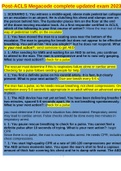
EPA 608 Type II Sample Test Questions well
answered already passed
1. Before charging a new system with refrigerant, what
Pressurize with
should be done?
nitrogen (classified as
an inert gas) and leak
2. Which refrigerant can be used for leak detection as a
R-22
trace gas and pressurized
with nitrogen?
3. What tools can you use to find general area of leaks
c. Electronic or
and pinpoint leaks?
ultrasonic leak
a. Soap bubbles.
detector will provide
b. Look for oil residue
the general area of
c. Electronic or ultrasonic leak detector will provide the
the leak
general area of
the leak
d. Refrigerant dye
4. Traces of oil around a sight glass inlet fitting of a refrig- a. A leak
eration system might
be the indication of:
a. A leak
b. Excessive oil in the system
c. An overcharge
d. A restriction at the TXV
5. Describe ways you can visually look for leaks. d. All the above
a. Using soap bubbles
b. Looking for traces of oil
c. Excessive superheat, caused by low refrigerant
charge
d. All the above
,EPA 608 Type II Sample Test Questions well
answered already passed
6.
, EPA 608 Type II Sample Test Questions well
answered already passed
Type II classification, as identified by EPA, applies to d. Split air conditioning
what equipment? equipment with five (5)
a. Small appliances with five (5) pounds of refrigerant pounds of
or less refrigerant or more
b. Refrigerators, freezers, and vending machine appli-
ances
c. Low pressure appliances
d. Split air conditioning equipment with five (5) pounds
of refrigerant
or more
7. What are the leak repair requirements for c. a and b
comfort cooling appliances and commercial
Appliances con- taining 50 lbs. or more of
refrigerant?
a. Must be repaired if leak rate exceeds 15% in
comfort cooling appliances.
b. Must be repaired if leak rate exceeds 35% in all
commercial and industrial
process refrigeration\
c. a and b
d. None of the above
8. What type of refrigerant was the most common before b. R-22
outlawing CFCs and
HCFCs?
a. R-12
b. R-22
c. R-500
d. R-134A
answered already passed
1. Before charging a new system with refrigerant, what
Pressurize with
should be done?
nitrogen (classified as
an inert gas) and leak
2. Which refrigerant can be used for leak detection as a
R-22
trace gas and pressurized
with nitrogen?
3. What tools can you use to find general area of leaks
c. Electronic or
and pinpoint leaks?
ultrasonic leak
a. Soap bubbles.
detector will provide
b. Look for oil residue
the general area of
c. Electronic or ultrasonic leak detector will provide the
the leak
general area of
the leak
d. Refrigerant dye
4. Traces of oil around a sight glass inlet fitting of a refrig- a. A leak
eration system might
be the indication of:
a. A leak
b. Excessive oil in the system
c. An overcharge
d. A restriction at the TXV
5. Describe ways you can visually look for leaks. d. All the above
a. Using soap bubbles
b. Looking for traces of oil
c. Excessive superheat, caused by low refrigerant
charge
d. All the above
,EPA 608 Type II Sample Test Questions well
answered already passed
6.
, EPA 608 Type II Sample Test Questions well
answered already passed
Type II classification, as identified by EPA, applies to d. Split air conditioning
what equipment? equipment with five (5)
a. Small appliances with five (5) pounds of refrigerant pounds of
or less refrigerant or more
b. Refrigerators, freezers, and vending machine appli-
ances
c. Low pressure appliances
d. Split air conditioning equipment with five (5) pounds
of refrigerant
or more
7. What are the leak repair requirements for c. a and b
comfort cooling appliances and commercial
Appliances con- taining 50 lbs. or more of
refrigerant?
a. Must be repaired if leak rate exceeds 15% in
comfort cooling appliances.
b. Must be repaired if leak rate exceeds 35% in all
commercial and industrial
process refrigeration\
c. a and b
d. None of the above
8. What type of refrigerant was the most common before b. R-22
outlawing CFCs and
HCFCs?
a. R-12
b. R-22
c. R-500
d. R-134A