NR 503-MIDTERM EXAM | QUESTIONS AND ANSWERS | VERIFIED
ANSWERS (100% CORRECT) | LATEST EXAM UPDATE
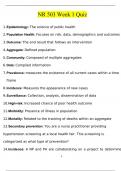
Epidemiology - CORECT ANSWER- Science of public health.
Study of disease within populations & risk factors.
Risk factors are genetic, environmental, social, cultural, or on some direct action
by the individual.
Servers to find the "why" of a disease & then to analyze the disease screening,
treatment, prevention, and monitoring.
population health - CORECT ANSWER- focuses on risk, data, demographics,
and outcomes
Outcomes - CORECT ANSWER- End result that follows an intervention
Aggregate - CORECT ANSWER- defined population
Community - CORECT ANSWER- Multiple aggregates
Data - CORECT ANSWER- Compiled information
,Prevalence - CORECT ANSWER- Existence of a disease.
Number of all cases of the disease
Incidence - CORECT ANSWER- Measures appearance of a disease over a period
of time.
Surveillance - CORECT ANSWER- Collection, analysis, and dissemination of
data.
High-risk - CORECT ANSWER- An increased chance of poor health outcomes
Morbidity - CORECT ANSWER- Presence of illness in a population
Mortality - CORECT ANSWER- Tracking deaths in an aggregate
Vital statistics - CORECT ANSWER- statistics on live births, deaths, fetal deaths,
marriages and divorces
Cases - CORECT ANSWER- Criterion used to make decisions whether the
patient has a disease or health event
Social Justice - CORECT ANSWER- The view that everyone deserves equal
economic, political and social rights and opportunities-including the right to good
health
,Inter-professional collaboration - CORECT ANSWER- Collaborative action
oriented toward a common goal of improving quality & safety of patient care.
Involves responsibility, accountability, coordination, communication, cooperation,
assertiveness, mutual respect, and autonomy.
HP2020 - CORECT ANSWER- 4 goals:
1) attain high-quality lives preventable disease
2) achieve health equity, eliminate disparities, improve health of all groups
3) create social and physical environments that promote good health.
4) promote quality of life, healthy development, and health
Determinants of Care - CORECT ANSWER- Range of personal, social,
economic, and environmental factors that influence health status
Risk Analysis - CORECT ANSWER- Characterization of the potential adverse
health effects of human exposures to environmental hazards
health disparities - CORECT ANSWER- Differences of health statuses between
various populations.
Sensitivity - CORECT ANSWER- Measures the proportion of actual positives
that are correctly identified as such (e.g., % of sick people who are correctly
identified as having the condition)
Specificity - CORECT ANSWER- True negative rate
, Measures actual negatives that are correctly identified as such (e.g., % of healthy
people who are correctly ID's as not having the condition)
Positive Predictive Value (PPV) - CORECT ANSWER- Probability that subjects
with a positive screening test truly have the disease
Epidemiological triangle - CORECT ANSWER- Triad with an external agent,
host, and an environment that cause the disease.
Environmental factors and genetics play a role.
Disease transmitted directly or indirectly.
Outright symptoms or subclinical disease.
Confounding Variable - CORECT ANSWER- Extra variable not accounted for
and can ruin the experiment.
Can introduce bias.
Study methods - CORECT ANSWER- Descriptive.
Analytic.
Experimental.
ANSWERS (100% CORRECT) | LATEST EXAM UPDATE
Epidemiology - CORECT ANSWER- Science of public health.
Study of disease within populations & risk factors.
Risk factors are genetic, environmental, social, cultural, or on some direct action
by the individual.
Servers to find the "why" of a disease & then to analyze the disease screening,
treatment, prevention, and monitoring.
population health - CORECT ANSWER- focuses on risk, data, demographics,
and outcomes
Outcomes - CORECT ANSWER- End result that follows an intervention
Aggregate - CORECT ANSWER- defined population
Community - CORECT ANSWER- Multiple aggregates
Data - CORECT ANSWER- Compiled information
,Prevalence - CORECT ANSWER- Existence of a disease.
Number of all cases of the disease
Incidence - CORECT ANSWER- Measures appearance of a disease over a period
of time.
Surveillance - CORECT ANSWER- Collection, analysis, and dissemination of
data.
High-risk - CORECT ANSWER- An increased chance of poor health outcomes
Morbidity - CORECT ANSWER- Presence of illness in a population
Mortality - CORECT ANSWER- Tracking deaths in an aggregate
Vital statistics - CORECT ANSWER- statistics on live births, deaths, fetal deaths,
marriages and divorces
Cases - CORECT ANSWER- Criterion used to make decisions whether the
patient has a disease or health event
Social Justice - CORECT ANSWER- The view that everyone deserves equal
economic, political and social rights and opportunities-including the right to good
health
,Inter-professional collaboration - CORECT ANSWER- Collaborative action
oriented toward a common goal of improving quality & safety of patient care.
Involves responsibility, accountability, coordination, communication, cooperation,
assertiveness, mutual respect, and autonomy.
HP2020 - CORECT ANSWER- 4 goals:
1) attain high-quality lives preventable disease
2) achieve health equity, eliminate disparities, improve health of all groups
3) create social and physical environments that promote good health.
4) promote quality of life, healthy development, and health
Determinants of Care - CORECT ANSWER- Range of personal, social,
economic, and environmental factors that influence health status
Risk Analysis - CORECT ANSWER- Characterization of the potential adverse
health effects of human exposures to environmental hazards
health disparities - CORECT ANSWER- Differences of health statuses between
various populations.
Sensitivity - CORECT ANSWER- Measures the proportion of actual positives
that are correctly identified as such (e.g., % of sick people who are correctly
identified as having the condition)
Specificity - CORECT ANSWER- True negative rate
, Measures actual negatives that are correctly identified as such (e.g., % of healthy
people who are correctly ID's as not having the condition)
Positive Predictive Value (PPV) - CORECT ANSWER- Probability that subjects
with a positive screening test truly have the disease
Epidemiological triangle - CORECT ANSWER- Triad with an external agent,
host, and an environment that cause the disease.
Environmental factors and genetics play a role.
Disease transmitted directly or indirectly.
Outright symptoms or subclinical disease.
Confounding Variable - CORECT ANSWER- Extra variable not accounted for
and can ruin the experiment.
Can introduce bias.
Study methods - CORECT ANSWER- Descriptive.
Analytic.
Experimental.