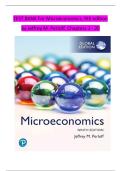
TEST BANK For Microeconomics, 9th edition
by Jeffrey M. Perloff, Chapters 1 - 20
,Table of contents
1. Introduction
2. Supply and Demand
3. Applying the Supply-and-Demand Model
4. Consumer Choice
5. Applying Consumer Theory
6. Firms and Production
7. Costs
8. Competitive Firms and Markets
9. Applying the Competitive Model
10. General Equilibrium and Economic Welfare
11. Monopoly
12. Pricing and Advertising
13. Oligopoly and Monopolistic Competition
14. Game Theory
15. Factor Markets
16. Interest Rates, Investments, and Capital Markets
17. Uncertainty
18. Externalities, Open-Access, and Public Goods
19. Asymmetric Information
20. Contracts and Moral Hazards
,Chapter 1 Introduction
1.1 Microeconomics: The Allocation of Scarce Resources
1) Microeconomics studies the allocation of
A) decision makers.
B) scarce resources.
C) models.
D) unlimited resources.
ANSWER: B
Section: The Allocation of Scarce Resources
Question Status: Old
AACSB: Analytic thinking
2) Microeconomics is often called
A) price theory.
B) decision science.
C) scarcity.
D) resource theory.
ANSWER: A
Section: The Allocation of Scarce Resources
Question Status: Old
AACSB: Analytic thinking
3) Most microeconomic models assume that decision makers wish to
A) make themselves as well off as possible.
B) act selfishly.
C) make others as well off as possible.
D) None of the above.
ANSWER: A
Section: The Allocation of Scarce Resources
Question Status: Old
AACSB: Analytic thinking
4) Society faces trade- ‑offs because of
A) government regulations.
B) profit motive.
C) faceless bureaucrats.
D) scarcity.
ANSWER: D
Section: The Allocation of Scarce Resources
, Question Status: Old
AACSB: Analytic thinking
5) A market
A) always involves the personal exchange of goods for money.
B) allows interactions between consumers and firms.
C) always takes place at a physical location.
D) has no influence on prices.
ANSWER: B
Section: The Allocation of Scarce Resources
Question Status: Old
AACSB: Analytic thinking
6) What links the decisions of consumers and firms in a market?
A) the government
B) prices
C) coordination officials
D) microeconomics
ANSWER: B
Section: The Allocation of Scarce Resources
Question Status: Old
AACSB: Analytic thinking
7) The price of a good is
A) always equal to the cost of producing the good.
B) never affected by the number of buyers and sellers.
C) usually determined in a market.
D) None of the above.
ANSWER: C
Section: The Allocation of Scarce Resources
Question Status: Old
AACSB: Analytic thinking
8) Who or what is responsible for bringing together scarce resources to produce most of thegoods
and services in the U.S.?
A) the U.S. government
B) the United Nations
C) the Federal Reserve Bank
D) markets and prices
by Jeffrey M. Perloff, Chapters 1 - 20
,Table of contents
1. Introduction
2. Supply and Demand
3. Applying the Supply-and-Demand Model
4. Consumer Choice
5. Applying Consumer Theory
6. Firms and Production
7. Costs
8. Competitive Firms and Markets
9. Applying the Competitive Model
10. General Equilibrium and Economic Welfare
11. Monopoly
12. Pricing and Advertising
13. Oligopoly and Monopolistic Competition
14. Game Theory
15. Factor Markets
16. Interest Rates, Investments, and Capital Markets
17. Uncertainty
18. Externalities, Open-Access, and Public Goods
19. Asymmetric Information
20. Contracts and Moral Hazards
,Chapter 1 Introduction
1.1 Microeconomics: The Allocation of Scarce Resources
1) Microeconomics studies the allocation of
A) decision makers.
B) scarce resources.
C) models.
D) unlimited resources.
ANSWER: B
Section: The Allocation of Scarce Resources
Question Status: Old
AACSB: Analytic thinking
2) Microeconomics is often called
A) price theory.
B) decision science.
C) scarcity.
D) resource theory.
ANSWER: A
Section: The Allocation of Scarce Resources
Question Status: Old
AACSB: Analytic thinking
3) Most microeconomic models assume that decision makers wish to
A) make themselves as well off as possible.
B) act selfishly.
C) make others as well off as possible.
D) None of the above.
ANSWER: A
Section: The Allocation of Scarce Resources
Question Status: Old
AACSB: Analytic thinking
4) Society faces trade- ‑offs because of
A) government regulations.
B) profit motive.
C) faceless bureaucrats.
D) scarcity.
ANSWER: D
Section: The Allocation of Scarce Resources
, Question Status: Old
AACSB: Analytic thinking
5) A market
A) always involves the personal exchange of goods for money.
B) allows interactions between consumers and firms.
C) always takes place at a physical location.
D) has no influence on prices.
ANSWER: B
Section: The Allocation of Scarce Resources
Question Status: Old
AACSB: Analytic thinking
6) What links the decisions of consumers and firms in a market?
A) the government
B) prices
C) coordination officials
D) microeconomics
ANSWER: B
Section: The Allocation of Scarce Resources
Question Status: Old
AACSB: Analytic thinking
7) The price of a good is
A) always equal to the cost of producing the good.
B) never affected by the number of buyers and sellers.
C) usually determined in a market.
D) None of the above.
ANSWER: C
Section: The Allocation of Scarce Resources
Question Status: Old
AACSB: Analytic thinking
8) Who or what is responsible for bringing together scarce resources to produce most of thegoods
and services in the U.S.?
A) the U.S. government
B) the United Nations
C) the Federal Reserve Bank
D) markets and prices