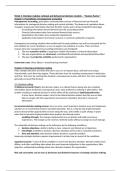
Week 1: Decision making; rational and behavioral decision models – ‘’Human Factor’’
Chapter 1: Foundations of management accounting
Management accounting: generation, communication and use of financial and non-financial
information for managerial decision making and control activities. The absence of regulation allows
managers to generate information that best fits their needs, and so bring competitive advantage.
- Accounting information derived directly form the accounting system
- Financial information taken from external financial data sources
- Quantitative information form production departments
- Qualitative information from human resource or customer satisfaction enquiries
Management accounting solutions that worked well for past problems may not be necessarily be the
best solution for current problems, so we can expect new solutions to evolve. There are three
reasons why new management accounting techniques are developed:
1. The way economic activity is organized; market information or internal information
2. The way organisations are structured; centralized/decentralized and specialized/diversified
3. The type of productive activities performed In organisations
Conversion costs: direct labour + manufacturing overhead
Chapter 2: Planning and decision making
More complex decisions are those that don’t occur on a frequent basis, and that have unique
characteristics each time they appear. These decisions have far reaching consequences in both place
and time. The more far reaching the decision’s consequences in place and time, the more uncertainty
generally surround the decision.
2.1: Decision making
Traditional economic theory: the decision maker as a rational human being who has complete
information about all decision consequences and a clear preference ordering of alternatives. This
enables reaching an optimal decision in which utility will be maximized; Optimizing behaviour
- In most cases, decision makers strive to be rational decision makers but they are not able
fully to comply with the requirements of economic rationality; they don’t oversee all
alternatives
Incremental decision making process: focus on a fey, most important, decision areas and implement
solutions in an incremental manner; bounded rationality. This is a step-by-step implementation
process that provides opportunities to learn along the way, and enables a quick change in plans
when the incremental implementation does produce the desired results.
- muddling through; The changes implemented are not drastic and build on previous
experiences. The change can be reserves relatively easily without causing too much damage.
The rationality of decision making can be influences by the following conditions:
decision objectives; ability to define a clear, coherent and limited set of objectives
knowledge; available to analyse a decision situation and to reach a reasoned conclusion
time and attention; that decision makers devote to a specific problem
Improving strategic decisions requires improvement in at least one or several of the conditions
organized anarchy: if none of these conditions is met in the decision situation. Decision makers have
diffuse, and often conflicting ideas about the most important objectives in the organisations; little
objective, undisputed knowledge about how decisions impacts the organisation.
Risk and uncertainty can be seen as dominant and distinctive features of strategic decision making!
,2.2: Decision making under risk and uncertainty
Uncertainty levels under different conditions appear to influence the decision maker’s utility function
and so also the decisions made.
Decision situations without risk and uncertainty
Cost-volume-profit (CVP) model: the basis for an intuitive understanding of the cost structure of the
firm and the impact of decision variables (sales/production volume, price, costs of inputs, revenues,
production technology and procurement decisions) on the profitability.
Deterministic model: the variables of this model van ex ante be estimated and the model
will generate point estimates of expected profits. With the contribution statement!
o contribution margin per unit: difference between the price and the variable costs
per unit; (p-v)
o contribution margin: multiply the contribution margin per unit by the total number
of products sold; (p-v)x
P= [ ( p−v ) x−f ] ( 1−t )
* P = after-tax profit
* p = selling price
* v = variable cost
* x = production volume (which we expect to be sold in the same period)
* f = fixed costs of the period
* t = tax rate; the 1-t terms determines what is left from profit once the taxes are paid
production volume: rework the basic CVP equation; it determines the level of products sold that is
needed to generate a required profit level P.
P
f+
( 1−t )
x=
( p−v )
Break-even point/quantity: number of products produced and sold at which the contribution margin
just covers the fixed costs, and so the profits are zero.
f
x be =
( p−v )
Determine selling price; when the capacity is established, and you know the required net income
P
f+
( 1−t )
( p−v )=
x
¿ ( p−v ) +v
Fixed costs vs. variable costs – committed costs vs. discretionary costs – direct costs vs. indirect costs
* Committed costs; fixed costs for the installed production capacity resources; plant
installations, buildings and equipment. The related cost are depreciation, interest payment
and property taxes. These costs are not avoidable or controllable in the short term.
* Discretionary costs: arise from specific decisions made during the planning period; costs for
marketing campaigns, advertisement, research and development, reorganizations,
unscheduled maintenance and factory support. These decisions don’t relate directly to the
activity levels, but are based on the informed judgement of experienced decision makers,
and can be influenced in the short term.
When you make a CVP analysis for the coming six months you would have to use a different
classification of fixed and variable costs than when you make the analysis for 5 years from now.
, Decision situations with uncertainty for some of the decision variables
Most of the variables in a CVP model are approximations of expected future conditions; the values of
these variables are influence by underlying distribution functions. This is useful when the company
has sufficient data available about past performance and when these historical data are still
representative for the decision situation.
Standard normal distribution: used to calculate probabilities for any normally distributed variable. A
variable’s distribution function can be defined by the mean and dispersion of the observations
around the mean; standard deviation.
Variance: indicator of risk, I presents the average squared differences between each year’s sales
number ant the mean sales numbers. The standard deviation is the square root of the variance!
n
∑ ( x i−x )2
i=1
variance=
n−1
Break-even; given the level of uncertainty, what is the probability to break even in the next year,
provided that the break-even sales number are x units. For this you have to bring the average sales
numbers to zero and the current standard deviation to one.
X −X
z=
s.d .
You have to use the z-table to find which value corresponds with the area under the normal distribution curve, and so find
de probability that a situation will occur.
Reconstructed probability: When reliable historical data are not available or not useful, distribution
functions could be reconstructed by asking decision makers about the lowest possible value, highest
possible value and expected most possible average. Based on these point estimates, a continuous
function could be fitted into the estimates and a mean and standard deviation could be estimated.
- The former of this probability is bounded; it has lowest and highest volume boundaries
Distribution in volume and price; the price and variable costs are uncertain.
Total contribution margin: TCM =quantity∗( price−variable costs)
Standard deviation of income before taxes: You can only use this equitation if yuk no all
other variables with certainty and if all prices are independent of each other.
2 2
var ( ax+ by )=a var ( x ) +b var ( y)
2 2 2 2 2 2
var ( TCM )= price ∗s . d . price + price ∗s . d . material price + price ∗s . d . labor wages
Due to the multiple sources of uncertainty that have a compounding effect on TCM, the standard
deviation will get larger.
Consider both volume and price uncertain (two normally distributed variables) will generate a
variable that does not have a normal distribution! Options to do in this case
- fix one variable first and the analyse the influence of uncertainty on the second variable.
- Monte Carlo simulations for each of the decision variables (chapter 4)
In order to have reliable data on variation which are relevant for the decision problem, processes
need to be repetitive and they should not have undergone major restructuring or innovation. In
practice this is almost never the case! An alternative may be to ask local managers or specialist to
reconstruct expected variation by estimating different expected outcomes under different
conditions; adverse, normal and optimal conditions
Chapter 1: Foundations of management accounting
Management accounting: generation, communication and use of financial and non-financial
information for managerial decision making and control activities. The absence of regulation allows
managers to generate information that best fits their needs, and so bring competitive advantage.
- Accounting information derived directly form the accounting system
- Financial information taken from external financial data sources
- Quantitative information form production departments
- Qualitative information from human resource or customer satisfaction enquiries
Management accounting solutions that worked well for past problems may not be necessarily be the
best solution for current problems, so we can expect new solutions to evolve. There are three
reasons why new management accounting techniques are developed:
1. The way economic activity is organized; market information or internal information
2. The way organisations are structured; centralized/decentralized and specialized/diversified
3. The type of productive activities performed In organisations
Conversion costs: direct labour + manufacturing overhead
Chapter 2: Planning and decision making
More complex decisions are those that don’t occur on a frequent basis, and that have unique
characteristics each time they appear. These decisions have far reaching consequences in both place
and time. The more far reaching the decision’s consequences in place and time, the more uncertainty
generally surround the decision.
2.1: Decision making
Traditional economic theory: the decision maker as a rational human being who has complete
information about all decision consequences and a clear preference ordering of alternatives. This
enables reaching an optimal decision in which utility will be maximized; Optimizing behaviour
- In most cases, decision makers strive to be rational decision makers but they are not able
fully to comply with the requirements of economic rationality; they don’t oversee all
alternatives
Incremental decision making process: focus on a fey, most important, decision areas and implement
solutions in an incremental manner; bounded rationality. This is a step-by-step implementation
process that provides opportunities to learn along the way, and enables a quick change in plans
when the incremental implementation does produce the desired results.
- muddling through; The changes implemented are not drastic and build on previous
experiences. The change can be reserves relatively easily without causing too much damage.
The rationality of decision making can be influences by the following conditions:
decision objectives; ability to define a clear, coherent and limited set of objectives
knowledge; available to analyse a decision situation and to reach a reasoned conclusion
time and attention; that decision makers devote to a specific problem
Improving strategic decisions requires improvement in at least one or several of the conditions
organized anarchy: if none of these conditions is met in the decision situation. Decision makers have
diffuse, and often conflicting ideas about the most important objectives in the organisations; little
objective, undisputed knowledge about how decisions impacts the organisation.
Risk and uncertainty can be seen as dominant and distinctive features of strategic decision making!
,2.2: Decision making under risk and uncertainty
Uncertainty levels under different conditions appear to influence the decision maker’s utility function
and so also the decisions made.
Decision situations without risk and uncertainty
Cost-volume-profit (CVP) model: the basis for an intuitive understanding of the cost structure of the
firm and the impact of decision variables (sales/production volume, price, costs of inputs, revenues,
production technology and procurement decisions) on the profitability.
Deterministic model: the variables of this model van ex ante be estimated and the model
will generate point estimates of expected profits. With the contribution statement!
o contribution margin per unit: difference between the price and the variable costs
per unit; (p-v)
o contribution margin: multiply the contribution margin per unit by the total number
of products sold; (p-v)x
P= [ ( p−v ) x−f ] ( 1−t )
* P = after-tax profit
* p = selling price
* v = variable cost
* x = production volume (which we expect to be sold in the same period)
* f = fixed costs of the period
* t = tax rate; the 1-t terms determines what is left from profit once the taxes are paid
production volume: rework the basic CVP equation; it determines the level of products sold that is
needed to generate a required profit level P.
P
f+
( 1−t )
x=
( p−v )
Break-even point/quantity: number of products produced and sold at which the contribution margin
just covers the fixed costs, and so the profits are zero.
f
x be =
( p−v )
Determine selling price; when the capacity is established, and you know the required net income
P
f+
( 1−t )
( p−v )=
x
¿ ( p−v ) +v
Fixed costs vs. variable costs – committed costs vs. discretionary costs – direct costs vs. indirect costs
* Committed costs; fixed costs for the installed production capacity resources; plant
installations, buildings and equipment. The related cost are depreciation, interest payment
and property taxes. These costs are not avoidable or controllable in the short term.
* Discretionary costs: arise from specific decisions made during the planning period; costs for
marketing campaigns, advertisement, research and development, reorganizations,
unscheduled maintenance and factory support. These decisions don’t relate directly to the
activity levels, but are based on the informed judgement of experienced decision makers,
and can be influenced in the short term.
When you make a CVP analysis for the coming six months you would have to use a different
classification of fixed and variable costs than when you make the analysis for 5 years from now.
, Decision situations with uncertainty for some of the decision variables
Most of the variables in a CVP model are approximations of expected future conditions; the values of
these variables are influence by underlying distribution functions. This is useful when the company
has sufficient data available about past performance and when these historical data are still
representative for the decision situation.
Standard normal distribution: used to calculate probabilities for any normally distributed variable. A
variable’s distribution function can be defined by the mean and dispersion of the observations
around the mean; standard deviation.
Variance: indicator of risk, I presents the average squared differences between each year’s sales
number ant the mean sales numbers. The standard deviation is the square root of the variance!
n
∑ ( x i−x )2
i=1
variance=
n−1
Break-even; given the level of uncertainty, what is the probability to break even in the next year,
provided that the break-even sales number are x units. For this you have to bring the average sales
numbers to zero and the current standard deviation to one.
X −X
z=
s.d .
You have to use the z-table to find which value corresponds with the area under the normal distribution curve, and so find
de probability that a situation will occur.
Reconstructed probability: When reliable historical data are not available or not useful, distribution
functions could be reconstructed by asking decision makers about the lowest possible value, highest
possible value and expected most possible average. Based on these point estimates, a continuous
function could be fitted into the estimates and a mean and standard deviation could be estimated.
- The former of this probability is bounded; it has lowest and highest volume boundaries
Distribution in volume and price; the price and variable costs are uncertain.
Total contribution margin: TCM =quantity∗( price−variable costs)
Standard deviation of income before taxes: You can only use this equitation if yuk no all
other variables with certainty and if all prices are independent of each other.
2 2
var ( ax+ by )=a var ( x ) +b var ( y)
2 2 2 2 2 2
var ( TCM )= price ∗s . d . price + price ∗s . d . material price + price ∗s . d . labor wages
Due to the multiple sources of uncertainty that have a compounding effect on TCM, the standard
deviation will get larger.
Consider both volume and price uncertain (two normally distributed variables) will generate a
variable that does not have a normal distribution! Options to do in this case
- fix one variable first and the analyse the influence of uncertainty on the second variable.
- Monte Carlo simulations for each of the decision variables (chapter 4)
In order to have reliable data on variation which are relevant for the decision problem, processes
need to be repetitive and they should not have undergone major restructuring or innovation. In
practice this is almost never the case! An alternative may be to ask local managers or specialist to
reconstruct expected variation by estimating different expected outcomes under different
conditions; adverse, normal and optimal conditions