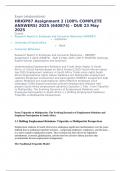
HES4810 Assignment 3
(100% COMPLETE
ANSWERS) 2025 - Due 5
September 2025
NO PLAGIARISM
[Pick the date]
[Type the company name]
, Exam (elaborations)
HES4810 Assignment 3 (100% COMPLETE
ANSWERS) 2025 - Due 5 September 2025
Course
Impact Mitigation and Management (HES4810)
Institution
University Of South Africa
Book
Handbook of Social Impact Assessment and Management
Impact Mitigation and Management - HES4810 Assignment 3 2025 (831851)
- Due 5 September 2025; 100 % TRUSTED workings, Expert Solved,
Explanations and Solutions.
QUESTION 1 [20] HES4810 “Impact Mitigation and Management” is rooted in
the process of Environmental Impact Assessment (EIA) that aims to protect
the environment by ensuring that projects are undertaken in a way that will
not compromise water quality. During this month of August, the world will be
celebrating Water Week on August 24-28, 2025. However, water pollution
has been an ongoing issue in South Africa that requires effective application
of relevant legislation and policies to ensure water security and accessibility
of clean water for all. Bearing this issue in mind, answer the following
questions regarding water quality. 1.1. Specify the legislation and specific
sections governing water quality in South Africa or that of the country where
you live. (2) 1.2 1.3 1.4 Briefly describe 10 activities or actions by
development that may cause water pollution or deterioration of water
quality. What legal mechanisms does the above legislation use to prevent
water pollution? Discuss three (3) methods that are used by municipalities to
clean sewage water to improve water quality to drinkable standards.
1.1 Legislation Governing Water Quality in South Africa
The primary legislation governing water quality in South Africa is the National Water Act 36 of
1998 (NWA). This act aims to ensure that the nation's water resources are protected, used,
developed, conserved, managed, and controlled in a sustainable and equitable manner. A key
section of the NWA related to water pollution is Section 19, which establishes a "duty of care"
for anyone who owns, controls, or occupies land where an activity is causing or is likely to cause
water pollution. This section legally obligates them to take all reasonable measures to prevent
such pollution. Another important piece of legislation is the Water Services Act 108 of 1997,
which focuses on the provision of water services and sanitation. The National Environmental
Management Act 107 of 1998 (NEMA) also plays a crucial role by providing an overarching
framework for environmental management, including provisions on pollution and environmental
degradation.
(100% COMPLETE
ANSWERS) 2025 - Due 5
September 2025
NO PLAGIARISM
[Pick the date]
[Type the company name]
, Exam (elaborations)
HES4810 Assignment 3 (100% COMPLETE
ANSWERS) 2025 - Due 5 September 2025
Course
Impact Mitigation and Management (HES4810)
Institution
University Of South Africa
Book
Handbook of Social Impact Assessment and Management
Impact Mitigation and Management - HES4810 Assignment 3 2025 (831851)
- Due 5 September 2025; 100 % TRUSTED workings, Expert Solved,
Explanations and Solutions.
QUESTION 1 [20] HES4810 “Impact Mitigation and Management” is rooted in
the process of Environmental Impact Assessment (EIA) that aims to protect
the environment by ensuring that projects are undertaken in a way that will
not compromise water quality. During this month of August, the world will be
celebrating Water Week on August 24-28, 2025. However, water pollution
has been an ongoing issue in South Africa that requires effective application
of relevant legislation and policies to ensure water security and accessibility
of clean water for all. Bearing this issue in mind, answer the following
questions regarding water quality. 1.1. Specify the legislation and specific
sections governing water quality in South Africa or that of the country where
you live. (2) 1.2 1.3 1.4 Briefly describe 10 activities or actions by
development that may cause water pollution or deterioration of water
quality. What legal mechanisms does the above legislation use to prevent
water pollution? Discuss three (3) methods that are used by municipalities to
clean sewage water to improve water quality to drinkable standards.
1.1 Legislation Governing Water Quality in South Africa
The primary legislation governing water quality in South Africa is the National Water Act 36 of
1998 (NWA). This act aims to ensure that the nation's water resources are protected, used,
developed, conserved, managed, and controlled in a sustainable and equitable manner. A key
section of the NWA related to water pollution is Section 19, which establishes a "duty of care"
for anyone who owns, controls, or occupies land where an activity is causing or is likely to cause
water pollution. This section legally obligates them to take all reasonable measures to prevent
such pollution. Another important piece of legislation is the Water Services Act 108 of 1997,
which focuses on the provision of water services and sanitation. The National Environmental
Management Act 107 of 1998 (NEMA) also plays a crucial role by providing an overarching
framework for environmental management, including provisions on pollution and environmental
degradation.