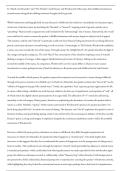
In “Death of a Naturalist” and “The Prelude”, both Heaney and Wordsworth reflect upon their childhood exuberance
towards nature alongside the shifting sentiment brought forth by growth.
Whilst both poems autobiographically recount the poets’ childhoods, the initial tone immediately sets the poems apart.
At the start of the first stanza, by describing the “flax-dam” as “festered”- implying a lack of growth, and the sun as
“punishing”-Heaney instils a stagnant tone and foreshadows the “[threatening]” side of nature. Alternatively, the overall
tone could also be used to contrast the speaker’s childlike fascination with nature, despite its objective lack of appeal.
This narrative, and the verb “festered” in particular could stem from Heaney feeling resentment for not being allowed to
pursue a university education- instead having to work on a farm. Contrastingly, in The Prelude, Wordsworth establishes
a warm, cosy tone towards the start of the stanza. Through saying “the twilight blaz’d”, the speaker describes the light of
the cottage echoing the setting sun. The verb “blaz’d” has connotations of fire, therefore implying a sense of warmth
(linking to imagery of cottages- which suggests familial intimacy), but also of vibrancy- linking to the exuberance
towards the middle of the stanza. In comparison, Wordsworth’s awe for nature differs to Heaney’s more cynical
introduction to nature perhaps because of both his identity as a Romantic poet and childhood in the Lake District.
Towards the middle of both poems, the speakers express their enjoyment and connection to nature during childhood
through a first-person narrative of a childish tone. In Death of a Naturalist, the speaker exclaims that “best of all” was his
“slobber of frogspawn that grew like clotted water”. Firstly, the superlative “best’ expresses genuine appreciation for life
in nature, whilst setting a childish tone with their jest- added on by their use of enjambment, and repetition of “and”- all
of which mimic the slightly chaotic speech pattern of an eager child; The alliteration of “w” sound also adds strong
musicality to the rich imagery Heaney paints, therefore re-emphasizing the abundance of wonders the speaker finds in
nature as a child. Similarly, “rapture” within nature is presented in Wordsworth's poem as the speaker proclaims “we
hiss’d along the polish’d ice” to mimic the sound of skating. The dynamic verb “hiss’d” emphasises the speaker’s sense of
freedom, liveliness and speed during skating, which is also reinforced by the onomatopoeic sibilance of this line- just like
Heaney’s poem, a strong aural imagery is employed, alongside the continuous enjambment used to reflect the youthful
excitement of Wordsworth.
However, whilst both poets portray enthusiasm to nature in childhood, they differ through interpretations of
innocence. In Death of a Naturalist, the speaker describes frogspawn as “clotted water”. The simile implies their
innocence as this suggests that they do not understand the nature of frogspawns, nor the transgression of taking away it
from its mother. This could also be seen through the adjective “clotted” which potentially has allusions to clotted cream-
a manufactured product- which could reflect him believing that nature was made especially for him and therefore again
project his oblivious enthusiasm towards it. Additionally, whilst “Mammy frog” reflects Heanley’s Irish background, it
also presents the child’s undisturbed, distanced perspective to reproduction- asserting the speaker’s wholesome curiosity,
while highlighting how they lacked the conventional unease at such topics perhaps due to their lack of comprehension,
towards nature alongside the shifting sentiment brought forth by growth.
Whilst both poems autobiographically recount the poets’ childhoods, the initial tone immediately sets the poems apart.
At the start of the first stanza, by describing the “flax-dam” as “festered”- implying a lack of growth, and the sun as
“punishing”-Heaney instils a stagnant tone and foreshadows the “[threatening]” side of nature. Alternatively, the overall
tone could also be used to contrast the speaker’s childlike fascination with nature, despite its objective lack of appeal.
This narrative, and the verb “festered” in particular could stem from Heaney feeling resentment for not being allowed to
pursue a university education- instead having to work on a farm. Contrastingly, in The Prelude, Wordsworth establishes
a warm, cosy tone towards the start of the stanza. Through saying “the twilight blaz’d”, the speaker describes the light of
the cottage echoing the setting sun. The verb “blaz’d” has connotations of fire, therefore implying a sense of warmth
(linking to imagery of cottages- which suggests familial intimacy), but also of vibrancy- linking to the exuberance
towards the middle of the stanza. In comparison, Wordsworth’s awe for nature differs to Heaney’s more cynical
introduction to nature perhaps because of both his identity as a Romantic poet and childhood in the Lake District.
Towards the middle of both poems, the speakers express their enjoyment and connection to nature during childhood
through a first-person narrative of a childish tone. In Death of a Naturalist, the speaker exclaims that “best of all” was his
“slobber of frogspawn that grew like clotted water”. Firstly, the superlative “best’ expresses genuine appreciation for life
in nature, whilst setting a childish tone with their jest- added on by their use of enjambment, and repetition of “and”- all
of which mimic the slightly chaotic speech pattern of an eager child; The alliteration of “w” sound also adds strong
musicality to the rich imagery Heaney paints, therefore re-emphasizing the abundance of wonders the speaker finds in
nature as a child. Similarly, “rapture” within nature is presented in Wordsworth's poem as the speaker proclaims “we
hiss’d along the polish’d ice” to mimic the sound of skating. The dynamic verb “hiss’d” emphasises the speaker’s sense of
freedom, liveliness and speed during skating, which is also reinforced by the onomatopoeic sibilance of this line- just like
Heaney’s poem, a strong aural imagery is employed, alongside the continuous enjambment used to reflect the youthful
excitement of Wordsworth.
However, whilst both poets portray enthusiasm to nature in childhood, they differ through interpretations of
innocence. In Death of a Naturalist, the speaker describes frogspawn as “clotted water”. The simile implies their
innocence as this suggests that they do not understand the nature of frogspawns, nor the transgression of taking away it
from its mother. This could also be seen through the adjective “clotted” which potentially has allusions to clotted cream-
a manufactured product- which could reflect him believing that nature was made especially for him and therefore again
project his oblivious enthusiasm towards it. Additionally, whilst “Mammy frog” reflects Heanley’s Irish background, it
also presents the child’s undisturbed, distanced perspective to reproduction- asserting the speaker’s wholesome curiosity,
while highlighting how they lacked the conventional unease at such topics perhaps due to their lack of comprehension,