SQE FLK2: Criminal Law for SQE2 about:srcdoc
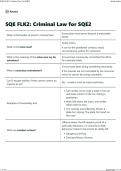
SQE FLK2: Criminal Law for SQE2
Prosecution must prove beyond a reasonable
What is the burden of proof in criminal law?
doubt
Guilty action.
What is the actus reus? It can be the prohibited conduct; result;
circumstances; and/or D's omissions
What is the meaning of the actus reus my be D must have consciously committed the AR to
voluntary? be criminally liable
D must have been doing something voluntarily.
What is conscious commission? If his muscles are not controlled by his conscious
mind, he cannot be acting voluntarily
Can D escape liability if they cannot control an
No - conduct must be truly involuntary
impulse to act?
• Sam strikes out to swat a wasp in her car
and loses control of the car, hitting a
pedestrian
• Mark falls down the stairs, and strikes
Examples of involuntary acts
Adam with his foot
• Tim sneezes and reflexively throws a
plate he’s drying. The plate hits Sarah on
the nose
Offence where the AR requires proof of a
particular behaviour, no outcome to that
behaviour needs to be proven to satisfy AR.
What are conduct crimes?
• Dangerous driving
• Driving without a licence
1 of 59 01/09/2025, 10:10
,SQE FLK2: Criminal Law for SQE2 about:srcdoc
• Require more than just D’s action
• Action must lead to specified
consequence
What are result crimes?
• Factual causation + legal causation +
absence of an intervening act breaking
chain of causation
AR includes the need for some particular
surrounding circumstance
What are circumstance crimes?
• Theft: must prove property belonged to
another
Geeral position is not liable for offences based
Can an offence be committed by omission? on failure to act.
• Exceptions: GNM, special duty to act
1. Crime can be committed by omissions
2. D was under a legal duty to act
What must be proven for D to be liable for an 3. D breached that duty
omission to act? 4. D did not discharge that duty
5. Breach caused AR of offence
6. D had MR if needed
• Statutory or contractual duties (police
fail to intervene)
• Special relationship (parent/child,
spouses, doctors)
What is a recognised duty to act?
• Voluntary assumption of responsibility
(care role)
• Creating/contribution to dangerous
situation
• Doctors/patients
• Teacher/pupil
Examples of special relationships
• Parent/child
• Spouses
By taking reasonable steps to rectify that
If D creates a dangerous situation, how can they
situation, not expected to risk own life to save
discharge their duty to act?
others
Can D be liable for omission if they contribute to Yes, if they know or ought to know the situation
a dangerous situation? has become life threatening
2 of 59 01/09/2025, 10:10
,SQE FLK2: Criminal Law for SQE2 about:srcdoc
When might D assume responsibility for Someone unable to care for themselves due to
another? (age/illness), a duty is imposed
By taking reasonable steps
Lifeguard expected to spot drowning and
How can D discharge their duty to act? rescue. Leaving to get another lifeguard would
not be reasonable and would not discharge that
duty
But for D’s actions, would the prohibited result
have occurred?
What is the test for factual causation?
if the result would have happened anyway = not
responsible
• D must be the substantial cause of the
result
What is the test for legal causation? • D need not be the only cause
• D must be the operating cause (no
break in chain)
What is the meaning of substantial cause for
More than slight and trifling
legal causation?
Are you sure that D's unlawful act was a
significant and operating cause of death?
What questions will the court ask for legal
causation in suicide cases? If yes, are you sure that at the time of the attack
it was reasonably foreseeable that V would die
by suicide as a result of V's injuries?
1. V dies from OG wound
When does suicide not break the chain of 2. Reasonably foreseeable act
causation? 3. D’s act was a significant and operating
cause of death
Where injuries inflicted by D have healed and V
When does suicide break the chain of causation?
acted voluntarily
• Acts in a way that is informed and
voluntary
How can acts by the victim break the chain of
• If V causes/contributes to injuries or
causation?
own demise if their response was
unreasonable or daft
If V neglects injuries inflicted by D, does this No - D remains responsible for the extent of
break the chain of causation? injuries suffered (take victim as you find them)
3 of 59 01/09/2025, 10:10
,SQE FLK2: Criminal Law for SQE2 about:srcdoc
Mark runs into the path of a car and suffers
What is considered proportionate if V
serious injuries while trying to escape from Sam,
contributes to their own injuries?
who was threatening him with a knife
If their actions are free, independent and
informed.
How can a third party break the chain of If Mark punches Sam and, while she is laying on
causation? the floor, Jensen (who has a grudge against
Sam) runs over and stabs her to death, Mark will
not be responsible for her death (merely the
original injuries).
Highly unusual - negligent treatment will not
break chain
Can medical treatment break the chain of
causation? Must be an independent act so potent that D’s
contribution is insignificant - must be so
overwhelming.
Must be an independent act so potent that D’s
contribution is insignificant.
When will medical treatment break the chain of
Treatment must be so overwhelming that it
causation?
makes the original injury part of the history.
Must be palpably wrong.
When it is unforeseeable to the reasonable
person and defendant.
Mark leaves Sam injured and unable to move on
a beach at low tide. Mark will be responsible for
When will an Act of God break the chain of Sam’s death when Sam drowns as it is
causation? foreseeable that the tide will come in. But where
Mark leaves Sam injured and unable to move in
her garden, and Sam dies as a result of being
struck by lightning, Mark will not be responsible
for her death
If a doctor gives someone the wrong medication
No
does that render D's actions insignificant?
When does 'fright or flight' of victim break the Where the escape was not foreseeable by a
chain of causation? reasonable person.
D is entitled to an acquittal and is no longer
What happens when the escape is not
deemed to be the legal cause of the prohibited
foreseeable by a reasonable person?
result.
4 of 59
01/09/2025, 10:10
SQE FLK2: Criminal Law for SQE2
Prosecution must prove beyond a reasonable
What is the burden of proof in criminal law?
doubt
Guilty action.
What is the actus reus? It can be the prohibited conduct; result;
circumstances; and/or D's omissions
What is the meaning of the actus reus my be D must have consciously committed the AR to
voluntary? be criminally liable
D must have been doing something voluntarily.
What is conscious commission? If his muscles are not controlled by his conscious
mind, he cannot be acting voluntarily
Can D escape liability if they cannot control an
No - conduct must be truly involuntary
impulse to act?
• Sam strikes out to swat a wasp in her car
and loses control of the car, hitting a
pedestrian
• Mark falls down the stairs, and strikes
Examples of involuntary acts
Adam with his foot
• Tim sneezes and reflexively throws a
plate he’s drying. The plate hits Sarah on
the nose
Offence where the AR requires proof of a
particular behaviour, no outcome to that
behaviour needs to be proven to satisfy AR.
What are conduct crimes?
• Dangerous driving
• Driving without a licence
1 of 59 01/09/2025, 10:10
,SQE FLK2: Criminal Law for SQE2 about:srcdoc
• Require more than just D’s action
• Action must lead to specified
consequence
What are result crimes?
• Factual causation + legal causation +
absence of an intervening act breaking
chain of causation
AR includes the need for some particular
surrounding circumstance
What are circumstance crimes?
• Theft: must prove property belonged to
another
Geeral position is not liable for offences based
Can an offence be committed by omission? on failure to act.
• Exceptions: GNM, special duty to act
1. Crime can be committed by omissions
2. D was under a legal duty to act
What must be proven for D to be liable for an 3. D breached that duty
omission to act? 4. D did not discharge that duty
5. Breach caused AR of offence
6. D had MR if needed
• Statutory or contractual duties (police
fail to intervene)
• Special relationship (parent/child,
spouses, doctors)
What is a recognised duty to act?
• Voluntary assumption of responsibility
(care role)
• Creating/contribution to dangerous
situation
• Doctors/patients
• Teacher/pupil
Examples of special relationships
• Parent/child
• Spouses
By taking reasonable steps to rectify that
If D creates a dangerous situation, how can they
situation, not expected to risk own life to save
discharge their duty to act?
others
Can D be liable for omission if they contribute to Yes, if they know or ought to know the situation
a dangerous situation? has become life threatening
2 of 59 01/09/2025, 10:10
,SQE FLK2: Criminal Law for SQE2 about:srcdoc
When might D assume responsibility for Someone unable to care for themselves due to
another? (age/illness), a duty is imposed
By taking reasonable steps
Lifeguard expected to spot drowning and
How can D discharge their duty to act? rescue. Leaving to get another lifeguard would
not be reasonable and would not discharge that
duty
But for D’s actions, would the prohibited result
have occurred?
What is the test for factual causation?
if the result would have happened anyway = not
responsible
• D must be the substantial cause of the
result
What is the test for legal causation? • D need not be the only cause
• D must be the operating cause (no
break in chain)
What is the meaning of substantial cause for
More than slight and trifling
legal causation?
Are you sure that D's unlawful act was a
significant and operating cause of death?
What questions will the court ask for legal
causation in suicide cases? If yes, are you sure that at the time of the attack
it was reasonably foreseeable that V would die
by suicide as a result of V's injuries?
1. V dies from OG wound
When does suicide not break the chain of 2. Reasonably foreseeable act
causation? 3. D’s act was a significant and operating
cause of death
Where injuries inflicted by D have healed and V
When does suicide break the chain of causation?
acted voluntarily
• Acts in a way that is informed and
voluntary
How can acts by the victim break the chain of
• If V causes/contributes to injuries or
causation?
own demise if their response was
unreasonable or daft
If V neglects injuries inflicted by D, does this No - D remains responsible for the extent of
break the chain of causation? injuries suffered (take victim as you find them)
3 of 59 01/09/2025, 10:10
,SQE FLK2: Criminal Law for SQE2 about:srcdoc
Mark runs into the path of a car and suffers
What is considered proportionate if V
serious injuries while trying to escape from Sam,
contributes to their own injuries?
who was threatening him with a knife
If their actions are free, independent and
informed.
How can a third party break the chain of If Mark punches Sam and, while she is laying on
causation? the floor, Jensen (who has a grudge against
Sam) runs over and stabs her to death, Mark will
not be responsible for her death (merely the
original injuries).
Highly unusual - negligent treatment will not
break chain
Can medical treatment break the chain of
causation? Must be an independent act so potent that D’s
contribution is insignificant - must be so
overwhelming.
Must be an independent act so potent that D’s
contribution is insignificant.
When will medical treatment break the chain of
Treatment must be so overwhelming that it
causation?
makes the original injury part of the history.
Must be palpably wrong.
When it is unforeseeable to the reasonable
person and defendant.
Mark leaves Sam injured and unable to move on
a beach at low tide. Mark will be responsible for
When will an Act of God break the chain of Sam’s death when Sam drowns as it is
causation? foreseeable that the tide will come in. But where
Mark leaves Sam injured and unable to move in
her garden, and Sam dies as a result of being
struck by lightning, Mark will not be responsible
for her death
If a doctor gives someone the wrong medication
No
does that render D's actions insignificant?
When does 'fright or flight' of victim break the Where the escape was not foreseeable by a
chain of causation? reasonable person.
D is entitled to an acquittal and is no longer
What happens when the escape is not
deemed to be the legal cause of the prohibited
foreseeable by a reasonable person?
result.
4 of 59
01/09/2025, 10:10