Question 1
1.1
For the Binomial Distribution to be applicable, four essential conditions must be
fulfilled. Firstly, the random variable must yield only two possible outcomes, which
are mutually exclusive and collectively exhaustive. Secondly, the process must
involve a fixed number of trials, with each trial producing only one of two results,
1.2
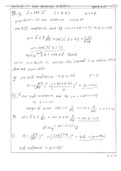
Probability that exactly 3 out of 8 flights are delayed
Probability of on time flight (p) = 75%
= 0.75
Probability of delayed flights (q) = 1 - 0.75
= 0.25
Number of trials (n) = 8
Number of successes (delayed flights) (k) = 3
Using the binomial probability formula:
p(x=k) = (n/k) pk (1 - p)n - k
P(x = 3) = (8/3) (0.25)3 (0.75)8 - 3
P(x = 3) = 8!/3!(8 - 3)! (0.25)3 (0.75)5
P(x = 3) = 8!/3!(5)! (0.25)3 (0.75)5
P(x = 3) = 56 x 0.015625 x 0.2373046875
P(x = 3) = 0.2076416016
P(x = 3) = 0.208
1.3
Probability of at least flue on - time flights:
Let Y = the number of on time flights in a sample of 6
Probability of on time flight (p) = 0.75
Number of trials (n) = 6
P(y ≥ 5) = p(y = 5) + p(y = 6)
1.1
For the Binomial Distribution to be applicable, four essential conditions must be
fulfilled. Firstly, the random variable must yield only two possible outcomes, which
are mutually exclusive and collectively exhaustive. Secondly, the process must
involve a fixed number of trials, with each trial producing only one of two results,
1.2
Probability that exactly 3 out of 8 flights are delayed
Probability of on time flight (p) = 75%
= 0.75
Probability of delayed flights (q) = 1 - 0.75
= 0.25
Number of trials (n) = 8
Number of successes (delayed flights) (k) = 3
Using the binomial probability formula:
p(x=k) = (n/k) pk (1 - p)n - k
P(x = 3) = (8/3) (0.25)3 (0.75)8 - 3
P(x = 3) = 8!/3!(8 - 3)! (0.25)3 (0.75)5
P(x = 3) = 8!/3!(5)! (0.25)3 (0.75)5
P(x = 3) = 56 x 0.015625 x 0.2373046875
P(x = 3) = 0.2076416016
P(x = 3) = 0.208
1.3
Probability of at least flue on - time flights:
Let Y = the number of on time flights in a sample of 6
Probability of on time flight (p) = 0.75
Number of trials (n) = 6
P(y ≥ 5) = p(y = 5) + p(y = 6)