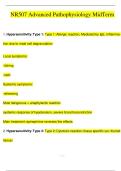
NR507 Advanced Pathophysiology MidTerm
1. Hypersensitivity: Type 1: Type 1: Allergic reaction, Mediated by IgE, Inflamma-
tion due to mast cell degranulation
Local symptoms:
-itching
-rash
Systemic symptoms:
-wheezing
Most dangerous = anaphylactic reaction
systemic response of hypotension, severe bronchoconstriction
Main treatment: epinephrine reverses the effects
2. Hypersensitivity: Type 2: Type 2: Cytotoxic reaction; tissue specific (ex: thyroid
tissue)
,Macrophages are the primary effectors cells involved
Can cause tissue damage or alter function
Grave's disease (hyperthyroidism) - example of altering thyroid function, but does
not destroy thyroid tissue
Incompatible blood type- example of cell/tissue damage that occurs; severe transfu-
sion reaction occurs and the transfused erythrocytes are destroyed by agglutination
or complement-mediated lysis.
3. Type 1 Hypersensitivity VS. Type 2 Hypersensitivity: Type 1 Hypersensitivity
Organ Specific
Antibody binds to the antigen on the cell surface
Type 2 Hypersensitivity
Not Organ Specific
Antibody binds to the soluble antigen outside the cell surface that was released into
the blood or body fluids, and the complex is then deposited in the tissues
, 4. Hypersensitivity: Type 3 - Examples: Rheumatoid arthritis: Antigen/antibodies
are deposited in the joints
Systemic Lupus Erythematosus (SLE)- very closely related to autoimmunity- anti-
gen/antibodies deposit in organs that cause tissue damage
5. Hypersensitivity: Type 4: Delayed response
1. Hypersensitivity: Type 1: Type 1: Allergic reaction, Mediated by IgE, Inflamma-
tion due to mast cell degranulation
Local symptoms:
-itching
-rash
Systemic symptoms:
-wheezing
Most dangerous = anaphylactic reaction
systemic response of hypotension, severe bronchoconstriction
Main treatment: epinephrine reverses the effects
2. Hypersensitivity: Type 2: Type 2: Cytotoxic reaction; tissue specific (ex: thyroid
tissue)
,Macrophages are the primary effectors cells involved
Can cause tissue damage or alter function
Grave's disease (hyperthyroidism) - example of altering thyroid function, but does
not destroy thyroid tissue
Incompatible blood type- example of cell/tissue damage that occurs; severe transfu-
sion reaction occurs and the transfused erythrocytes are destroyed by agglutination
or complement-mediated lysis.
3. Type 1 Hypersensitivity VS. Type 2 Hypersensitivity: Type 1 Hypersensitivity
Organ Specific
Antibody binds to the antigen on the cell surface
Type 2 Hypersensitivity
Not Organ Specific
Antibody binds to the soluble antigen outside the cell surface that was released into
the blood or body fluids, and the complex is then deposited in the tissues
, 4. Hypersensitivity: Type 3 - Examples: Rheumatoid arthritis: Antigen/antibodies
are deposited in the joints
Systemic Lupus Erythematosus (SLE)- very closely related to autoimmunity- anti-
gen/antibodies deposit in organs that cause tissue damage
5. Hypersensitivity: Type 4: Delayed response