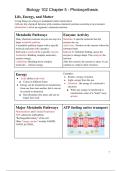
Biology 102 Chapter 5 - Photosynthesis
Life, Energy, and Matter
Living things use energy to manipulate matter (molecules).
Cells are tiny chemical factories with countless chemical reactions occurring at any moment.
Metabolism is all of an organismʼs chemical reactions.
Metabolic Pathways Enzyme Activity
Many chemical reactions are just one step of a Substrate: A specific molecule that the
larger metabolic pathway. enzyme acts on.
A metabolic pathway begins with a specific Active site : Position on the enzyme where the
molecule and ends with a product. substrate binds.
Each step is catalyzed by a specific enzyme. Induced fit: Substrate binding causes the
Anabolism: Building complex molecules – enzyme to change shape. This catalyzes the
requires energy. reaction.
Catabolism: Breaking down complex After the reaction, the enzyme is intact. It can
molecules – releases energy. continue to catalyze other reactions.
Energy Examples:
● Kinetic- energy of motion
● Is the ability to do work.
● Light- energy from the sun
■ Comes in different forms
● Chemical - the energy of a molecule's
● Energy can be transferred or transformed
electrons
from one form into another, but it can not
■ When any energy is transferred or
be created or destroyed.
transformed, some of it "leaks" away
■ Heat dissipates into space and can no
as heat.
longer fuel work.
Major Metabolic Pathways ATP fueling active transport
Photosynthesis and Cellular Respiration
ATP: adenosine triphosphate
"Rechargeable battery" of the cell
Other "energy carriers" include NADPH,
NADH, & FADH2.
1
, Biology 102 Chapter 5 - Photosynthesis
Photosynthesis
Using light energy to make sugars from CO2 Glucose is used as both a source of energy
and H2O. and as the foundation upon which other
Oxygen is just a byproduct. biological molecules are synthesized.
Energy from sunlight is transformed into We can summarize the photosynthetic
chemical energy. This is locked up in the pathway with a chemical equation.
covalent bonds of glucose. 6CO2 + 6H2O → C6H12O6 (glucose) + 6O2
Photosynthesis occurs in the chloroplasts of
Photosynthesis has 2 major steps: plants.
1. Light Reactions 2. Calvin Cycle
Chloroplast
● Thylakoids: Membranous sacs
● Double membrane
● Stroma: Fluid-filled space outside the
Thylakoids are green due to chlorophyll.
thylakoids.
2
Life, Energy, and Matter
Living things use energy to manipulate matter (molecules).
Cells are tiny chemical factories with countless chemical reactions occurring at any moment.
Metabolism is all of an organismʼs chemical reactions.
Metabolic Pathways Enzyme Activity
Many chemical reactions are just one step of a Substrate: A specific molecule that the
larger metabolic pathway. enzyme acts on.
A metabolic pathway begins with a specific Active site : Position on the enzyme where the
molecule and ends with a product. substrate binds.
Each step is catalyzed by a specific enzyme. Induced fit: Substrate binding causes the
Anabolism: Building complex molecules – enzyme to change shape. This catalyzes the
requires energy. reaction.
Catabolism: Breaking down complex After the reaction, the enzyme is intact. It can
molecules – releases energy. continue to catalyze other reactions.
Energy Examples:
● Kinetic- energy of motion
● Is the ability to do work.
● Light- energy from the sun
■ Comes in different forms
● Chemical - the energy of a molecule's
● Energy can be transferred or transformed
electrons
from one form into another, but it can not
■ When any energy is transferred or
be created or destroyed.
transformed, some of it "leaks" away
■ Heat dissipates into space and can no
as heat.
longer fuel work.
Major Metabolic Pathways ATP fueling active transport
Photosynthesis and Cellular Respiration
ATP: adenosine triphosphate
"Rechargeable battery" of the cell
Other "energy carriers" include NADPH,
NADH, & FADH2.
1
, Biology 102 Chapter 5 - Photosynthesis
Photosynthesis
Using light energy to make sugars from CO2 Glucose is used as both a source of energy
and H2O. and as the foundation upon which other
Oxygen is just a byproduct. biological molecules are synthesized.
Energy from sunlight is transformed into We can summarize the photosynthetic
chemical energy. This is locked up in the pathway with a chemical equation.
covalent bonds of glucose. 6CO2 + 6H2O → C6H12O6 (glucose) + 6O2
Photosynthesis occurs in the chloroplasts of
Photosynthesis has 2 major steps: plants.
1. Light Reactions 2. Calvin Cycle
Chloroplast
● Thylakoids: Membranous sacs
● Double membrane
● Stroma: Fluid-filled space outside the
Thylakoids are green due to chlorophyll.
thylakoids.
2