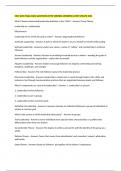
,RSK4804 Assignment 2 2025 WELL ANSWERED
QUESTIONS Due 30 August 2025
Question 1 — Credit Default Swaps (CDS) (Total 10 marks)
(a) Why are credit default swaps necessary? (2 marks)
Short answer (full-mark points):
1. Transfer / hedge credit risk: CDS allow lenders or
bondholders to transfer the risk of borrower default to
protection sellers without selling the underlying
loan/bond. (1 mark)
2. Improve market functioning & price discovery: CDS create
a traded market for credit risk which helps price a
borrower’s default risk and enables investors to manage
exposures (liquidity, portfolio management). (1 mark)
(Markers look for the two distinct benefits above —
hedge/transfer + market/price/discovery.)
(b) Why are some investors not in favour of credit default
swaps? (2 marks)
Short answer (full-mark points):
1. Speculation / naked CDS & moral hazard: CDS can be used
to speculate on a default by buying protection without
holding the underlying exposure. This can amplify price
moves and may create moral hazard. (1 mark)
, 2. Counterparty and systemic risk / opacity: CDS introduce
counterparty risk (if protection seller defaults) and in
opaque markets can concentrate risk and increase
systemic fragility. (1 mark)
(Two clear criticisms required.)
(c) Case analysis: Magong Rural Investments and Moepi
Minerals Exploration (6 marks)
You didn’t give the case text, so I’ll give a model answer
structure and a sample resolution that you can adapt to the
facts in your case. Markers expect: identification of parties,
the legal/economic issue, application of CDS mechanics,
recommended solution, and a short justification.
Model answer structure (tick boxes for full marks):
1. Identify parties & positions (1 mark): Who is the
protection buyer (e.g., Magong — lender/investor) and
who is the protection seller (could be a bank or
counterparty). Identify underlying reference obligation
(Moepi’s bond/loan).
2. State the problem (1 mark): e.g., Magong is exposed to
Moepi default risk or Moepi’s project risk increases;
Magong wants to reduce credit exposure without selling
the loan.
QUESTIONS Due 30 August 2025
Question 1 — Credit Default Swaps (CDS) (Total 10 marks)
(a) Why are credit default swaps necessary? (2 marks)
Short answer (full-mark points):
1. Transfer / hedge credit risk: CDS allow lenders or
bondholders to transfer the risk of borrower default to
protection sellers without selling the underlying
loan/bond. (1 mark)
2. Improve market functioning & price discovery: CDS create
a traded market for credit risk which helps price a
borrower’s default risk and enables investors to manage
exposures (liquidity, portfolio management). (1 mark)
(Markers look for the two distinct benefits above —
hedge/transfer + market/price/discovery.)
(b) Why are some investors not in favour of credit default
swaps? (2 marks)
Short answer (full-mark points):
1. Speculation / naked CDS & moral hazard: CDS can be used
to speculate on a default by buying protection without
holding the underlying exposure. This can amplify price
moves and may create moral hazard. (1 mark)
, 2. Counterparty and systemic risk / opacity: CDS introduce
counterparty risk (if protection seller defaults) and in
opaque markets can concentrate risk and increase
systemic fragility. (1 mark)
(Two clear criticisms required.)
(c) Case analysis: Magong Rural Investments and Moepi
Minerals Exploration (6 marks)
You didn’t give the case text, so I’ll give a model answer
structure and a sample resolution that you can adapt to the
facts in your case. Markers expect: identification of parties,
the legal/economic issue, application of CDS mechanics,
recommended solution, and a short justification.
Model answer structure (tick boxes for full marks):
1. Identify parties & positions (1 mark): Who is the
protection buyer (e.g., Magong — lender/investor) and
who is the protection seller (could be a bank or
counterparty). Identify underlying reference obligation
(Moepi’s bond/loan).
2. State the problem (1 mark): e.g., Magong is exposed to
Moepi default risk or Moepi’s project risk increases;
Magong wants to reduce credit exposure without selling
the loan.