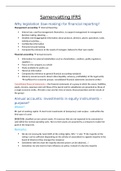
Samenvatting IFRS
Why legislation (law-making) for financial reporting?
Management accounting Internal Reporting
Internal use: used by management themselves, to support management in management
decision making, planning, …
Detailed and disaggregated information about products, divisions, plants, operations, tasks,
individual activities, …
Confidential information
Primarily forward-looking
Computed by reference to the needs of managers (tailored to their own needs)
Financial accounting Annual Accounts
Information for external stakeholders such as shareholders, creditors, public regulators,
suppliers, …
Focus on the company as a whole
Made available for public use
Historical information
Computed by reference to general financial accounting standards
Statutory annual accounts: about ratios (liquidity, solvency, profitability) of the legal entity
Insufficient for economic groups: consolidated financial statements (economic entity)
Consolidated financial statements = the financial statements of a group in which the assets, liabilities,
equity, income, expenses and cash flows of the parent and its subsidiaries are presented as those of
a single economic entity. (Provide a true and fair view of assets, financial position and the results of
the group)
Annual accounts: investments in equity instruments –
purpose?
Where?
51: part of working capital short term investments of (temporary) cash surplus – sold within the
time span of a year
28 (0/2/4): classified as non-current assets resources that are not expected to be consumed or
sold within the normal operating cycle. Non-current assets are acquired by a company to realize her
goals in the long term.
Remarks:
We do not necessarily need 100% of the voting rights, 50% + 1 vote the majority of the
voting’s can be sufficient (depending on the articles of association) to appoint majority in the
board of directors (they manage the company)
Sometimes with less than the majority decisive power can be obtained… !
Sometimes we only want to have influence on policy, instead of a decisive majority
,Consolidated financial statements
Definitions
Participation
Participation = voting rights acquired for the purpose of creating a sustainable and specific relation
with the entity, and to enable the holder to influence the orientation of management decisions.
(EXAM) (art 1:22)
Presumed (refutable) to be a participation:
1. Voting rights representing 10% or more
2. Voting rights representing less than 10% when:
a) together with rights held by subsidiaries, represent 10% or more
b) these rights are subject to commitments from the entity
Participating interest = companies that are no related companies: (art 1:23)
In which a company has a participation directly or through its subsidiaries
That, by knowledge of the administrators of the company, have a participating interest in the
share capital of the company directly or through its subsidiaries
That, by knowledge of the administrators of the company, are subsidiaries of the company
referred to in previous sentence.
Annual accounts: determines classification of the equity instruments to decide classification
280/282/284.
Short term investment of cash surplus: current asset 51
Intention to hold for the long term: non-current asset 28
No sustainable and specific relation with the entity 284
Sustainable and specific relation = participation 280 and 282 if not related
Related/associated
Companies related with a company: (art 1:20)
All companies subject to its power of control
All companies controlling the company
All companies with whom it forms a consortium
All companies under the power of control of the companies mentioned in previous sentences
Associated company = company, other than a subsidiary or joint subsidiary, in which another
company holds a participation, and exercises a significant influence on the orientation of the
management policies. Presumption (refutable): at least 20% of the voting rights are held. art 1:21
Control
Control = power de jure or de facto to exercise a decisive influence on the appointment of the
majority of the members of board of directors or general management or on the orientation of the
policies of an enterprise. ֍ (art 1:14)
Control de jure (irrefutable presumption)
Resulting from a direct or indirect holding of the majority of the voting rights
A partner has the right to appoint or to remove the majority of the directors
, A partner has control in application of the articles of association or in application of an
agreement with the company
A partner has control in application of an agreement with the other partners (or associates)
Joint control
Control de facto (refutable presumption): control resulting from other factors than those mentioned
above.
A partner (or associate) is presumed, unless prove otherwise, to have control when representing the
majority of the votes attached to the shares represented at the last two annual shareholders’
meeting.
Parent = a company excl or jointly controlling another company (art 1:15)
Subsidiary = company towards whom a power of control exists.
Exclusive control = control exercised by a company, either alone, either together with one or more of
his subsidiaries. (art 1:17)
Joint control = control exercised jointly by a limited number of shareholders when they have agreed
that the decisions concerning the orientation of the enterprises’ management policies cannot be
taken without their mutual consent.
Calculating power of control = adding indirect control through subsidiaries of direct control.
Do not include:
Shares without voting rights, or voting rights that cannot be exercised
Voting rights held by the company itself or by its subsidiaries
Consortium
A consortium exists when an entity together with one or more other entities, without being a
subsidiary, or being subsidiaries of the same parent, are subject to central management. ֍ (art 1:19)
Presumptions:
De jure (irrefutable presumption)
Central management results from agreements between parties or articles of
association
Administrative board for the majority consists of the same persons.
De facto (refutable presumption): the same persons have the majority of the shares in the
entities.
Obligation for consolidation – who?
A parent company, controlling subsidiaries (exclusively or jointly), shall prepare consolidated financial
statements.
In case of a consortium the consolidated financial statements comprise all members of the
consortium and their subsidiaries. Each member of the consortium is considered to be a parent, and
they are mutually responsible for the consolidated financial statements.
, Obligation for consolidation – exemptions
1. small groups (art 3:25/26)
Not exceeding more than one of the following thresholds on a consolidated basis for two consecutive
years:
Average headcount: 250
Turnover: 34 000 000 EUR
Balance sheet total 17 000 000 EUR
2. sub-consolidation: parent that is a subsidiary of another parent
Decision by the shareholders meeting:
Renewal every 2 years
Approved by at least 90% of the shareholders
The company and all its subsidiaries are included in the consolidated financial statements of
the ultimate parent
The consolidated financial statements of the ultimate parent are effectively established and
available for public use.
To be approved by the workers’ council.
No exemption however if:
Quoted on a stock exchange
Workers council (exempt small groups: no agreement required)
Methods of consolidation
1. full consolidation: all assets of the parent and subsidiaries added together + consolidation entries.
2. Proportionate: replace the value of the investments in a subsidiary by the share of assets and
liabilities of the subsidiary held by the group.
Real consolidation methods
3. Equity method: rather a valuation method then a consolidation method. The investment is
accounted for as the equity portion owned by the group in the company (instead of historical
purchase price).
EXAM
Affiliation Characteristic % control Method
Subsidiary Control: de jure/de >50% Full consolidation
facto
Joint venture Joint control Proportionate
Associated company Significant influence 20 – 50% Equity method
Other Purchase value
Excluded (level of subsidiary)
Subsidiary excluded from consolidation if:
Negligible importance
Restrictions in the effective power of control (important and long term)
Why legislation (law-making) for financial reporting?
Management accounting Internal Reporting
Internal use: used by management themselves, to support management in management
decision making, planning, …
Detailed and disaggregated information about products, divisions, plants, operations, tasks,
individual activities, …
Confidential information
Primarily forward-looking
Computed by reference to the needs of managers (tailored to their own needs)
Financial accounting Annual Accounts
Information for external stakeholders such as shareholders, creditors, public regulators,
suppliers, …
Focus on the company as a whole
Made available for public use
Historical information
Computed by reference to general financial accounting standards
Statutory annual accounts: about ratios (liquidity, solvency, profitability) of the legal entity
Insufficient for economic groups: consolidated financial statements (economic entity)
Consolidated financial statements = the financial statements of a group in which the assets, liabilities,
equity, income, expenses and cash flows of the parent and its subsidiaries are presented as those of
a single economic entity. (Provide a true and fair view of assets, financial position and the results of
the group)
Annual accounts: investments in equity instruments –
purpose?
Where?
51: part of working capital short term investments of (temporary) cash surplus – sold within the
time span of a year
28 (0/2/4): classified as non-current assets resources that are not expected to be consumed or
sold within the normal operating cycle. Non-current assets are acquired by a company to realize her
goals in the long term.
Remarks:
We do not necessarily need 100% of the voting rights, 50% + 1 vote the majority of the
voting’s can be sufficient (depending on the articles of association) to appoint majority in the
board of directors (they manage the company)
Sometimes with less than the majority decisive power can be obtained… !
Sometimes we only want to have influence on policy, instead of a decisive majority
,Consolidated financial statements
Definitions
Participation
Participation = voting rights acquired for the purpose of creating a sustainable and specific relation
with the entity, and to enable the holder to influence the orientation of management decisions.
(EXAM) (art 1:22)
Presumed (refutable) to be a participation:
1. Voting rights representing 10% or more
2. Voting rights representing less than 10% when:
a) together with rights held by subsidiaries, represent 10% or more
b) these rights are subject to commitments from the entity
Participating interest = companies that are no related companies: (art 1:23)
In which a company has a participation directly or through its subsidiaries
That, by knowledge of the administrators of the company, have a participating interest in the
share capital of the company directly or through its subsidiaries
That, by knowledge of the administrators of the company, are subsidiaries of the company
referred to in previous sentence.
Annual accounts: determines classification of the equity instruments to decide classification
280/282/284.
Short term investment of cash surplus: current asset 51
Intention to hold for the long term: non-current asset 28
No sustainable and specific relation with the entity 284
Sustainable and specific relation = participation 280 and 282 if not related
Related/associated
Companies related with a company: (art 1:20)
All companies subject to its power of control
All companies controlling the company
All companies with whom it forms a consortium
All companies under the power of control of the companies mentioned in previous sentences
Associated company = company, other than a subsidiary or joint subsidiary, in which another
company holds a participation, and exercises a significant influence on the orientation of the
management policies. Presumption (refutable): at least 20% of the voting rights are held. art 1:21
Control
Control = power de jure or de facto to exercise a decisive influence on the appointment of the
majority of the members of board of directors or general management or on the orientation of the
policies of an enterprise. ֍ (art 1:14)
Control de jure (irrefutable presumption)
Resulting from a direct or indirect holding of the majority of the voting rights
A partner has the right to appoint or to remove the majority of the directors
, A partner has control in application of the articles of association or in application of an
agreement with the company
A partner has control in application of an agreement with the other partners (or associates)
Joint control
Control de facto (refutable presumption): control resulting from other factors than those mentioned
above.
A partner (or associate) is presumed, unless prove otherwise, to have control when representing the
majority of the votes attached to the shares represented at the last two annual shareholders’
meeting.
Parent = a company excl or jointly controlling another company (art 1:15)
Subsidiary = company towards whom a power of control exists.
Exclusive control = control exercised by a company, either alone, either together with one or more of
his subsidiaries. (art 1:17)
Joint control = control exercised jointly by a limited number of shareholders when they have agreed
that the decisions concerning the orientation of the enterprises’ management policies cannot be
taken without their mutual consent.
Calculating power of control = adding indirect control through subsidiaries of direct control.
Do not include:
Shares without voting rights, or voting rights that cannot be exercised
Voting rights held by the company itself or by its subsidiaries
Consortium
A consortium exists when an entity together with one or more other entities, without being a
subsidiary, or being subsidiaries of the same parent, are subject to central management. ֍ (art 1:19)
Presumptions:
De jure (irrefutable presumption)
Central management results from agreements between parties or articles of
association
Administrative board for the majority consists of the same persons.
De facto (refutable presumption): the same persons have the majority of the shares in the
entities.
Obligation for consolidation – who?
A parent company, controlling subsidiaries (exclusively or jointly), shall prepare consolidated financial
statements.
In case of a consortium the consolidated financial statements comprise all members of the
consortium and their subsidiaries. Each member of the consortium is considered to be a parent, and
they are mutually responsible for the consolidated financial statements.
, Obligation for consolidation – exemptions
1. small groups (art 3:25/26)
Not exceeding more than one of the following thresholds on a consolidated basis for two consecutive
years:
Average headcount: 250
Turnover: 34 000 000 EUR
Balance sheet total 17 000 000 EUR
2. sub-consolidation: parent that is a subsidiary of another parent
Decision by the shareholders meeting:
Renewal every 2 years
Approved by at least 90% of the shareholders
The company and all its subsidiaries are included in the consolidated financial statements of
the ultimate parent
The consolidated financial statements of the ultimate parent are effectively established and
available for public use.
To be approved by the workers’ council.
No exemption however if:
Quoted on a stock exchange
Workers council (exempt small groups: no agreement required)
Methods of consolidation
1. full consolidation: all assets of the parent and subsidiaries added together + consolidation entries.
2. Proportionate: replace the value of the investments in a subsidiary by the share of assets and
liabilities of the subsidiary held by the group.
Real consolidation methods
3. Equity method: rather a valuation method then a consolidation method. The investment is
accounted for as the equity portion owned by the group in the company (instead of historical
purchase price).
EXAM
Affiliation Characteristic % control Method
Subsidiary Control: de jure/de >50% Full consolidation
facto
Joint venture Joint control Proportionate
Associated company Significant influence 20 – 50% Equity method
Other Purchase value
Excluded (level of subsidiary)
Subsidiary excluded from consolidation if:
Negligible importance
Restrictions in the effective power of control (important and long term)