MED SURG HESI Exam – Study Guide (Updated 2025)
Topic 2: Respiratory Disorders
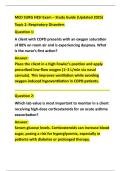
Question 1:
A client with COPD presents with an oxygen saturation
of 88% on room air and is experiencing dyspnea. What
is the nurse’s first action?
Answer:
Place the client in a high Fowler’s position and apply
prescribed low-flow oxygen (1–2 L/min via nasal
cannula). This improves ventilation while avoiding
oxygen-induced hypoventilation in COPD patients.
Question 2:
Which lab value is most important to monitor in a client
receiving high-dose corticosteroids for an acute asthma
exacerbation?
Answer:
Serum glucose levels. Corticosteroids can increase blood
sugar, posing a risk for hyperglycemia, especially in
patients with diabetes or prolonged therapy.
,Question 3:
A nurse hears wheezing in a patient with asthma. After
administering a bronchodilator, the wheezing stops, but
breath sounds are now absent. What does this indicate?
Answer:
Possible severe airway obstruction or impending
respiratory failure. The absence of breath sounds in this
context is an emergency, requiring immediate
notification of the provider and possible advanced
airway support.
Question 4:
What is the priority nursing intervention following a
thoracentesis?
Answer:
Monitor for signs of pneumothorax (sudden chest pain,
dyspnea, decreased breath sounds on the affected side).
Prompt detection prevents respiratory compromise.
, Question 5:
Why should a nurse encourage pursed-lip breathing in a
patient with emphysema?
Answer:
Pursed-lip breathing prolongs exhalation, prevents
airway collapse, and improves gas exchange by
maintaining positive airway pressure in patients with
chronic lung disease.
Topic 2: Respiratory Disorders
Q6. A patient with COPD is receiving oxygen therapy at 4 L/min via nasal cannula. What is the
nurse’s priority intervention?
A6. The nurse should reduce the flow to 1–2 L/min because high oxygen concentrations can
suppress the hypoxic drive in COPD patients, leading to CO₂ retention and respiratory failure.
Monitoring oxygen saturation, respiratory rate, and ABG values is critical.
Q7. What nursing interventions help prevent complications of pneumonia?
A7. Encourage deep breathing and coughing, provide adequate hydration, administer
prescribed antibiotics, position the patient in semi-Fowler’s to promote lung expansion, and
monitor oxygen saturation. Early mobilization and incentive spirometry also help reduce
atelectasis and improve oxygenation.
Q8. How can the nurse differentiate between respiratory alkalosis and respiratory acidosis using
ABG values?
A8. Respiratory alkalosis presents with elevated pH and low PaCO₂ due to hyperventilation.
Respiratory acidosis presents with decreased pH and elevated PaCO₂ due to hypoventilation.
Monitoring HCO₃ helps determine compensation status.
Topic 2: Respiratory Disorders
Question 1:
A client with COPD presents with an oxygen saturation
of 88% on room air and is experiencing dyspnea. What
is the nurse’s first action?
Answer:
Place the client in a high Fowler’s position and apply
prescribed low-flow oxygen (1–2 L/min via nasal
cannula). This improves ventilation while avoiding
oxygen-induced hypoventilation in COPD patients.
Question 2:
Which lab value is most important to monitor in a client
receiving high-dose corticosteroids for an acute asthma
exacerbation?
Answer:
Serum glucose levels. Corticosteroids can increase blood
sugar, posing a risk for hyperglycemia, especially in
patients with diabetes or prolonged therapy.
,Question 3:
A nurse hears wheezing in a patient with asthma. After
administering a bronchodilator, the wheezing stops, but
breath sounds are now absent. What does this indicate?
Answer:
Possible severe airway obstruction or impending
respiratory failure. The absence of breath sounds in this
context is an emergency, requiring immediate
notification of the provider and possible advanced
airway support.
Question 4:
What is the priority nursing intervention following a
thoracentesis?
Answer:
Monitor for signs of pneumothorax (sudden chest pain,
dyspnea, decreased breath sounds on the affected side).
Prompt detection prevents respiratory compromise.
, Question 5:
Why should a nurse encourage pursed-lip breathing in a
patient with emphysema?
Answer:
Pursed-lip breathing prolongs exhalation, prevents
airway collapse, and improves gas exchange by
maintaining positive airway pressure in patients with
chronic lung disease.
Topic 2: Respiratory Disorders
Q6. A patient with COPD is receiving oxygen therapy at 4 L/min via nasal cannula. What is the
nurse’s priority intervention?
A6. The nurse should reduce the flow to 1–2 L/min because high oxygen concentrations can
suppress the hypoxic drive in COPD patients, leading to CO₂ retention and respiratory failure.
Monitoring oxygen saturation, respiratory rate, and ABG values is critical.
Q7. What nursing interventions help prevent complications of pneumonia?
A7. Encourage deep breathing and coughing, provide adequate hydration, administer
prescribed antibiotics, position the patient in semi-Fowler’s to promote lung expansion, and
monitor oxygen saturation. Early mobilization and incentive spirometry also help reduce
atelectasis and improve oxygenation.
Q8. How can the nurse differentiate between respiratory alkalosis and respiratory acidosis using
ABG values?
A8. Respiratory alkalosis presents with elevated pH and low PaCO₂ due to hyperventilation.
Respiratory acidosis presents with decreased pH and elevated PaCO₂ due to hypoventilation.
Monitoring HCO₃ helps determine compensation status.