

100% satisfaction guarantee Immediately available after payment Both online and in PDF No strings attached 4.2 TrustPilot
logo-home
Class notes

WGU C723 Quantitative Analysis for Business

Rating
-
Sold
-
Pages
4
Uploaded on
27-08-2025
Written in
2025/2026

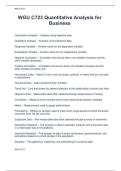
Quantitative Analysis - -Analysis using objective data. Qualitative Analysis - -Analysis using subjective data. Response Variable - -Another name for the dependent variable. Explanatory Variable - -Another name for the independent variable. Negative Correlation - -Correlation that occurs when one variable increases and the other variable decreases. Positive Correlation - -Correlation that occurs when one variable increases and the other variable increases, too. Nonnumeric Data - -Data of a form such as words, symbols, or letters that are not used in calculations. Numerical Data - -Data represented by numbers. Trend line - -Line that shows the general direction of the relationship of points over time. Objective Data - -Measurable data oftain obtained through observations or testing. Correlation - -Measure of the strength of the linear relationship between variables. Metric - -Measurement used to gauge performance. Forecasting - -Method or process used to make short range decisions where the actual outcomes have not yet occurred. Subjective Data - -Non-measurable data often obtained through surveys or interviews. Descriptive Statistics - -The analysis of data to describe, interpret, and summarize data in a meaningful way to find patterns. Inferential Statistics - -The analysis of data to reach conclusions, generalizations, and estimations based on a small sample of the population. Statistics - -The gathering, organizing, and interpreting of numerical data. WGU C723 WGU C723 WGU C723 Moderating Variable - -Variable that changes the effect of independent variable on the dependent variable. Mediating Variable - -Variable that explains the relationship between the independent and dependent variables. Dependent Variable - -Variable that is being measured or affected. Independent Variable - -Variable that is free to change in a given model. Cyclical Trend - -A pattern that tends to repeat itself every few years and is observed over a long time period. Mean - -Average of a set of numbers. Population - -Entire set of data being evaluated. Bar Chart - -Graph showing the frequency of occurrence in each category for qualitative data. Histogram - -Graph showing the frequency of occurrence in each category for quantitative data. Pie Chart - -Graph showing the percentage of occurrence in each category for qualitative data. Scatter Plot - -Graph used to compare two variables to determine if there is a possible relationship between them. Probability - -Mathematical statement about the likelihood of an event occurring. Median - -Middle number in a list of numbers. Time Series - -Resulting set of data points taken over specific time intervals. Sample - -Subset of the population. Trend - -The general upward or downward movement of data over a relatively long period. Mode - -The number that occurs most often in a set of numbers. Linear Equation - -Type of equation when the slope between any two points is constant. Random Trend - -Unpredictable trend in the data. WGU C723 WGU C723 Seasonal Trend - -Upward or downward movement in data that repeats at regular intervals. Correlation - -Used to compare two variables to determine the strength of the linear relationship between them. Uncertainty - -A non-quantifiable value because the future events are not predictable. Decision Point - -A point where one of several alternatives can be selected. State of Nature Node - -A possible outcome on a decision tree that would be out of the decision maker's control. Risk - -Known possibility measured by its probability of occurrence. Expected Monetary Value - -Method used for decision making when the risks involved in a decision situation have several states of nature and the likelihood, or probability, of each state is known. Payoff Table - -Similar to a decision tree except that it uses a table instead of a graphical representation of the data. Identify the Problem - -Step 1 of the decision-making model. Establish Decision Criteria - -Step 2 of the decision-making model. Weigh Decision Criteria - -Step 3 of the decision-making model. Generate Alternatives - -Step 4 of the decision-making model. Evaluate the Alternatives - -Step 5 of the decision-making model. Choose the Best Alternative - -Step 6 of the decision-making model. Implement the Decision - -Step 7 of the decision-making model. Evaluate the Decision - -Step 8 of the decision-making model. Decision Tree - -Tool that can be used to visualize important aspects of a problem. Project - -A strategic undertaking and not a regular operational activity. Network Diagram - -Identifiable set of project activities organized in a logical method. Successor - -Task that comes after the predecessor. WGU C723 WGU C723 Predecessor - -Task that must be completed before the next step can be started. Optimistic Time - -The best case scenario, or minimum length of time, to complete an activity. Most Likely Time - -The duration of an activity given a normal level of effort and performance under normal working conditions. Critical Path - -The longest sequence of tasks in the network diagram. Pessimistic Time - -The worst case scenario, or maximum length of time, to complete an activity. Activity - -Unique unit of the project which can be described within limits of time. Linear Programming - -A mathematical technique that can be used to identify the value of a variable for a given set of constraints. Economic Order Quantity - -Amount of inventory a business should order to minimize the total amount of inventory costs, including carrying, ordering, and shortage costs. Inventory - -Any goods held in stock for immediate or future use. Feasible Region - -Area of the graph that satisfies all constraints. Coefficient - -Multiplier of the variable, as in linear equations or inequalities. Constraint - -Restriction that limits the degree in which a company can pursue its objective. Ordering Costs - -The cost of replenishing inventory, including receiving logistics. Carrying Costs - -The costs of storing inventory, insurance, and managing inventory risk due to damage or theft. Shortage Costs - -The costs resulting from not having an item on the shelf for sale. Objective Function - -The function that seeks to minimize or maximize some quantity. Demand - -The number of items needed, typically per year.

Show more Read less
Institution
WGU C723 Quantitative Analysis For Business
Course
WGU C723 Quantitative Analysis for Business


Whoops! We can’t load your doc right now. Try again or contact support.

Written for

Institution
WGU C723 Quantitative Analysis for Business
Course
WGU C723 Quantitative Analysis for Business

Document information

Uploaded on
August 27, 2025
Number of pages
4
Written in
2025/2026
Type
Class notes
Professor(s)
Unknown
Contains
All classes

Subjects

  • wgu c723

Content preview

WGU C723


WGU C723 Quantitative Analysis for
Business

Quantitative Analysis - -Analysis using objective data.

Qualitative Analysis - -Analysis using subjective data.

Response Variable - -Another name for the dependent variable.

Explanatory Variable - -Another name for the independent variable.

Negative Correlation - -Correlation that occurs when one variable increases and the
other variable decreases.

Positive Correlation - -Correlation that occurs when one variable increases and the
other variable increases, too.

Nonnumeric Data - -Data of a form such as words, symbols, or letters that are not used
in calculations.

Numerical Data - -Data represented by numbers.

Trend line - -Line that shows the general direction of the relationship of points over time.

Objective Data - -Measurable data oftain obtained through observations or testing.

Correlation - -Measure of the strength of the linear relationship between variables.

Metric - -Measurement used to gauge performance.

Forecasting - -Method or process used to make short range decisions where the actual
outcomes have not yet occurred.

Subjective Data - -Non-measurable data often obtained through surveys or interviews.

Descriptive Statistics - -The analysis of data to describe, interpret, and summarize data
in a meaningful way to find patterns.

Inferential Statistics - -The analysis of data to reach conclusions, generalizations, and
estimations based on a small sample of the population.

Statistics - -The gathering, organizing, and interpreting of numerical data.


WGU C723

$9.99
Get access to the full document:

100% satisfaction guarantee
Immediately available after payment
Both online and in PDF
No strings attached

Get to know the seller
Seller avatar
AlexScorer
4.0
(1)

Get to know the seller

Seller avatar
AlexScorer Chamberlain College Of Nursing
View profile
Follow You need to be logged in order to follow users or courses
Sold
5
Member since
1 year
Number of followers
0
Documents
1519
Last sold
2 months ago
Best Scorers Review Guide

Hesitate not to get 100% Recent updated and Verified Documents .Total Guarantee to success

4.0

1 reviews

5
0
4
1
3
0
2
0
1
0

Recently viewed by you

Why students choose Stuvia

Created by fellow students, verified by reviews

Quality you can trust: written by students who passed their tests and reviewed by others who've used these notes.

Didn't get what you expected? Choose another document

No worries! You can instantly pick a different document that better fits what you're looking for.

Pay as you like, start learning right away

No subscription, no commitments. Pay the way you're used to via credit card and download your PDF document instantly.

Student with book image

“Bought, downloaded, and aced it. It really can be that simple.”

Alisha Student

Frequently asked questions
