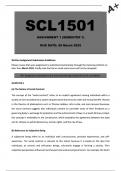
PSC1501 Assignment 3
PORTFOLIO (COMPLETE
ANSWERS) 2025 - DUE 3
September 2025
NO PLAGIARISM
[Pick the date]
[Type the company name]
, Exam (elaborations)
PSC1501 Assignment 3 PORTFOLIO
(COMPLETE ANSWERS) 2025 - DUE 3
September 2025
Course
Practical Science for the Classroom (PSC1501)
Institution
University Of South Africa (Unisa)
Book
Teaching Science in the Primary Classroom
QUESTION 1 1.1 Demonstrate your understanding of the “big ideas of science” by: •
Identifying what pedagogy they are linked to. (2) • Defining the term. (6) • Where
do they come from? (6) • Supplying six “big ideas of science”. (6)
The Big Ideas of Science
The "big ideas of science" are a pedagogical approach designed to help students understand core
scientific concepts by focusing on a few overarching ideas rather than isolated facts. They aim to
provide a coherent framework that connects different scientific disciplines, helping students see
the "big picture" of how the world works. 💡
Pedagogy and Definition
Pedagogy Link: The big ideas of science are linked to a constructivist pedagogy. This
approach focuses on students actively building their own knowledge by making
connections between new information and their existing understanding. By using a few
core ideas as a framework, students can more easily link fragmented topics from different
science subjects.
Definition: The term "big ideas of science" refers to a small number of powerful,
overarching concepts that provide a framework for explaining a wide range of
phenomena and facts across all scientific disciplines. They are a conceptual lens that
helps students make sense of the world and understand how different scientific fields—
like biology, chemistry, and physics—are interconnected. A "big idea" is a principle with
significant explanatory power that can be applied in many different contexts.
PORTFOLIO (COMPLETE
ANSWERS) 2025 - DUE 3
September 2025
NO PLAGIARISM
[Pick the date]
[Type the company name]
, Exam (elaborations)
PSC1501 Assignment 3 PORTFOLIO
(COMPLETE ANSWERS) 2025 - DUE 3
September 2025
Course
Practical Science for the Classroom (PSC1501)
Institution
University Of South Africa (Unisa)
Book
Teaching Science in the Primary Classroom
QUESTION 1 1.1 Demonstrate your understanding of the “big ideas of science” by: •
Identifying what pedagogy they are linked to. (2) • Defining the term. (6) • Where
do they come from? (6) • Supplying six “big ideas of science”. (6)
The Big Ideas of Science
The "big ideas of science" are a pedagogical approach designed to help students understand core
scientific concepts by focusing on a few overarching ideas rather than isolated facts. They aim to
provide a coherent framework that connects different scientific disciplines, helping students see
the "big picture" of how the world works. 💡
Pedagogy and Definition
Pedagogy Link: The big ideas of science are linked to a constructivist pedagogy. This
approach focuses on students actively building their own knowledge by making
connections between new information and their existing understanding. By using a few
core ideas as a framework, students can more easily link fragmented topics from different
science subjects.
Definition: The term "big ideas of science" refers to a small number of powerful,
overarching concepts that provide a framework for explaining a wide range of
phenomena and facts across all scientific disciplines. They are a conceptual lens that
helps students make sense of the world and understand how different scientific fields—
like biology, chemistry, and physics—are interconnected. A "big idea" is a principle with
significant explanatory power that can be applied in many different contexts.