Created with Coconote - https://coconote.app
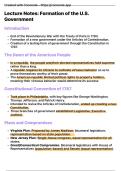
Lecture Notes: Formation of the U.S.
Government
Introduction
• End of the Revolutionary War with the Treaty of Paris in 1783.
• Formation of a new government under the Articles of Confederation.
• Creation of a lasting form of government through the Constitution in
1787.
The Dawn of the American People
• In a republic, the people and their elected representatives hold supreme
rather than a king.
• A republic requires its citizens to cultivate virtuous behavior so as to
prove themselves worthy of their power.
• The American republic limited political rights to property holders,
meaning their virtuous behavior would determine its success
Constitutional Convention of 1787
• Took place in Philadelphia, with key figures like George Washington,
Thomas Jefferson, and Patrick Henry.
• Intended to revise the Articles of Confederation, ended up creating a new
Constitution.
• Three branches of government established: Legislative, Executive,
Judicial.
Plans and Compromises
• Virginia Plan: Proposed by James Madison; bicameral legislature,
representation based on state population.
• New Jersey Plan: Single-house congress, equal representation for all
states.
• Great/Connecticut Compromise: Bicameral legislature with House of
Representatives (population-based) and Senate (equal representation).
Lecture Notes: Formation of the U.S.
Government
Introduction
• End of the Revolutionary War with the Treaty of Paris in 1783.
• Formation of a new government under the Articles of Confederation.
• Creation of a lasting form of government through the Constitution in
1787.
The Dawn of the American People
• In a republic, the people and their elected representatives hold supreme
rather than a king.
• A republic requires its citizens to cultivate virtuous behavior so as to
prove themselves worthy of their power.
• The American republic limited political rights to property holders,
meaning their virtuous behavior would determine its success
Constitutional Convention of 1787
• Took place in Philadelphia, with key figures like George Washington,
Thomas Jefferson, and Patrick Henry.
• Intended to revise the Articles of Confederation, ended up creating a new
Constitution.
• Three branches of government established: Legislative, Executive,
Judicial.
Plans and Compromises
• Virginia Plan: Proposed by James Madison; bicameral legislature,
representation based on state population.
• New Jersey Plan: Single-house congress, equal representation for all
states.
• Great/Connecticut Compromise: Bicameral legislature with House of
Representatives (population-based) and Senate (equal representation).