Performance Appraisal and Performance Management: 100 Years of Progress?
This is an article summarizing the research done over the last 100 years in performance
appraisal and performance management.
- Performance appraisal refers to a formal process, which occurs infrequently, by which
employees are evaluated by some judge (typically a super-visor) who assesses the
employee’s performance along a given set of dimensions, assigns a score, and then
usually informs the employee of his or her formal rating. Organizations typically base
a variety of decisions concerning the employee partially on this rating.
- Performance management refers to the wide variety of activities, policies, procedures
and interventions (feedback, goal setting, training, reward systems) designed to help
employees to improve their performance. The basis for this is usually a performance
appraisal
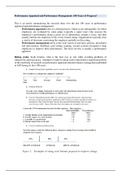
Rating scales. Scale formats, what is the best way to rate while avoiding problems of
subjectivity and inaccuracy. Attempts to improve rating scales represented a significant portion
of the total body of research on performance appraisal and performance management published
in JAP during its first 100 years.
This is an article summarizing the research done over the last 100 years in performance
appraisal and performance management.
- Performance appraisal refers to a formal process, which occurs infrequently, by which
employees are evaluated by some judge (typically a super-visor) who assesses the
employee’s performance along a given set of dimensions, assigns a score, and then
usually informs the employee of his or her formal rating. Organizations typically base
a variety of decisions concerning the employee partially on this rating.
- Performance management refers to the wide variety of activities, policies, procedures
and interventions (feedback, goal setting, training, reward systems) designed to help
employees to improve their performance. The basis for this is usually a performance
appraisal
Rating scales. Scale formats, what is the best way to rate while avoiding problems of
subjectivity and inaccuracy. Attempts to improve rating scales represented a significant portion
of the total body of research on performance appraisal and performance management published
in JAP during its first 100 years.