Assignment Instructions
**Assignment Title:** SFBT Reflection and Application Paper
**Objective:** To analyze the principles of Solution-Focused Brief Therapy (SFBT) and
reflect on their application in client counseling.
**Scenario:** You are a clinical social worker tasked with applying SFBT techniques to help
clients achieve positive outcomes.
**Requirements:**
- Summarize key principles of SFBT and their relevance to modern counseling.
- Reflect on personal insights gained from the therapy process.
- Discuss challenges and strategies for applying SFBT with diverse clients.
**Formatting:** APA, 3–4 pages, Times New Roman 12pt, double-spaced.
**Submission:** Upload to the Social Work LMS portal.
SOWK 5014 –AGSP
Solution Focused Therapy Role Play Reflection Paper
Solution Focused Behavioral Therapy in Social Work Practice
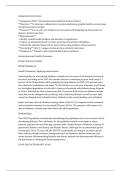
This week’s topic is to examine and understand the use of solution focused behavior
therapy (SFBT) in social work practice beginning in the late 1970s, Steve de Shazer (1940-
2005) and Insoo Kim Berg (1934-2007) worked with colleagues at the Milwaukee Brief
Family Therapy Center to create SFBT. SFBT, as its name implies, is goal-directed, future-
focused, and solution-focused rather than problem-focused, which is what initially drew
clients to treatment. SFBT is an evidence-based, short-term goal-focused therapy approach
that builds on positive psychology practices and ideas. Rather than concentrating on
problems, SFBT helps clients change by helping them create solutions. Basically, solution-
focused behavioral therapy is a positive, optimistic, future-focused method of creating,
encouraging, implementing, and maintaining desired behavioral change.
Group Role Play
My group consisted of Jenny, Ariel, Jerica and myself. In this week’s role play we were
implementing. SFBT interventions including, exception questions, coping questions, scaling
questions and the miracle question. We all alternated the roles of therapist, client, and
observer. In the 1st role play: Ariel was the client whom was struggling with integrating
back into the community after deployment to Afghanistan, Jenny was her therapist, Jerica
and myself were the observers. The 2nd role plays the therapist was played by Ariel, Jerica
served as Ariel's client, jenny and I were the observers. In the 3rd role play I served as the
therapist while Jenny took on the role of the client, Ariel and Jerica were the observers. In
the 4th and final role play I adapted
the role of the client Jerica served as my therapist, Jenny and Ariel were the observers. All
in all, I think we all did a good job of introducing the interventions and building a rapport
with our
**Assignment Title:** SFBT Reflection and Application Paper
**Objective:** To analyze the principles of Solution-Focused Brief Therapy (SFBT) and
reflect on their application in client counseling.
**Scenario:** You are a clinical social worker tasked with applying SFBT techniques to help
clients achieve positive outcomes.
**Requirements:**
- Summarize key principles of SFBT and their relevance to modern counseling.
- Reflect on personal insights gained from the therapy process.
- Discuss challenges and strategies for applying SFBT with diverse clients.
**Formatting:** APA, 3–4 pages, Times New Roman 12pt, double-spaced.
**Submission:** Upload to the Social Work LMS portal.
SOWK 5014 –AGSP
Solution Focused Therapy Role Play Reflection Paper
Solution Focused Behavioral Therapy in Social Work Practice
This week’s topic is to examine and understand the use of solution focused behavior
therapy (SFBT) in social work practice beginning in the late 1970s, Steve de Shazer (1940-
2005) and Insoo Kim Berg (1934-2007) worked with colleagues at the Milwaukee Brief
Family Therapy Center to create SFBT. SFBT, as its name implies, is goal-directed, future-
focused, and solution-focused rather than problem-focused, which is what initially drew
clients to treatment. SFBT is an evidence-based, short-term goal-focused therapy approach
that builds on positive psychology practices and ideas. Rather than concentrating on
problems, SFBT helps clients change by helping them create solutions. Basically, solution-
focused behavioral therapy is a positive, optimistic, future-focused method of creating,
encouraging, implementing, and maintaining desired behavioral change.
Group Role Play
My group consisted of Jenny, Ariel, Jerica and myself. In this week’s role play we were
implementing. SFBT interventions including, exception questions, coping questions, scaling
questions and the miracle question. We all alternated the roles of therapist, client, and
observer. In the 1st role play: Ariel was the client whom was struggling with integrating
back into the community after deployment to Afghanistan, Jenny was her therapist, Jerica
and myself were the observers. The 2nd role plays the therapist was played by Ariel, Jerica
served as Ariel's client, jenny and I were the observers. In the 3rd role play I served as the
therapist while Jenny took on the role of the client, Ariel and Jerica were the observers. In
the 4th and final role play I adapted
the role of the client Jerica served as my therapist, Jenny and Ariel were the observers. All
in all, I think we all did a good job of introducing the interventions and building a rapport
with our