8/24/25, 7:01 PM D117 AP Psychology Unit 6
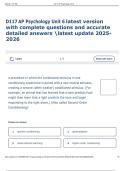
D117 AP Psychology Unit 6 latest version
with complete questions and accurate
detailed answers \latest update 2025-
2026
Learn 1/7 Study with Learn
a procedure in which the conditioned stimulus in one
conditioning experience is paired with a new neutral stimulus,
creating a second (often weaker) conditioned stimulus. (For
example, an animal that has learned that a tone predicts food
might then learn that a light predicts the tone and begin
responding to the light alone.) (Also called Second-Order
Conditioning)
Choose an answer
1 operant conditioning 2 generalization
3 observational learning 4 higher-order conditioning
https://quizlet.com/1067806515/d117-ap-psychology-unit-6-flash-cards/?funnelUUID=e95051f6-b5fc-403a-9c5c-62f6228a76bd 1/8
, 8/24/25, 7:01 PM D117 AP Psychology Unit 6
a relatively permanent change in an organism's
learning
behavior due to experience
an organism's decreasing response to a stimulus with
habituation
repeated exposure to it
learning that certain events occur together. The
events may be two stimuli (as in classical conditioning)
associative learning
or a response and its consequences (as in operant
conditioning
a type of learning in which one
learns to link two or more stimuli
classical conditioning
and anticipate events
the view that psychology: (1) should be an objective
science that (2) studies behavior without reference to
behaviorism
mental processes. Most research psychologists today
agree with (1) but not with (2)
in classical conditioning, the unlearned, naturally
unconditioned response
occurring response to the unconditioned stimulus
(UR)
(US), such as salivation when food is in the mouth
in classical conditioning, a
unconditioned stimulus stimulus that unconditionally -
(US) naturally and automatically -
triggers a response
conditioned response in classical conditioning, the learned response to a
(CR) previously neutral (but now conditioned) stimulus (CS)
https://quizlet.com/1067806515/d117-ap-psychology-unit-6-flash-cards/?funnelUUID=e95051f6-b5fc-403a-9c5c-62f6228a76bd 2/8
D117 AP Psychology Unit 6 latest version
with complete questions and accurate
detailed answers \latest update 2025-
2026
Learn 1/7 Study with Learn
a procedure in which the conditioned stimulus in one
conditioning experience is paired with a new neutral stimulus,
creating a second (often weaker) conditioned stimulus. (For
example, an animal that has learned that a tone predicts food
might then learn that a light predicts the tone and begin
responding to the light alone.) (Also called Second-Order
Conditioning)
Choose an answer
1 operant conditioning 2 generalization
3 observational learning 4 higher-order conditioning
https://quizlet.com/1067806515/d117-ap-psychology-unit-6-flash-cards/?funnelUUID=e95051f6-b5fc-403a-9c5c-62f6228a76bd 1/8
, 8/24/25, 7:01 PM D117 AP Psychology Unit 6
a relatively permanent change in an organism's
learning
behavior due to experience
an organism's decreasing response to a stimulus with
habituation
repeated exposure to it
learning that certain events occur together. The
events may be two stimuli (as in classical conditioning)
associative learning
or a response and its consequences (as in operant
conditioning
a type of learning in which one
learns to link two or more stimuli
classical conditioning
and anticipate events
the view that psychology: (1) should be an objective
science that (2) studies behavior without reference to
behaviorism
mental processes. Most research psychologists today
agree with (1) but not with (2)
in classical conditioning, the unlearned, naturally
unconditioned response
occurring response to the unconditioned stimulus
(UR)
(US), such as salivation when food is in the mouth
in classical conditioning, a
unconditioned stimulus stimulus that unconditionally -
(US) naturally and automatically -
triggers a response
conditioned response in classical conditioning, the learned response to a
(CR) previously neutral (but now conditioned) stimulus (CS)
https://quizlet.com/1067806515/d117-ap-psychology-unit-6-flash-cards/?funnelUUID=e95051f6-b5fc-403a-9c5c-62f6228a76bd 2/8