Biological molecules and biochemical
processes
A: Understand the structure and function of biological molecules and their
importance in maintaining biochemical processes
Water structure and bonding and importance
Water is a small molecule with the molecular formula: H2O consisting of
two hydrogen atoms and an oxygen atom which are covalently bonded
together – This means they share electrons to create a strong electrostatic
attraction.
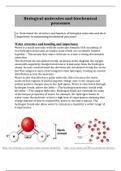
The electrons are not shared evenly; as shown in the diagram, the oxygen
atom pulls negatively charged electrons to it and away from the hydrogen
atoms. In each covalent bond the electrons are not shared evenly due to the
fact that oxygen is more electronegative than hydrogen, creating an uneven
distribution across the molecule.
Water is also described as a polar molecule; this is because the water
molecule has regions of partial negative charge near to the oxygen and
partial positive charges near to the hydrogens. Water is structured through
hydrogen bonds, where the delta + (The hydrogen molecule) bonds with
the delta – (The oxygen molecule). Hydrogen bonds are essential for some
of the unique properties of water, for example, the hydrogen bonds in
water cause the molecule to have a high heat of vaporisation-meaning that
a large amount of heat Is required for water to become a vapour. The
hydrogen bonds also allow water to remain as a liquid for a wider range of
temperatures.
https://alevelbiology.co.uk/notes/water-structure-properties/ https://www.quora.com/Why-do-lipids-not-dissolve-
in-water
, Importance of water
Water is very important and has many functions. These functions include:
- As a transport of molecules – Water is a good transport medium in
living organisms because it stays in liquid state over a large
temperature range.
- Acting as a medium for chemical reactions – All metabolic processes
in organisms rely on chemicals to be able to react together in a
solution. Water is a good solvent for chemical reactions, this is
because the polar molecules dissolve in water because it is a solvent
and has an uneven charge distribution across the molecule.
- Regulating pH – At a PH level of 7, water contains equal
concentrations of H+ (Positively charged hydrogen ion) and OH- ions
(oxygen and hydrogen atom held together by a covalent bond,
holding a negative electric charge). Living organisms are very
sensitive to pH and function best when internal conditions are closest
to the optimum pH, therefore, water plays an important role in
regulating the pH in living organisms. Buffer solution is a solution
that resists changes in pH when small quantities of an acid or alkali
are added to it, buffer solutions can be found in blood. They stop to
pH changing when hydrogen or hydroxide ions are added. Water also
has the ability to accept and donate H+ where necessary, meaning
that it plays an important role in keeping pH steady and so without
water, solutions would be unable to keep the pH required
- Temperature regulator – Water has the ability to withstand
temperature changes as it requires a lot of energy to change the
temperature. This is due to the hydrogen bonds between water
molecules – when the temperature rises, water molecules gain more
kinetic energy and vibrate more to break the hydrogen bonds
between the water molecules. Many organisms are mainly composed
of water, the fact that water does not change temperature rapidly
enables these organisms to regulate their internal body temperature.
For example, our body temperature does not drastically change or
drop to the same temperature as the outside temperature when we
go out in the snow. It is very important for your body temperature to
remain stable to ensure that the temperature is optimum for enzyme
activity inside the body.
processes
A: Understand the structure and function of biological molecules and their
importance in maintaining biochemical processes
Water structure and bonding and importance
Water is a small molecule with the molecular formula: H2O consisting of
two hydrogen atoms and an oxygen atom which are covalently bonded
together – This means they share electrons to create a strong electrostatic
attraction.
The electrons are not shared evenly; as shown in the diagram, the oxygen
atom pulls negatively charged electrons to it and away from the hydrogen
atoms. In each covalent bond the electrons are not shared evenly due to the
fact that oxygen is more electronegative than hydrogen, creating an uneven
distribution across the molecule.
Water is also described as a polar molecule; this is because the water
molecule has regions of partial negative charge near to the oxygen and
partial positive charges near to the hydrogens. Water is structured through
hydrogen bonds, where the delta + (The hydrogen molecule) bonds with
the delta – (The oxygen molecule). Hydrogen bonds are essential for some
of the unique properties of water, for example, the hydrogen bonds in
water cause the molecule to have a high heat of vaporisation-meaning that
a large amount of heat Is required for water to become a vapour. The
hydrogen bonds also allow water to remain as a liquid for a wider range of
temperatures.
https://alevelbiology.co.uk/notes/water-structure-properties/ https://www.quora.com/Why-do-lipids-not-dissolve-
in-water
, Importance of water
Water is very important and has many functions. These functions include:
- As a transport of molecules – Water is a good transport medium in
living organisms because it stays in liquid state over a large
temperature range.
- Acting as a medium for chemical reactions – All metabolic processes
in organisms rely on chemicals to be able to react together in a
solution. Water is a good solvent for chemical reactions, this is
because the polar molecules dissolve in water because it is a solvent
and has an uneven charge distribution across the molecule.
- Regulating pH – At a PH level of 7, water contains equal
concentrations of H+ (Positively charged hydrogen ion) and OH- ions
(oxygen and hydrogen atom held together by a covalent bond,
holding a negative electric charge). Living organisms are very
sensitive to pH and function best when internal conditions are closest
to the optimum pH, therefore, water plays an important role in
regulating the pH in living organisms. Buffer solution is a solution
that resists changes in pH when small quantities of an acid or alkali
are added to it, buffer solutions can be found in blood. They stop to
pH changing when hydrogen or hydroxide ions are added. Water also
has the ability to accept and donate H+ where necessary, meaning
that it plays an important role in keeping pH steady and so without
water, solutions would be unable to keep the pH required
- Temperature regulator – Water has the ability to withstand
temperature changes as it requires a lot of energy to change the
temperature. This is due to the hydrogen bonds between water
molecules – when the temperature rises, water molecules gain more
kinetic energy and vibrate more to break the hydrogen bonds
between the water molecules. Many organisms are mainly composed
of water, the fact that water does not change temperature rapidly
enables these organisms to regulate their internal body temperature.
For example, our body temperature does not drastically change or
drop to the same temperature as the outside temperature when we
go out in the snow. It is very important for your body temperature to
remain stable to ensure that the temperature is optimum for enzyme
activity inside the body.